



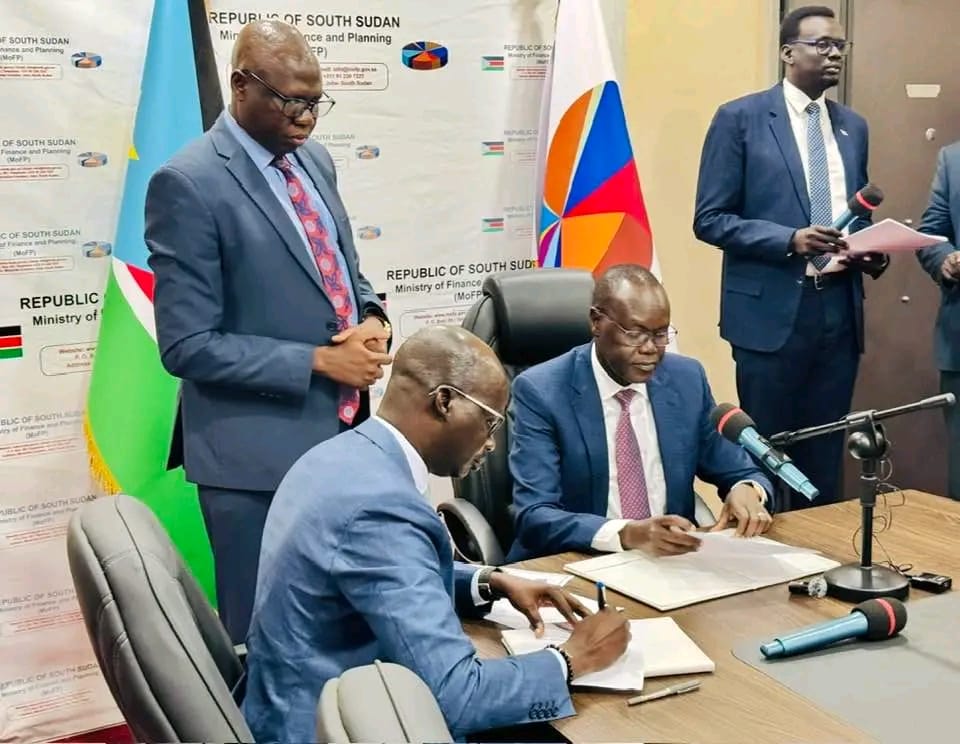
According to the government financial bodies, the new system will enable government payments to be transferred electronically into beneficiaries’ bank accounts, eliminating the need for physical cheques
By Aguok Chok
The government has launched an electronic payment system to replace manual cheques, improve financial accountability and strengthen public expenditure management.
The Bank of South Sudan and the Ministry of Finance and Planning on Tuesday launched a new electronic government payment system aimed at replacing manual cheque-based transactions with direct electronic transfers.
The South Sudan Interbank Payment and Settlement System (SSIPSS) is designed to modernise government payments by integrating the Real-Time Gross Settlement (RTGS) and Automated Clearing House (ACH) with the Integrated Financial Management Information System (IFMIS).
The new system will enable government payments to be transferred electronically into beneficiaries’ bank accounts, eliminating the need for physical cheques and reducing delays associated with manual transactions.
According to a joint communiqué issued by the two institutions, the RTGS component will handle high-value and urgent payments, while the ACH will process eligible low-value and bulk transactions.
Speaking during the launch in Juba, Governor of the Bank of South Sudan, Hon. Dr. Addis Ababa Othow, said the introduction of RTGS would strengthen the country’s financial infrastructure by improving the speed and security of interbank transactions.
He said the system would support faster interbank transfers, secure settlements and increased confidence in the banking system.
The initiative is expected to improve the movement of money between commercial banks and provide a more efficient channel for processing government financial transactions.
Caretaker Minister of Finance and Planning, Hon. Athian Diing Athian, said the new payment system will improve budget execution, strengthen expenditure controls and enhance oversight of public spending.
The minister’s remarks highlighted the government’s efforts to improve the management of public resources through modern financial systems that promote transparency and accountability.
The integration of SSIPSS with IFMIS is also expected to strengthen coordination between government financial management processes and the banking system, particularly in the processing and settlement of public payments.
Meanwhile, Mr. Akum David Sabahker, Director of the National Payment System at the Bank of South Sudan, explained the requirements for individuals and institutions receiving government payments.
He said all beneficiaries, including suppliers, contractors, institutions and individuals, must maintain accounts with commercial banks licensed by the Central Bank to receive government payments.
Sabahker also advised beneficiaries seeking information about their payments or following up on pending transactions to contact the Ministry of Finance and Planning.
He explained that the ministry remains responsible for payment initiation, authorisation and processing.
The clarification means that beneficiaries will need to ensure their bank account details are properly maintained to facilitate the electronic transfer of government funds.
The launch was witnessed by the First Undersecretary of the Ministry of Finance and Planning and other senior officials from both institutions.
The introduction of the electronic payment system marks an important step in South Sudan’s efforts to modernise public financial management and strengthen the country’s payment infrastructure.
The reform is expected to reduce reliance on manual transactions, improve payment efficiency and strengthen accountability in the management of government expenditure.
It also represents a move towards a more integrated financial system in which government payments can be processed and settled electronically through the country’s commercial banking network.