

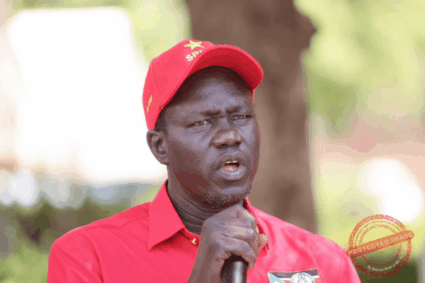




Assuming that the history of the Juba City Council was to be documented today, there is no doubt that one name would grab the prime pages of that writing: Kalisto Lado Faustino.
Though he served for a short stint, his ascension to the echelons of power and the unexpected fall was meteoric and also dramatic. It was a misfortune that stabbed his back while he was on top of touch with the needs of the residents. Kalisto’s appointment to the Juba City leadership and his dismissal months after is one of the political events worth noting in 2021. But just how did this whole script pan out?
After taking around two years with no mayor, Central Equatoria State (CES) Governor Emmanuel Adil Anthony appointed Kalisto to take over as the mayor of the capital.
This was in a gubernatorial decree number 12/2021 read in March 2021 where Solomon Pitia Nyambur was named as the deputy mayor for administration and finance and Thiik Thiik Mayardit, the deputy mayor for infrastructural development.
Kalisto took over the challenge to spearhead various development projects in the city. He was vocal and maintained a commitment to cleaning up Juba especially getting off the garbage and fighting crime. These earned him applause as his star continued to rise. His supporters considered him the face of the reason and one of the few sane voices in connection with people’s needs.
Top of his call
In September 2021, Kalisto declared war against witchdoctors which ended up in the arrest of nine suspected witchcraft practitioners and fetishes.
The suspects were later charged according to the findings and degree of crimes they were found guilty of committing, resulting in jail terms not exceeding three (3) months and a fine of 25,000 SSP.
Five of the suspects were sentenced to a jail term of one month, two of them were given three months jail term, was given a two-month jail term and one was given a 45-day jail term.
“They are destroying our society, communities, families, and their activities led to the death of many people. They (witchdoctors) have broken up families and bewitch others to death and perform to their clients to get money through spiritual activities,” Kalisto said as he issued a warning shot.
“We have proved it beyond reasonable doubt when we caught women and men naked. We found others smoking so that they can get husbands or wives. We found many goats slaughtered and cats were tied-down and some have their bodies cut.”
In a similar fight, the City Council arrested 11 suspected prostitutes and witchdoctors in Munuki Block B who were detained at the Malakia Police Station and fined SSP 25,000. Among them was a lactating mother with a five-month-old.
He then advanced to banning the display of coffins in the city, claiming that it instilled fears in the citizens.
Poisoned chalice?
Crackdown on witchcraft aside, in August, Kalisto had launched an aggressive restructuring of Juba which was characterised by the demolition of makeshift structures, especially along the road. The bulldozer roared after his 72-hour notice had elapsed.
The exercise was part of the “Keep Juba City clean and green project” to ease the movement of vehicles and pedestrians.
“We are giving them 72-hours and after 72-hours exactly on Saturday my team will reach those areas and demolish all shops constructed there,” he warned.
The project took shape in Gudele, Hai Thoura, and customs markets, where huge chunks of demolition were witnessed.
With pressure piling up from the investors who their property, in October, Kalisto never minced his words as he vowed not to compensate the victims of demolitions as he maintained that they were lawbreakers.
He maintained that Juba City Council only had a plan to allot land to traders as part of the markets.
But he also stressed that his leadership clearly understood the plight of traders and that they needed to be patient.
“There is no compensation for anybody who builds along the road, or for anybody who illegally occupies a piece of land that is not his or hers. In our policy and our strategic plan, we are expanding the market and creating more markets for our traders. So, all our traders who lack shops or land for the construction of their shops will have pieces of land,” he explained.
He reached out to the public for the support as he maintained that the duty to sort out the mess in the city was not solely tagged to the city council.
“People should not say the cleaning of Juba is the responsibility of the Juba City Council alone. It is a responsibility of everybody, so let the people of South Sudan [must] cooperate and work together with the Juba City Council to put things in order,” Kalisto stressed.
Kalisto would then get rare praise from Governor Adil, who on his inspectional visit praised Kalisto for championing the restructuring of the Juba City Council.
Diminishing fame
But the basking in glory seemed to be short-lived as the traders and women groups raised concerns to the Central Equatoria State Chamber of Commerce about their suffering after demolitions.
The Chamber referred the demolition to as a “manmade disaster stemming from the unplanned operation,” during a press conference.
“As a government, you need to consider [that] because one of the roles of the government is to protect its people.”
Downfall of Kalisto
The chairperson of the Juba City Chamber of Commerce Stephen Wani would then tell journalists that more than 70 shops were demolished under Kalisto’s leadership.
He warned of the possible impacts of the demolitions on traders and consumers, which could cause commodity prices to climb.
“These small businesses are the backbone of the country’s economy, so, they deserve every right and respect from the government and everyone in the country,” said Wani.
“You cannot create problems on people without giving a solution and you call yourself a government.”
He called for the intervention of the state and national governments to save the situation.
Kalisto last day in the office
On November 18, a few hours before Kalisto was fired, the Chairperson of the Central Equatoria State Chamber of Commerce, Robert Pitia Francis, convened a press conference in which he accused Kalisto of overcharging traders by a staggering SSP380, 000 to SSP 700,000.
Pitia said the normal fines are between SSP50, 000-SSP 70,000.
In the evening of the same day, an order was released by Governor Emmanuel Adil Anthony about the firing of Kalisto on Thursday, November 18, which sparked mixed reactions from citizens and traders in Juba.
Kalisto would then drop a sarcastic acknowledgement post on his Facebook page.
“I give a special congratulations as I was appointed and as well as after relieving,” he noted.
There days later, the deputy Mayor for Infrastructure Development Thiik Thiik Mayardit while addressing traders at Custom market apologised to the business community over high taxation.
“On behalf of Juba City Council, I apologise through media houses here that please, an institution is an institution and we are apologising because we are leaders and for anything that has happened,” Thiik said.
“If there is any mismanagement, which our people find to be unlawful, let me apologize again to the people of South Sudan that we are going to correct the mistakes very soon and later.”
The Deputy Mayor for Finance and Planning, Solomon Pitia who also present pledged that the high taxes would be lowered.
“We understand you people have been taxed highly, but take it from me as acting Mayor of the Juba City Council that we are going to make sure that the high taxes are reduced,” he said.
“You South Sudanese, you have been in a war, so you have no capital. Therefore, we need to encourage you to compete with the foreigners.”
The Minister of Local Government and Law Enforcement, Moro Isaac Jenesio, also blamed Kalisto’s administration for breaking the law by conducting unlawful and independent demolitions without involving other line institutions in the state.
“We want to see a change in the Juba City Council because the relationship between the Juba City Council and business communities is a gap and they want to sue the council,” he said.