


Bringing care, healing closer to South Sudan, the Chinese medical way

An historic overview of the Chinese Medical Team’s work in South Sudan reveals that China first dispatched medical teams to what was then southern Sudan in 1971, a service that now has notable impact across communities in independent, South Sudan
By Aguok Chok
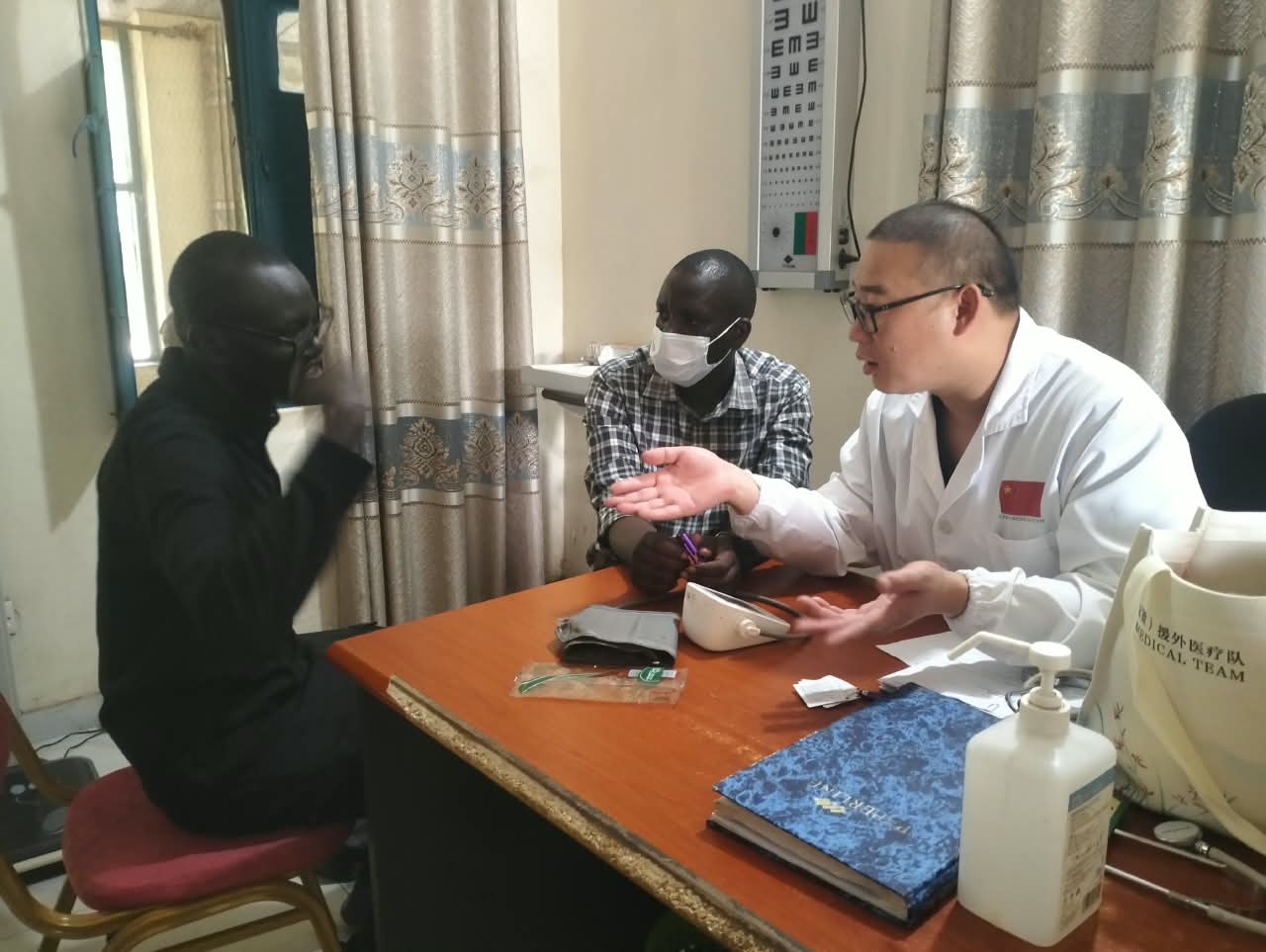
A Chinese health officer who is part of the Chinese Medical Team in Juba, attends to a patient. [Photo: Courtesy]
For students and residents living around the University of Juba, Wednesday mornings have become an opportunity to seek medical attention from Chinese doctors who provide consultations and medicines at the university clinic.
The weekly service brings medical professionals closer to people who may struggle to afford treatment at health facilities. Patients arrive with different health complaints, including headaches, stomach pain, joint pain and other conditions, hoping to receive medical advice and treatment.
Among the doctors attending to patients is Li Zheng, a gynaecologist with the Chinese Medical Team in South Sudan.
Zheng confirms that the team visits the university every Wednesday morning to provide medical assistance to students, staff and members of the surrounding community.
“We come here every Wednesday to help women, children and the people here, and also to take some medicine for them,” she says of their services at the clinic, which operates during the morning, with doctors attending to patients until around 11:30 a.m. or noon, depending on the number of people seeking medical care.
According to Zheng, the team treats common health complaints and provides medicines when they are available. Doctors also advise patients on their lifestyles, eating habits and physical exercise as part of efforts to improve their health.
“If they have some problem like arthritis, abdominal pain or fever, like many, many problems, we can give them some treatment and medicine,” she says.
Her medical team, she explains, has interacted with patients suffering from several common conditions, including stomach ulcers, headaches, high blood pressure, diabetes, haemorrhoids, joint pain and muscle pain. The offer them healthy lifestyle guides, recommended foods, and the necessary medicines to improve their lives.
According to the health professional, they attend to approximately 30 patients during a typical Wednesday morning, although the number may vary.
Financial hardship delays treatment
Despite the services offered at the clinic, she says financial difficulties remain a major challenge for patients who need further investigations, specialist care or surgery.
She explained that some patients cannot afford the additional medical attention required to diagnose or treat their conditions. Others delay seeking medical care until their illnesses worsen.
“Sometimes it requires some check-ups, timely check-ups, but due to some financial hardship, they are unable to until the illnesses gets worse,” she said.
Zhang warned that delaying medical attention can allow health conditions to deteriorate, making treatment more difficult. She encouraged students and locals to take their health seriously and seek medical assistance when they experience symptoms.
“Young people should get timely and early check-ups, have a good regular lifestyle. When the patients complain of minor problems, or feel unwell, the people nearby or students need to seek help before the condition grows worse.”
Students flock medical camp
For some students, the weekly clinic provides an opportunity to receive medical advice without the financial pressure associated with seeking treatment elsewhere.
Margret Tabu Freza, a 24-year-old engineering student at the University of Juba, describes her first interaction with the Chinese at the facility as incredible, an opportunity that gave her firsthand experience on the real impact of their work on local community.
“Actually, it was my first time to come to the clinic and I saw some of the Chinese doctors there, helping our people. It was eye-catching witnessing their compassion while attending to some of the vulnerable people,” she said.
Freza, who had sought medical assistance for a severe headache that had troubled her for a long time, says the doctors gave her proper medical advise, drug prescriptions and planned a follow-up visit after one week. She was relieved.
While at the facility, Freza witnessed how the medical team helped a woman who had been misdiagnosed and given medicines for diabetes by some private clinic, when she was not suffering from the condition.
“They had given her a medicine for diabetes. After conducting some tests, they discovered that the woman wasn’t suffering from diabetes. That’s why they have stopped the medicine and they prescribed the right one,” she said.
Freza urged the Chinese medical team to establish a more permanent presence at the university so that patients can access the service more consistently.
She also called for wider publicity about the clinic, saying many people did not know when the doctors visited.
“If they are coming, they should at least stay for some time because there are very many people out there. They don’t know about their visit here. It’s good that they will come and information will go out and they will help very many people,” she added.
Repeat visits bring relief
Sonya Laku, a 25-year-old fifth-year medical student, said she had visited the Chinese medical team for a second time because of persistent ankle pain.
During her previous visit, the doctors gave her a medicated plaster to help manage the pain.
She said the treatment had brought relief, prompting her to return when she saw the team at the clinic again.
“Because last time I was relieved, I was like, it’s good. So I’m planning to come,” she said.
Laku said she had hoped to receive the same treatment during her latest visit, although the plaster was not available that day.
For her, the service is valuable not only because of the medicines provided but also because it gives people an opportunity to seek care despite financial challenges.
“My message is to the Chinese medical team is that they have really made a great service. Because at times here, especially in South Sudan, our people whenever they feel pain or some complication in the body, they are unable to access proper medical attention due to financial strains,” she said.
“So because of this free services, people tend to reach them. At least you can afford for the transport and you reach so that you get the medical service. They have really helped people.”
Laku also observed that the clinic serves people beyond the university community, as information about the doctors’ visits reaches residents outside the campus.
She said this wider reach increases the value of the service, particularly for people who might otherwise delay seeking treatment.
A long history of health cooperation
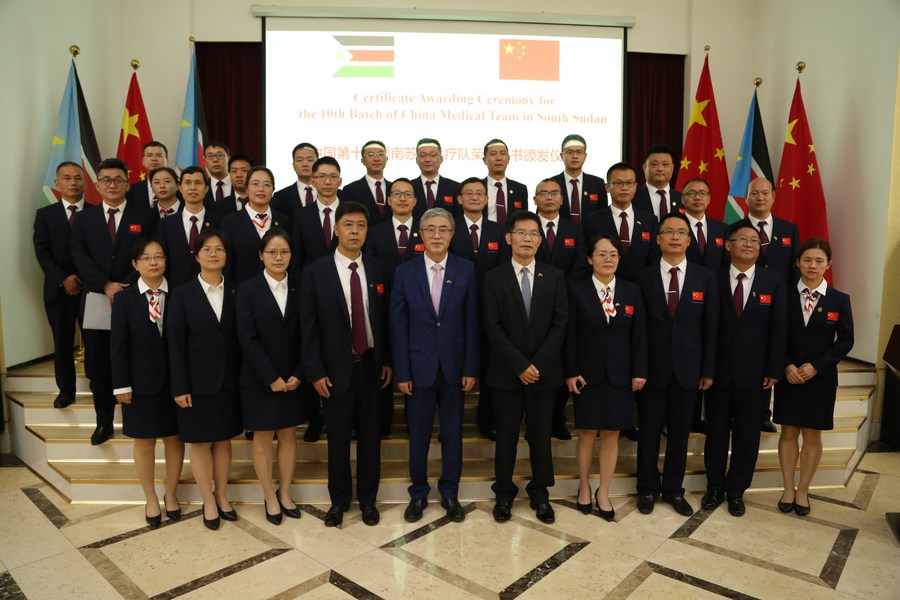
Chinese Ambassador to South Sudan, Ma Qiang, with a cohort of the Chinese medical team at a past ceremony in Juba. [Photo: Courtesy]
The weekly clinic forms part of broader medical cooperation between China and South Sudan, which has developed over several decades.
An historic overview of the Chinese Medical Team’s work in South Sudan reveals that China first dispatched medical teams to what was then southern Sudan in 1971. The teams provided medical services in Juba, Wau and Malakal before their operations were suspended because of regional conflicts.
Following South Sudan’s independence in 2011, China resumed dispatching national medical teams in 2012, with the teams based at Juba Teaching Hospital, the country’s main referral medical facility.
Since then, 14 batches comprising more than 200 Chinese medical workers have served in South Sudan, according to the overview.
The multidisciplinary teams cover specialties including internal medicine, surgery, obstetrics and gynaecology, paediatrics, anaesthesiology, medical imaging and traditional Chinese medicine. Their work includes clinical treatment, training for local medical personnel and outreach services.
Beyond direct treatment, the teams have contributed to the development of medical facilities and services. Their work has included supporting the establishment of an electronic gastroscopy unit, a cervical cancer screening centre, a remote imaging consultation centre and a modern microbiology laboratory at Juba Teaching Hospital.
The teams also provide medicines and medical equipment and support efforts to strengthen the skills of South Sudanese health workers through training and professional exchanges.
Traditional Chinese medicine has also become part of the cooperation. Since 2016, the teams have included traditional Chinese medicine physicians who promote treatments such as acupuncture and tuina, alongside health-preservation practices.
In 2024, a programme was launched for South Sudanese medical personnel to receive further training in traditional Chinese medicine in China’s Anhui Province. According to the overview, three groups comprising nine physicians had travelled there for studies.
The cooperation also extends to public health. During the COVID-19 pandemic, China provided anti-epidemic supplies and sent expert teams to support South Sudan’s response. Community and school outreach activities have also been used to raise awareness of disease prevention.
Support for the main referral hospital, communities
In December 2025, the 13th batch of the Chinese Medical Team donated pharmaceutical products and medical equipment to Juba Teaching Hospital.
At the donation ceremony, South Sudan’s then Minister of Health, Sarah Cleto Rial, described the Chinese medical teams as partners who have helped strengthen the country’s health services.
“For years, the dedicated members of the Chinese medical teams have been more than just doctors; they are our partners, our teachers, and true envoys of goodwill,” Cleto reportedly said.
Chinese Ambassador to South Sudan Ma Qiang said at the time that 196 Chinese medical personnel had served in the country since 2012, providing medical services to more than 90,000 patients, performing over 1,430 surgeries and rescuing more than 30,000 critically ill patients.
The support is part of wider China–South Sudan health cooperation, including the second phase of the Juba Teaching Hospital modernisation and expansion project.
For patients visiting the University of Juba clinic, however, the cooperation is experienced through direct consultations, medical advice and access to available medicines.
The students’ accounts point to both the benefits and the limitations of the service. While the weekly visits offer assistance to people who might otherwise struggle to seek care, the cost of further treatment remain a challenge.
As the Chinese medical team continues its Wednesday visits, Zhang’s message to students and residents is to maintain healthy lifestyles, pay attention to changes in their bodies and seek medical attention early.
For Freza and Laku, the hope is that the service will continue, become more widely known and reach more people who need it.