
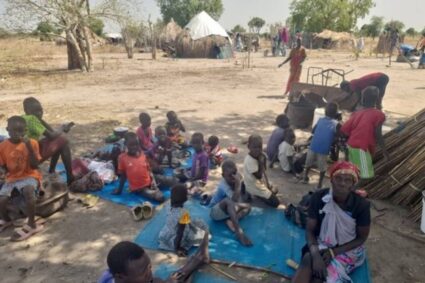

700,000 refugees, IDPs face food scarcity- WFP

A total of 700,000 refugees and internally displaced persons in South Sudan are staring at food scarcity after the United Nations World Food Programme (WFP) announced a food rationing move.
The food aid agency said the funding gap has forced its arm into making drastic measures which will come at a pinch to the victims in dire need of food assistance.
Up to Thursday, April 8, the refugees and IDPs were subjected to 70 per cent food rationing but now it has increased to a 50 per cent dock. This implies that they will be receiving 1,050 kilocalories per person instead of the initial 2,100 kilocalories per person.
Matthew Hollingworth, the WFP Representative and Country Director in South Sudan lamented the tough decision but gave a justification for it.
“It is a very painful decision to take from the hungry to give to the starving, but this is the reality; because of the alarming rise of food insecurity in remote locations, WFP has to reduce the size of its rations in some communities, including refugees and internally displaced people, which are in a less precarious situation,” he said in a statement to the media.
He added the WFP is devoted to saving lives but the financial constraints have necessitated adjustments. He added the resources are needed urgently to address the gap.
“We must try to save the lives of those likely to face famine during the lean season if they do not receive sufficient assistance. WFP simply does not have enough resources to provide full rations to all of those in South Sudan who rely on our assistance to survive,” said Hollingworth.
With the COVID-19 pandemic taking a toll on the global economy and eating into the donors’ pockets, WFO said it now needs US$125 million to sustain the recipients for the next six months.
“We know how hard it is for vulnerable people who struggle every day to survive and provide for their children. By introducing these reductions now, WFP is making sure that all refugees and displaced people will continue to receive our food assistance albeit in smaller quantities.”
The agency has 440,000 dependants drawn from Bentiu, Bor, Juba, Wau, Malakal and Mingkaman. There are also 260,000 refugees from Sudan, DR Congo, Central African Republic and Ethiopia.
WFP decries a possibility of social problems which may ensue in the event that the reduction in food supplies takes effect.
The agency noted in a statement: “These cuts are likely to lead to higher rates of malnutrition and anaemia, stunted child growth and people resorting to survival strategies.
“People who struggle to meet their basic food needs cope by skipping or reducing meals, taking loans with high interest, selling assets, and using child labour. There is often also increased domestic violence when people are in this situation. “
But the agency stated that vulnerable people like children and pregnant mothers will be accorded special care to ensure that they are in proper health situation.
The latest Integrated Food Security Phase Classification (IPC) painted a grim situation saying 7.24 million people will be affected by the food crisis in South Sudan by July 2021. In this number, 1.4 million children are expected to be victims of malnourishment.