






H-Brothers Food Controversy: Lab tests rule out expired goods, confirm damaged products as govt. destroys stock

Standards official says two laboratories produced consistent findings, confirming that the products were damaged and did not conform to the required standards but were not expired.
By Emmanuel Mandella
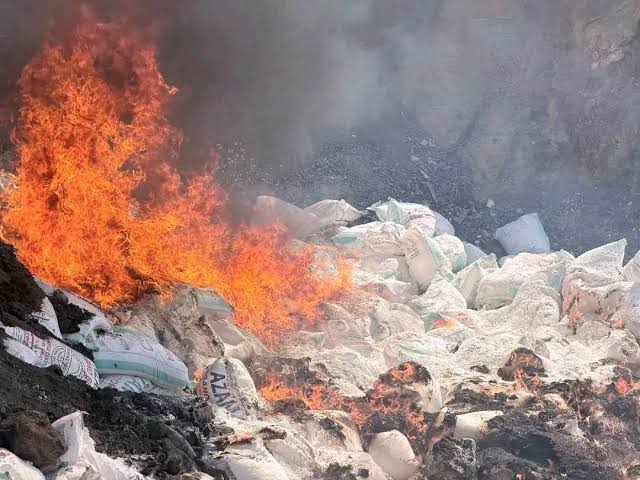
Government says the damaged food items were destroyed. [Photo: Courtesy]
A government investigation into allegations that H Brothers General Trading and Investment Company Limited was repackaging expired food products for public consumption has found that the seized commodities were damaged and non-conforming but not expired, following laboratory examinations by the South Sudan National Bureau of Standards (SSNBS) and a regional partner laboratory.
The findings mark a significant development in a controversy that has attracted public attention, raised concerns about consumer protection and placed the operations of the trading company under government scrutiny for nearly a month.
The investigation was launched after eight employees of H Brothers were arrested on October 24, 2026, following allegations that they were transferring expired maize flour into new sacks for resale at the company’s warehouses in Gumbo, Juba County.
However, presenting the investigation findings at the company’s premises on Saturday, Garang Mayor Nyariel, Quality Manager at the SSNBS and a member of the government investigation committee, said laboratory examinations had not established that any of the products examined had passed their expiry dates.
“The Bureau of Standards would like to stress that with all the consignment that were there, we did not manage to find any of the product expired, but we did find a lot of non-conforming products,” Nyariel said.
He explained that samples were collected from the company’s warehouses and subjected to laboratory examinations at the national standards laboratory before being sent to a partner laboratory in another regional country for additional testing.
According to Nyariel, the two laboratories produced consistent findings, confirming that the products were damaged and did not conform to the required standards but were not expired.
He further stated that the examinations did not identify any immediate public health risk associated with the sampled products.
“We did not find anything to be of an immediate public health risk, and anyone who’s interested further in the results could come to the Bureau of Standards and they will be furnished with them,” he added.
The announcement provides an important clarification in a case that initially generated widespread public concern after authorities alleged that expired food commodities were being repackaged and prepared for distribution to consumers.
The controversy emerged on October 24 when Juba County authorities announced the arrest of eight employees of H Brothers General Trading and Investment Company Limited during an operation at the company’s premises in Gumbo.
According to the Office of the Caretaker Commissioner Kalisto Lado, security personnel reportedly discovered workers transferring what authorities described as expired maize flour into new sacks for resale.
Following the operation, the company’s storage facilities were closed, while the eight employees were taken into custody pending further legal proceedings.
The Caretaker Commissioner warned traders and business owners against engaging in activities that could expose consumers to unsafe food products.
The arrests immediately raised questions about the company’s food storage practices, product handling procedures and the effectiveness of regulatory inspections in preventing potentially non-compliant commodities from reaching the public.
On October 26, Central Equatoria State Caretaker Governor General Augustino Jadalla Kamilo Wani ordered a comprehensive investigation into the allegations after leading an inspection visit to the company’s premises alongside the Juba County caretaker commissioner.
A statement from the governor’s office indicated that the inspection team had discovered large quantities of flour, biscuits, cooking oil, sugar and other essential commodities that were allegedly expired and being repackaged into new sacks, jerricans and boxes with altered expiry dates.
The governor subsequently directed relevant authorities, including the standards bureau and security agencies, to investigate the matter and pursue appropriate legal action where violations were established.
However, the company’s management disputed the allegations from the beginning.
A manager who spoke to Eye Radio anonymously maintained that the products were unexpired wheat flour rather than maize flour, as initially alleged by authorities.
The manager argued that the goods might have been affected by excessive heat during storage and that the activities observed at the premises involved separating damaged products from other stock rather than repackaging expired commodities for commercial distribution.
The manager also claimed that the company had previously undergone an inspection by the standards bureau and received documentation concerning products that needed to be separated.
The latest laboratory findings have now supported the central part of the company’s earlier position that the products were not expired, although the investigation confirmed that significant quantities were damaged and failed to meet applicable standards.
Beyond the question of whether the products had expired, the investigation has also drawn attention to the regulatory requirements governing the repackaging, labelling and distribution of food commodities in South Sudan.
In an earlier clarification, the South Sudan National Bureau of Standards said the repackaging of flour allegedly involving expired products under another company’s branding had been conducted without the required government approval.
‘Unauthorised branding’
Neima Samson Goma, the Bureau’s Director of Certification and Export, explained that companies intending to repackage food products must first involve the standards authority to ensure compliance with established procedures.
She said businesses are required to submit product samples for laboratory testing, disclose the quantities intended for repackaging and obtain the necessary authorization before proceeding.
The Bureau must also supervise the repackaging process once approval has been granted, she said.
Goma further raised concerns about the use of pre-labelled packaging materials imported from outside the country.
She specifically alleged that H Brothers had used Azam branding without authorization from the manufacturer or relevant government institutions.
She called for tighter controls on the importation of empty packaging materials already carrying company branding, arguing that product labelling should, where possible, be undertaken locally under appropriate regulatory supervision.
Despite the laboratory findings that the products were not expired and presented no immediate public health risk according to the examinations, the government investigation committee proceeded with corrective and administrative measures against the company.
Destruction of ‘damaged commodities’
Trade and Industry Minister Dr. Labanya Margret Mathya ordered the destruction of the damaged commodities and directed the company to refurbish its storage facilities to meet the required food safety standards.
The measures were intended to prevent non-conforming products from entering the consumer market and improve the conditions under which food commodities are stored.
The minister explained that the refurbishment requirements were also intended to protect the company’s investment while ensuring that food products handled at the premises meet acceptable standards.
“There are other penalties which have been set by the committee, including refurbishing of the stores, ensuring that the stores meet the standard that is required to protect even their investment. In fact, we are protecting the people of South Sudan, including the investment of H-Brothers,” Mathya said.
Following the presentation of the investigation findings, the committee proceeded to the Nesitu dumping site along the Juba-Nimule road, where the damaged commodities were dumped, destroyed and burned.
The consignment reportedly destroyed included 2,115 bags of wheat flour, 20 bags of sugar, 35 jerricans of cooking oil, Three bags of rice, and Three bags of powdered juice.
The decision also raises an important regulatory question about the distinction between food that has passed its expiry date and products that remain within their expiry period but have deteriorated because of poor storage or other quality-related problems.
The investigation also extended beyond food quality and storage conditions to concerns about the treatment of South Sudanese employees working at the company.
During the inspection and subsequent investigation, Trade and Industry Minister Dr. Labanya Margret Mathya expressed concern over the reported living conditions of local workers.
She described the conditions as troubling and called for improvements in the welfare and protection of South Sudanese employees.
Mathya also raised concerns about the employment of children, warning the company against hiring young workers without complying with the relevant labour regulations and obtaining the necessary authorization from the Ministry of Labour.
She stressed that businesses operating in South Sudan must respect applicable labour requirements and ensure that employees work under acceptable conditions.
The concerns have added another dimension to the investigation, shifting attention from consumer protection alone to broader questions surrounding corporate responsibility, workers’ rights and regulatory compliance.
Meanwhile, Undersecretary at the Ministry of Trade and Industry Yel Luol disclosed that H Brothers General Trading and Investment Company Limited is owned by shareholders of South Sudanese, Eritrean and Ethiopian nationalities.
However, he did not disclose the identities of the individual shareholders.
The disclosure has brought further attention to the responsibilities of businesses operating in South Sudan, particularly those involved in importing, storage, processing, packaging and distributing essential food commodities.
The case has also highlighted the importance of coordination between the national standards bureau, county authorities, state government, security agencies and the Ministry of Trade and Industry in enforcing food safety regulations.
The standards bureau has previously urged traders to maintain proper stock management systems, maintain quality standards and adhere to the local trading laws and regulations.
The institution has also encouraged consumers to inspect product labels and expiry dates before purchasing food items and to report suspected cases of expired or unsafe products to relevant authorities.
Although the latest laboratory findings have clarified that the products examined at H Brothers were not expired, several issues remain important for public accountability.
For consumers, the central concern remains whether food products entering markets and shops are properly stored, packaged, labelled and safe for consumption.
For businesses, the case serves as a reminder that compliance with food safety requirements extends beyond expiry dates to include storage conditions, product quality, packaging procedures and regulatory authorization.
As the investigation concludes, the H Brothers case presents an important test of South Sudan’s consumer protection system: ensuring that businesses are held accountable for established violations while protecting them from allegations that have not been substantiated by evidence.