



South Sudan’s higher education system is structurally imbalanced, Prof Akech says

According to the University of Juba Vice Chancellor, too many students enrol in conventional academic programmes, leaving only a few to pursue education in technical and vocational institutions, a mismatch for the locally-required technical opportunities
By Samuel Yuang
The Vice Chancellor of the University of Juba, Professor John Akech, has warned against the prevalent structural imbalance in higher education in South Sudan, noting an increasing number of students pursuing courses in conventional universities and shying away from vocation and technical colleges, which offer the technical skills majorly required in the current local market.
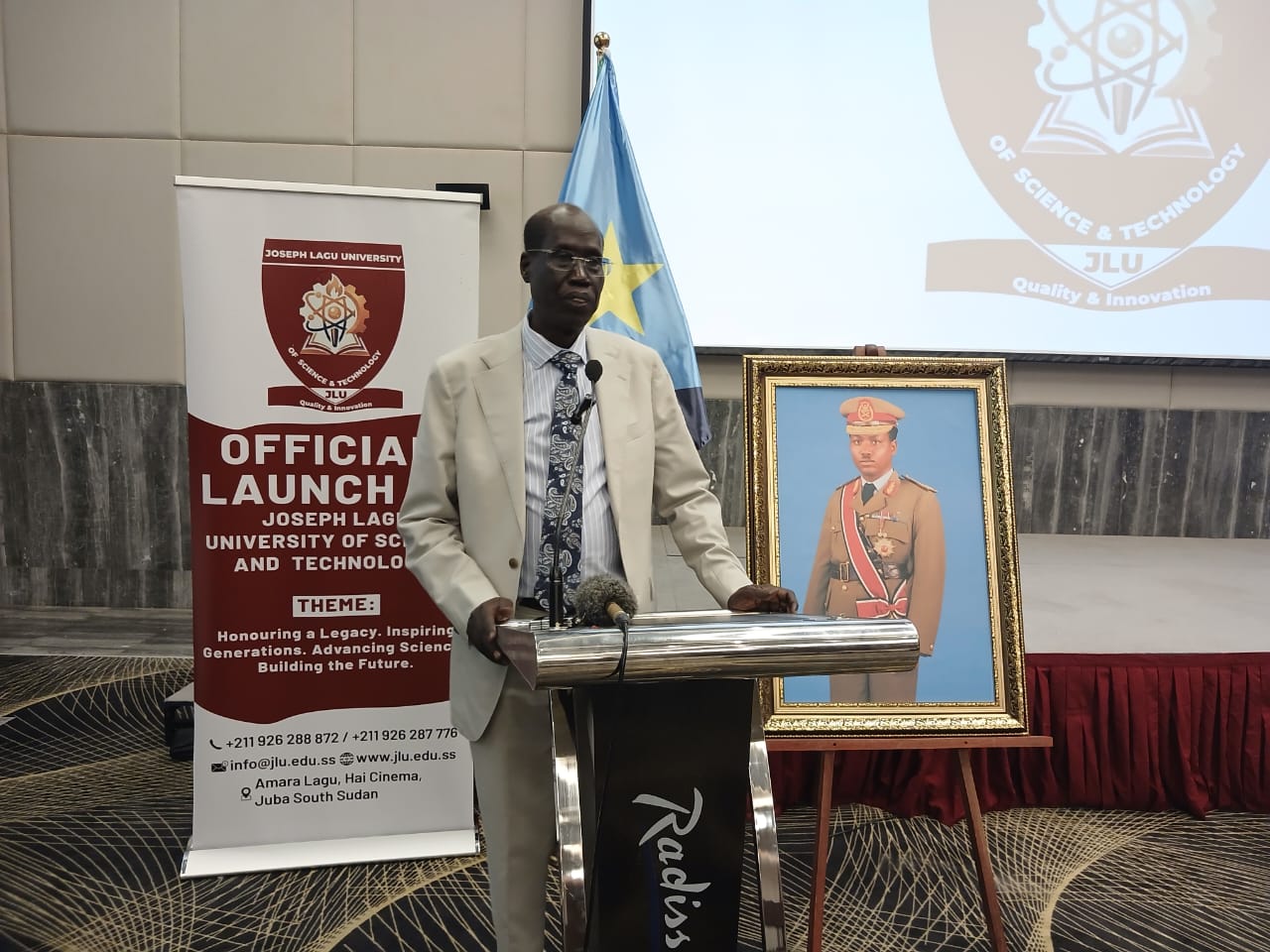
Speaking at the launch of the newly established Joseph Lagu University of Science and Technology (JLU) in Juba, the varsity vice chancellor urged the management of the institution to focus on practical and technical education, warning that South Sudan’s higher education sector faces major challenges, including limited infrastructure, inadequate funding and a shortage of vocational training opportunities.
Referring to a study he conducted in 2011, Prof. Akech said that by 2021, the country’s universities and other higher learning institutions had approximately 38,000 students, including those in technical and vocational institutions.
Of that number, about 36,000 were enrolled in conventional universities, while only around 2,000 were in technical and vocational education and training (TVET) institutions.
He described the situation as an inverted educational pyramid, arguing that the country needs to strengthen vocational and community-based institutions to produce a skilled workforce capable of meeting labour market demands.
“Do we open another law school, school of education, or are we going to focus on engineering? We need to think about that,” Professor Akech said, urging the university’s founders and board of trustees to identify gaps in the country’s education system rather than duplicate programmes already offered by other institutions.
He also challenged the assumption that university graduates should automatically be ready for employment, explaining that academic qualifications must be complemented by industry-based experience, professional training and practical skills.
Professor Akech congratulated the founders of Joseph Lagu University of Science and Technology, describing the move as a timely initiative, saying the institution should reflect the values and legacy of the late General Joseph Lagu, particularly his resilience and determination.
He said the university should draw inspiration from the former liberation leader’s ability to overcome political divisions and difficult circumstances without abandoning his commitment to leadership.
Professor Akech noted that the establishment of the university should go beyond commemorating a national figure, stressing that institutions named after national leaders should embody the principles and values those leaders stood for.
He further highlighted the growing demand for higher education in South Sudan, revealing that an average of approximately 47,000 candidates have been sitting for secondary school examinations annually over the past three years.
However, he said the University of Juba has a capacity of only about 11,000 to 12,000 students, raising concerns about the future of thousands of young people who cannot secure places in existing universities.
The Vice Chancellor further warned that private universities face financial difficulties due to low tuition fees, which make it difficult to acquire modern equipment, attract qualified lecturers and maintain quality academic standards.
He said universities are increasingly relying on students’ tuition fees to sustain their operations, while the cost of delivering quality higher education continues to rise.
Professor Akech also pointed to growing competition from foreign universities, noting that South Sudanese students increasingly seek educational opportunities in countries such as Rwanda, Kenya, Uganda, Dubai, Malaysia, India and China.
He argued that improving the learning environment, facilities and quality of education would be essential for local universities to attract and retain students.
On the country’s economic challenges, Professor Akech raised concerns about income inequality and the wage differences between the oil sector, international organisations and public institutions.
He said attractive salaries in the oil and NGO sectors have contributed to the movement of qualified professionals away from public institutions, including universities, weakening the country’s capacity to retain skilled personnel.
According to him, the government needs to address disparities in national income distribution to create conditions that allow universities and other public institutions to attract and retain qualified staff.
He further stressed that the country’s limited industrial base presents another challenge for universities seeking to establish practical training programmes, noting that the oil sector remains one of the country’s major industries but does not employ a sufficiently large proportion of the population.
Despite these challenges, Professor Akech expressed optimism about the future of Joseph Lagu University, saying the institution has an opportunity to contribute meaningfully to the development of South Sudan’s education sector.
He urged its founders, leadership and board of trustees to carefully consider the institution’s academic direction, financial sustainability and long-term development strategy.
Professor Akech concluded by emphasising that peace remains fundamental to the development of higher education and the country as a whole, warning that violence undermines economic progress and institutional development.
He encouraged the university’s leadership to remain resilient as it navigates the challenges facing newly established institutions, expressing hope that improved national conditions would eventually create a stronger environment for higher education in South Sudan.