

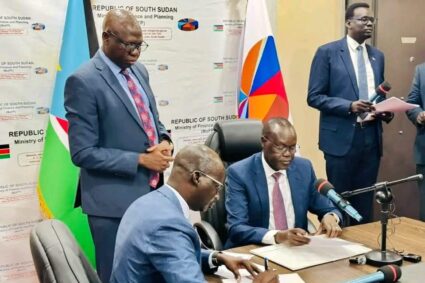


President outlines three national priorities,including peace and security, economic recovery and elections, that require full commitment and adequate funding.
By Aguok Chok
President Salva Kiir has instructed the Bank of South Sudan, the Ministry of Finance and the wider macroeconomic team to work in close coordination to stabilise the country’s struggling economy.
The directive underscores renewed government efforts to address persistent financial challenges and place South Sudan on a path toward sustainable recovery.
The President issued the directive while presiding over the swearing-in ceremony of Johnny Ohisa Damian, who was reappointed as Governor of the Bank of South Sudan for a third consecutive term.
The event marked both a continuation of leadership at the Central Bank and a renewed call for unity among institutions responsible for economic management.
Addressing the ceremony, President Kiir outlined three national priorities that he said require full commitment and adequate funding.
These priorities, he said, are “peace and security, economic recovery, as well as holding general elections.”
He emphasized that progress in these areas depends heavily on a stable and well-managed economy, calling for collective responsibility among state institutions.
In line with these priorities, the President tasked the Governor of the Bank of South Sudan to take the lead in resolving key economic challenges.
He directed the Central Bank to address the ongoing liquidity crisis, reform the banking sector, and restore public confidence in the financial system.
Central to this effort, he stressed, is the implementation of sound and disciplined monetary policies.
The President’s message highlighted the importance of cooperation between the Central Bank and the Ministry of Finance, noting that fragmented efforts would not yield the desired results.
By calling for a “united economic front,” the President signaled the need for alignment between fiscal and monetary authorities to stabilise prices, strengthen the currency, and improve service delivery.
In his acceptance remarks, Governor Johnny Ohisa Damian acknowledged the scale of the challenges facing the economy and pointed to the need for diversification.
He highlighted the importance of investing in non-oil sectors, particularly initiatives such as the gold purchase project, which he said could help improve national revenues and reduce overreliance on oil income.
Governor Ohisa also reaffirmed the Central Bank’s commitment to its core mandate. The Bank of South Sudan plays a critical role in the formulation of monetary policy, banking supervision, and the maintenance of financial stability. These responsibilities, officials noted, are now at the center of renewed national efforts to resuscitate the economy and rebuild trust in financial institutions.
Observers say the reappointment of Governor Ohisa provides continuity at a time when stability is urgently needed. However, they also stress that meaningful progress will depend on concrete reforms, strict financial discipline, and effective coordination among all economic actors.
As South Sudan grapples with inflation, currency pressures, and limited public confidence, the President’s directive sets a clear tone for collective action. The coming months are expected to test the ability of the Bank of South Sudan, the Ministry of Finance, and the broader economic team to translate this call for unity into tangible results that improve livelihoods and strengthen the national economy.