


The third Russia-Africa Summit: What does it mean for Africa’s future?

For South Sudan, the engagements at the summit build on previous commitments by Russia to increase investment in areas such as agriculture, mining, education and health.
By Clive Olera
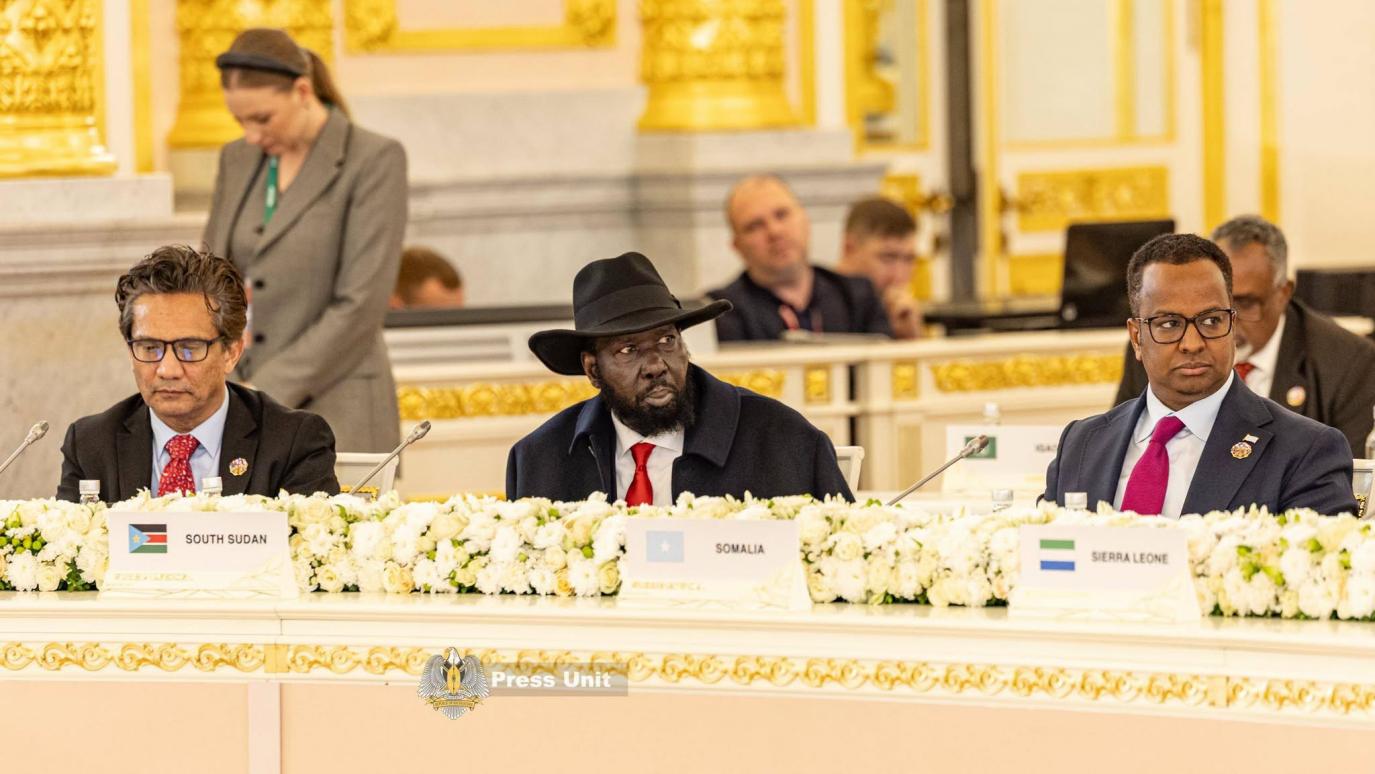
South Sudan President Salva Kiir (centre)at the Third Russia-Africa Summit in Moscow, Russia. [Photo: PPU]
The third Russia–Africa Summit and Economic and Humanitarian Forum recently successfully concluded at the Grand Kremlin Palace in Moscow, Russia. The two-day high-level event, held on 28th and 29th October 2026, brought together heads of state and government, representatives from African countries’ ministries and state agencies, business leaders, and experts in various sectors.
Russian President Vladimir Putin and Burundian President Evariste Ndayishimiye, who is also the current Chairperson of the African Union, co-chaired the meeting, which brought together representatives from 48 African countries, including 22 heads of state.
This year’s summit builds on the foundations established by the inaugural and second summits held in 2019 and 2023, respectively. The summits aim to strengthen cooperation between Russia and Africa in areas such as diplomacy, politics, trade, investment and energy.
They also provide a platform for Russia and African countries to advance mutually beneficial relations in agriculture and food security, science and technology, infrastructural development and education. These were among the key areas of focus at the just concluded summit.
Russia-Africa relations have a long history, dating back to the pre-independence period, when Russia, then part of the Soviet Union, supported African liberation movements and provided assistance in education, military training, defence and infrastructure development. Liberation movements in South Africa, Egypt, Zimbabwe and Mozambique, among others, benefited from different forms of Soviet support.
These ties have evolved over the years and continue to be shaped by shifting interests and realignments in global diplomacy. Some media outlets have reported diplomatic tensions in the build-up to the meeting in Moscow, with the US and some of its Western allies reportedly urging African countries not to participate and threatening possible sanctions.
As Africa’s suitors continue to flex their influence, the big question remains: how is Africa benefiting?
While the previous summits in Sochi and Saint Petersburg saw numerous agreements signed, committing both sides to expand cooperation in key areas of mutual benefit, the overall results have been modest. Among the ambitions set at the inaugural summit was a target of reaching USD 40 billion in annual trade.
Despite an increase from USD 18 billion in 2022 to over USD 27 billion in 2025 in Russia-Africa trade, persistent trade imbalance remains a critical concern, with Russia’s exports to Africa substantially exceeding its imports from the continent, reflecting a broader challenge in Africa’s trade relations with major global economies.
Addressing the summit’s plenary session, President Putin noted that trade between Russia and Africa has expanded and reaffirmed the Kremlin’s commitment to increasing its value.
“The main figures are that trade is growing between Russia and Africa. Its total volume increased by 1.5 times and was above $27 billion since 2022,” Putin said, adding that the figures could reach USD 50 billion in future.
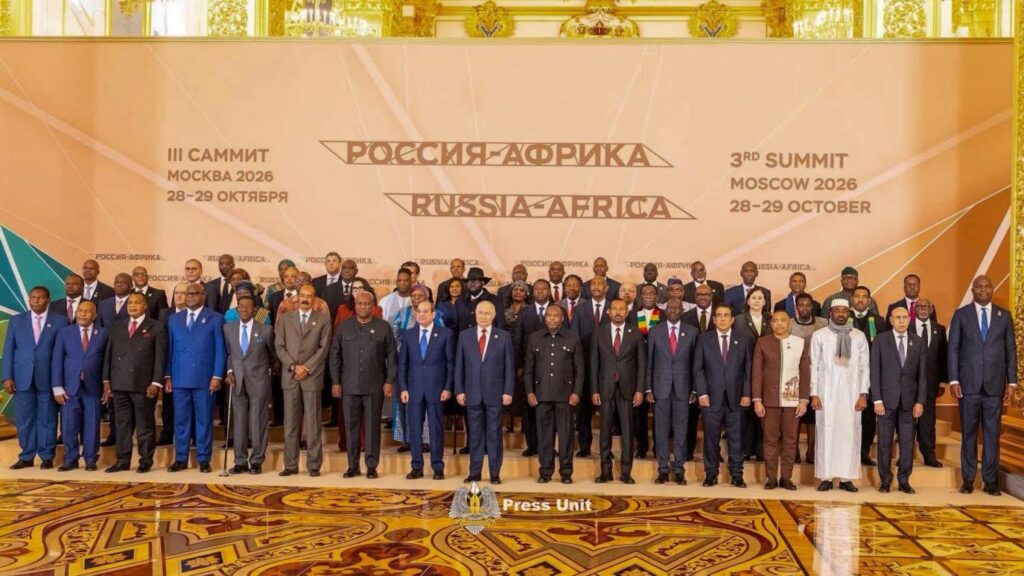
African leaders in a group photo with Russia’s President Vladimir Putin in Moscow, Russia during the Third Russia-Africa Summit held on the 28-29 October, 2026. [Photo: Courtesy]
However, compared with Africa’s trade with other leading economic partners such as the European Union, China, the US and India, Russia-Africa trade is significantly lower. For example, while EU-Africa trade was valued at approximately USD 384 billion in 2004 and China-Africa at approximately USD 348 billion in 2025, Russia-Africa trade lags at USD 27 billion.
Beyond trade, Russia has also been a significant player in supporting Africa’s food security and public health. It also remains one of the continent’s leading suppliers of military equipment.
President Putin said Russia had exported more than 13 million tonnes of agricultural products to Africa in the first nine months of 2026, while supplies of grain and fertilisers reached more than 40 African countries. The country has also established 15 mobile anti-epidemic laboratories across eight African countries and trained approximately 450 African health specialists.
These figures show that despite significant trade deficits, Russia-Africa relations have contributed to tangible benefits in other sectors across the continent.
East Africa’s economic circle
The East African region was represented at the summit by South Sudan’s President Salva Kiir, Kenya’s President William Ruto, Burundi’s President Évariste Ndayishimiye and Uganda’s Vice President Jessica Alupo.
Rwanda, Tanzania, the Democratic Republic of Congo (DRC) and Somalia were also represented by senior government officials, including Rwanda’s Prime Minister, Dr Justin Nsengiyumva, and Tanzania’s Prime Minister, Dr Mwigulu Nchemba.
South Sudan actively participated in the summit, calling for stronger bilateral ties with Russia, increased investment in its natural resources and greater cooperation on international security.
In his address, President Salva Kiir Mayardit reaffirmed the friendship between South Sudan and Russia, urging increased investment in the country. He also stressed the need for the summit to build a fair and equitable international order that guarantees economic and physical security for all.
“We must foster economic cooperation through mutual investment. South Sudan is blessed with natural resources, which offer investment opportunities in agriculture, petroleum, mining and tourism. We welcome investors from the Russian Federation and other interested nations to invest in South Sudan,” President Kiir said.
On the sidelines of the summit, the Minister of Petroleum, Hon. Awow Daniel Chuong’, led a delegation of senior ministry officials in a meeting with Russia’s Minister of Energy, Sergey Tsivilev. The meeting, which also involved Nile Petroleum Corporation (NilePet) and Russian state-owned oil company Zarubezhneft, resulted in the signing of preliminary agreements to deepen cooperation in South Sudan’s oil sector. The agreements provide for the proposed transfer of former Petronas interests in two South Sudanese oil operating consortia to Zarubezhneft.
Separately, South Sudan’s Caretaker Minister of Justice and Constitutional Affairs, Dr Wek Mamer Kuol, met Russia’s Minister of Justice, Konstantin Chuychenko, to explore opportunities for stronger legal cooperation between the two countries.
A statement from the Office of the President said the meeting proposed sharing legal expertise through joint seminars, expert consultations and the exchange of best practices. This reflects South Sudan’s wider engagement with Russia across several areas.
South Sudan’s engagements at the summit build on previous commitments by Russia to increase investment in areas such as agriculture, mining, education and health.
In a meeting held in March 2026 between Russian Ambassador to South Sudan Aleksandr V. Kosmodemiyanskiy and the then Minister of Finance and Planning, the two countries discussed expanding Russian investment in South Sudan’s oil refineries, increasing agricultural assistance and providing more scholarship opportunities to South Sudanese students.
Kenya’s President William Ruto raised similar concerns about trade imbalances, describing Africa’s continued reliance on exporting raw materials and importing finished products as “neither sustainable nor acceptable”. He called on Russian companies to invest in Kenya, promote value addition and support the development of local manufacturing industries.
Kenya’s and South Sudan’s engagements reflect the broader interests of countries across the East African Community (EAC) and the continent.
Russia–Africa cooperation must therefore address these imbalances through greater investment in manufacturing, technology transfer, knowledge development and job creation.
However, the region’s remain with wide opportunities, which can be explored for mutual economic benefits.