



Juba communities offered life lessons on conflict resolution mechanisms in tensed situations

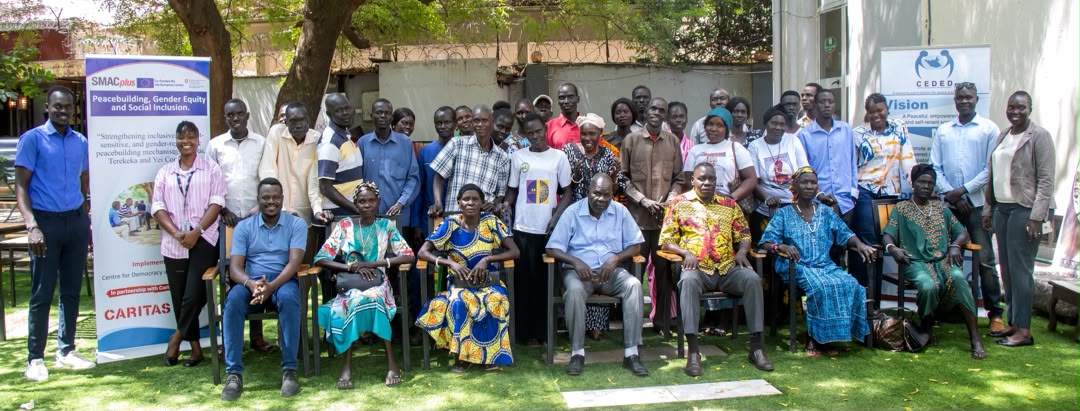
Centre for Democracy and Development (CEDED) organises a five-day training to equip participants with skills in conflict mapping, mediation, dialogue and conflict analysis
By Binia Elizabeth
Participants at the peacebuilding training organised by the Centre for Democracy and Development (CEDED) in Juba. [Photo: Courtesy]
When armed individuals arrive at Ladu Payam administrative office over land disputes, Susan Peter says the threat is not always only about property disagreements but also the safety of those expected to resolve them.
As the Deputy Director of Ladu Payam, Peter has witnessed how land related conflicts and armed intimidation make community dispute resolution increasingly difficult, particularly for women involved in local leadership.
“When someone has a gun, they can do anything they want, including shooting you,” she says.
But after attending a five day peacebuilding training organised by the Centre for Democracy and Development (CEDED), Susan believes she has gained practical skills that can help her manage tensions and prevent disagreements from escalating into violence.
One of her take home lessons is the importance of remaining calm when dealing with aggressive individuals.
“When you see someone aggressive, you should not talk back in a rough way. You should remain calm and let him talk. Keep quiet and listen until he/she calms down then you can address the issue in a better way,” she says.
For susan, however, building lasting peace also requires giving women a meaningful role in decision making and conflict resolution.
She says women often have a clear understanding of the challenges facing their communities but are not always given equal opportunities to contribute to solutions.
“Women can be important, even in assisting men. When men work alone, it can be overwhelming. But when there is support from women, they can easily build the nation,” she said
Her concerns reflect the wider challenges facing grassroots peacebuilding, where local knowledge and community participation are essential but often constrained by insecurity and limited resources
For Alfredo Gennario, an official from the State Ministry of Animal Resources and Fisheries stationed in Rajaf Payam, years of conflict have weakened relationships and trust among communities.
In his observations, violence and unresolved tensions have affected even activities that would ordinarily bring people together. Gennario recals how football, often considered a tool for promoting unity, has in some occasions triggered confrontations due to lingering hostility and mistrust.
“Sometimes people think football can bring communities together for peace and love, but at the end of the day, because of the trauma of hatred, it triggers violence and fights,” he said.
He identified land grabbing, family disputes, harassment, political tensions and disagreements between individuals and communities as some of the major sources of conflict
Although traditional leaders remain central to resolving local disputes, Gennario says their authority is sometimes limited, particularly when cases involve armed individuals or security personnel.
He believes communities must move away from violence and embrace peaceful ways of resolving disagreements.
“Let us work hard to change these bullets to hoes and seeds, how to farm and feed ourselves,” he said.
For him, replacing weapons with agricultural tools represents a broader shift towards productive livelihoods, cooperation and peaceful coexistence
Young people, often associated with insecurity, drug use and violence, were also encouraged to become active participants in peacebuilding.
Jackson Soka, a youth representative from Nyawa Boma in Lodu Payam, said the training had changed how he viewed his responsibility towards his community.
He believes young people should not only be seen as part of the security problem but also as potential agents of change.
“This training has opened my mind and given me skills and knowledge to address issues in our community. When I go back home, I will bring young people together and teach them how we can stop conflicts in our community”he said
Soka also proposed encouraging young people to participate in agricultural activities as a way of promoting cooperation and keeping them engaged in productive work.
His commitment reflects the initiative’s wider objective of involving young people in identifying, preventing and addressing conflicts within their communities.
For Victor Lodu, Sub-Chief of Lodu East, recurring disputes over land boundaries, land grabbing and cattle destroying farms have continued to strain relationships between communities
He said traditional leaders struggle to resolve disputes involving armed individuals and young people who refuse to respect their authority.
However, he believes the establishment of grassroots peace committees could strengthen local efforts to address such challenges
“Earlier, we had issues resolving conflicts involving young people because some of them take drugs and become difficult. But with this training and the establishment of peace committees, I am sure we are going to bring peace to our community” Lodu said
The committees are expected to provide communities with a platform to identify emerging tensions, encourage dialogue and address disputes before they escalate into violence.
The five-day training equipped participants with skills in conflict mapping, mediation, dialogue and conflict analysis.
However, participants said several challenges could affect the implementation of the initiative, including limited accessibility, transportation and financial resources.
Susan said women from remote communities sometimes struggle to travel to Juba to participate in training, while some venues are not easily accessible to people with mobility difficulties.
She called on CEDED and its partners to take future training opportunities closer to rural communities to ensure wider participation.
Gennario also urged the government and development partners to provide financial, transportation and security support to enable peace committees to carry out their responsibilities
CEDED has pledged to conduct regular monitoring visits to assess the committees’ progress and support the implementation of their community action plans
For the participants, the real test of the initiative begins after the training, when they return to communities where land disputes, armed intimidation and youth related violence remain major concerns.
Peter wants women to have a stronger voice in decision making. Soka wants young people to become advocates for peace, while Lodu hopes traditional leaders will have better mechanisms to resolve disputes.
Gennario, meanwhile, wants communities to abandon violence and embrace productive livelihoods.
Their experiences point to a shared desire for communities where disagreements can be settled through dialogue rather than threats, fighting or loss of life.
The success of the initiative will ultimately depend on whether the skills acquired during the training translate into meaningful action and whether communities are willing to embrace peaceful ways of resolving their differences.
For these grassroots peace ambassadors, peace is no longer simply a subject discussed in a training room. It is a responsibility they must carry into their homes, villages and communities