



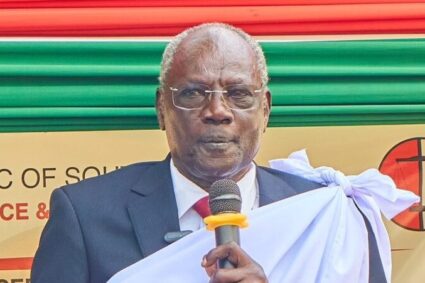


VP Abdelbagi calls for stronger cooperation in visit to health ministry


By Correspondent
In what officials described as a historic step toward improving public health services, the Vice President and Chairperson of the Services Cluster, Hussein Abdelbagi Akol, on Tuesday conducted a landmark courtesy visit to the Ministry of Health – Republic of South Sudan, urged for stronger cooperation among institutions to improve healthcare delivery across South Sudan.
The Tuesday visit of the ministry of Health in Juba on Tuesday, marked the first time a sitting Vice President has undertaken a working visit to the Ministry of Health as part of direct oversight of key government institutions under the Services Cluster, which also supervises the education and agriculture sectors.
Officials said the visit reflects the government’s renewed commitment to strengthening the country’s health system and ensuring effective service delivery to citizens.
Speaking during the engagement, Vice President Abdelbagi reaffirmed his personal dedication to improving healthcare services, describing the sector as central to national development and the wellbeing of the population.
“Healthcare delivery remains one of the most critical pillars of our national development,” Abdelbagi said. “We must strengthen cooperation among institutions and ensure that the health sector receives the support it needs to serve our people effectively.”
The Vice President’s visit was conducted in his capacity as Chairperson of the Services Cluster, a government structure tasked with coordinating policies and programs among ministries responsible for social services.
During the meeting, Abdelbagi commended the Minister of Health, Sarah Cleto Rial, for her leadership and commitment to reforming the health sector.
He particularly praised the minister’s initiative of conducting unannounced visits to health facilities across the country, noting that such measures help strengthen accountability and improve service delivery.
“These surprise visits to health facilities are important,” the Vice President said. “They help ensure that services are delivered effectively and that health workers remain committed to their responsibilities.”
He further assured the Minister of his continued support in advancing reforms aimed at improving healthcare services nationwide.
Responding to the Vice President’s remarks, Health Minister Sarah Cleto outlined a series of priorities aimed at strengthening governance and improving healthcare delivery across the country.
Among the key priorities highlighted were efforts to finalize and validate the National Health Strategy, a policy framework designed to guide the development of the country’s health sector in the coming years.
The minister also emphasized the need for stronger financial and institutional coordination between the health sector and economic institutions to ensure effective service delivery.
“We are focusing on strategic governance and planning to create the fiscal and structural environment needed for effective healthcare services,” Cleto said.
She explained that the ministry is working to implement mechanisms such as the “Accountability Bridge,” which seeks to integrate public financial management systems with supply chain operations in the health sector.
Additionally, the Ministry of Health plans to institutionalize joint budget review meetings with the Ministry of Finance to strengthen accountability and improve resource allocation for healthcare programs.
South Sudan’s health sector has faced numerous challenges since independence, including inadequate infrastructure, limited funding and the effects of years of conflict.
However, government officials say increased political attention and reform initiatives could help accelerate progress toward delivering quality healthcare services for all citizens.