


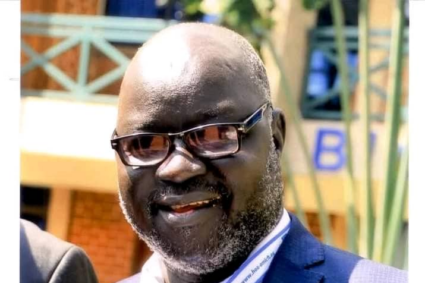


With Yaba Odongo Odoyo (photo byline)
Impact knowledge by reading
In my quest for more knowledge, l ventured into finding out who are the literature moguls in Africa and why they write books on different topics. One would wonder why at my 70s plus years, l would embark on this kind of a journey. My conviction is very simple and derived from the saying that knowledge is power. Indeed, it is.
First, I had to establish the purpose and reason for writing a book which is not a single dose of undertaking but vary depending on the author’s goals and intentions. Some write to educate, some to entertain, while others write to inspire or persuade the public. Ultimately, the purpose of writing a book is to share a story, idea, or message with readers, which leads to my definition of the word “literature,” briefly translated as a written works, especially to those considered superior or lasting artistic merit and of “a great work of literature among them, the purpose of writing and using the word ‘political’ in the widest possible sense.
Desire to push the world in a certain direction, to alter other people’s idea and the kind of society that they should strive after. Once again, no book is genuinely free from political bias. I found out that most renowned African authors are using English Literature which in its very core refers to the study of texts from around the world, written in the English language. By studying English Literature, one will learn how to analyze a multitude of texts and write clearly using several different styles. I was inspired to take these chores since there is a new title recently released, “Transitional Justice Under Scrutiny” and earmarked to join others already published by top classic African writers which is a must read.
Chinua Achebe’s Things fall apart, and other titles by Ngũgĩ wa Thiong’o, Ayi Kwei Armah, Peter Abrahams, Flora Nwapa, Wole Soyinka,Elechi Amadi and Camara Laye, equally fall in the same category , with the pure intention to learn more from our own and far beyond bearing in mind the benefit of acquiring knowledge for the young and the old alike.
Along the line Achebe is considered the father of African writers according to archived records. When he died, he was mourned around the world, proclaimed as the “Father of African Literature,” as the author of contemporary classics such as Things Fall Apart and No Longer at Ease, and as a perennial Nobel Prize candidate. In the circle is yet one of the most popular author in the world, Stephen King an American fiction writer.
However, globally ranked top five authors are William Shakespeare, Jane Austen, Charles Dickens, Virginia Woolf, and Toni Morrison. They did not just tell stories but also redefined storytelling, breaking conventions and forging new paths in English literature as recorded. It is believed that there are three main reasons why authors write? A simple trick to summarize the three main categories of author’s purpose is to use the acronym PIE, which stands for Persuade, Inform and Entertain.
Although there are many reasons to write, PIE represent the three main forms of author’s purpose. Which brings me to the new title I have mentioned here above “Transitional Justice Under Scrutiny” authored by Amb Prof. Joram M. Biswaro with a vast socio-political experience in the continent and the world over having served and brushed shoulders with the high and mighty through his service to humanity. Published by Ssali Publishing House in conjunction with UNISA Press., the master piece is yet to gain momentum to be among the winning titles among other continental and global authored books.
We all should agree that reading is a must and competition for knowledge and education are not negotiable as they are driving power houses for human-beings. With public demand across the divide, we can briefly sample the new book to find out its in-depth category. “Volumes One and Two presents a meticulously crafted analysis of major socio-political landscapes, spanning both past and present generations. With remarkable depth, the author unearths issues that have long remained concealed beneath the surface, offering a compelling examination of some of the most pressing social and political dilemmas of our time. His insights extend beyond Africa to encompass global contexts where injustices and human rights violations have been rampant.
At the heart of this work lies a profound message: “There are three things that cannot be long hidden—the sun, the moon, and the truth.” This statement encapsulates the book’s core purpose: to shed light on historical and contemporary injustices while fostering discourse on truth, justice, and reconciliation.
The Struggle for Justice and Human Rights
Since time immemorial, human history has been marked by struggle—first against nature, then against fellow human beings. As societies evolved, the emergence of private property introduced class struggles, exacerbating conflicts. In this turbulent landscape, men and women have suffered immense loss—of life, property, dignity, and rights—due to marginalization, exploitation, and atrocities.
Biswaro delves into fundamental questions regarding political power, justice, equality, freedom, democracy, and governance. He examines the intricate relationship between individuals and society, emphasizing the rights and responsibilities of citizens within political frameworks. His exploration of transitional justice offers a crucial lens through which to view efforts aimed at addressing systematic human rights violations.
Understanding Transitional Justice
The book defines transitional justice as a response to widespread human rights abuses, designed to acknowledge victims, promote reconciliation, and facilitate democratic transformation. It is not merely a distinct form of justice but an adaptation of justice to societies seeking to heal from historical traumas.
These societies face critical questions:
- How much of the past should be remembered, and who bears responsibility?
- Should perpetrators be prosecuted, or would such actions deepen divisions?
- Should amnesty be granted, and if so, under what conditions?
These dilemmas underscore the moral complexities inherent in seeking justice and reconciliation. The author provides an in-depth discussion of the trade-offs societies must navigate in their pursuit of peace.
A Thought-Provoking Masterpiece
This voluminous work is intellectually stimulating and thought-provoking. Its impact depends on the reader’s perspective and the author’s intent. Biswaro, a seasoned scholar and diplomat with vast local and international experience, brings to the table urgent concerns affecting Africa and the wider world. His proposed solutions aim to curb, if not eliminate, the persistent political instability that plagues many nations.
With clarity and depth, Transitional Justice Under Scrutiny engages with real-world issues, offering a compelling and insightful perspective. It transcends mere academic discourse, providing practical insights into justice, governance, and human rights.
A Must-Read for Thought Leaders
In today’s world, many are conditioned to accept falsehoods and follow predefined narratives without critical thought. A society devoid of independent reasoning is vulnerable to manipulation, particularly when those in power dictate its ideological course. Biswaro challenges such passivity, encouraging readers to engage critically with history, justice, and governance.
The book addresses pressing issues, including war, genocide, mass rape, gender-based violence, economic exploitation, and political repression. As nations grapple with these challenges, rebuilding shattered lives and institutions remains a daunting task. Beyond physical reconstruction, there is a need to restore social fabrics torn apart by distrust and betrayal.
The Relevance of Transitional Justice
Transitional justice has become a global norm in post-conflict and post-authoritarian societies. While past efforts were largely nationally driven, international involvement has increased, shaping the mechanisms used to address gross human rights violations. The United Nations’ 2004 definition remains one of the most cited: Transitional justice refers to the full range of processes and mechanisms associated with a society’s attempt to come to terms with a legacy of large-scale past abuses to ensure accountability, serve justice, and achieve reconciliation.
Biswaro’s work provides a critical interrogation of these processes, shedding light on the evolving nature of transitional justice. This book is essential reading for scholars, policymakers, and anyone interested in justice, governance, and human rights. The book has made a significant contribution to discussions on justice and reconciliation. His analysis is both enlightening and provocative, compelling readers to rethink prevailing narratives and consider holistic approaches to justice. This book is not only a scholarly triumph, but also a vital tool for those committed to shaping a more peaceful, just, gender balanced and equitable world”.
Note: Readers of this weekly column are invited to share their opinions on this and other topical issues in the world.
Yaba (Jaduong) Odongo Odoyo is a leading commentator, writer and established Editor with long standing career in journalism and media industry internationally. The comments and insight shared are his own. You can contact him at +211921351878, +254795226883or e-mail: odoyo2002@gmail.com