



Hundreds of lawmakers were sworn into the Transitional National Legislature (TNLA) in a pomp and colour ceremony on August 30, 2021. The move was expected to effect the legislative oversight roles from an expanded House, which promised more but turned out to be underwhelming.
The new parliament was to address the challenges faced by people who had suffered impacts of the conflicts of 2013 and 2016, which displaced millions of people forcing them to seek refuge in the neighbouring countries, UN-run civilian protection zones across the country, as many others were killed.
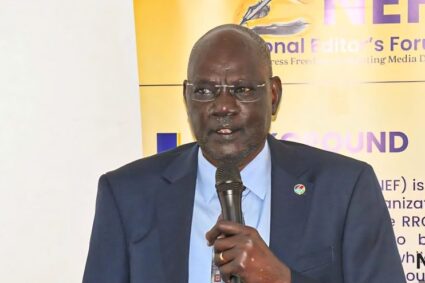
With the formation of the parliamentary committees still in the offing, Paul Lukudu, a lawmaker in the Council of States, expresses hope the current parliament may exceed the performance of the last House by making 2022 a year of good governance and service delivery.
“The committees are really a milestone to the parliament. Once there are committees in place, there is a high chance of us having effective governance, effective checks and balance and that will help us to see good governance prevailing at all levels of the government because the parliament by itself is an independent wing of the government,” he said in an interview with The City Review.
“The citizens must expect a lot of hard work from the national legislature in 2022 and the expectation from the MPs definitely will happen. I realised one thing that I have seen in this reconstituted parliament, that the MPs are very close to their people,’’ Lukudu says.
According to him, most MPs are staying in residential areas with their constituents and this has brought about the closeness that enhances consultations with the leadership.
“Let the citizens start approaching their MPs who are residing with them in the residential areas…access them through phone or invite them over” the lawmaker urges the people.
Lukudu urged the citizens to be optimistic, adding that the MPs will accomplish a lot of things once the specialised committees that deal directly with the line ministries are constituted.
Bridging gap
The MP says that in the absence of committees, there was a gap in oversight between the national institutions and state institutions. But Lukudu expects committees to be a link between the parliament and the concerned ministries to eliminate the difficulty that barred briefing of the House.
‘‘Having functional committees in the parliament aids in providing services to the people and solving some of the difficulties that communities experience in their areas by engaging legislators with their constituents, particularly during recess,’’ he argues.
This, he believes, may be accomplished by MPs submitting resolutions to the legislature on matters such as health, education, security, salary, and catastrophes, among other things.
He argues that the committees will almost be equivalent to the ministries because each ministry has a committee that is relevant to it, and the parliament’s main purpose is to oversee the executive and judiciary. However, the process of forming all the committees is still underway because the committees will have chairpersons and deputies, he says.
‘‘There will be a committee on education to look into anything related to education, including the ministry of education policies and issues affecting students. For example, students on government scholarships studying in Addis Ababa, Ethiopia, were not paid at one point and were forced to stay in the embassy due to unrest in Ethiopia,’’ he says.
‘‘The committee will be accountable and will inquire of the ministry of higher education [knows] what is going on as well as the ministry of general education, particularly when something is going on with students in secondary schools and even primary schools,’’ he adds.
Because the house passes budgets for each and every government entity, the parliament will ensure that all commitments made by line ministries are carried out through specialised committees.
“If it is about educating the parliament do the follow-up and if there is a health crisis in the country like what happens in Western Equatoria State last time,” Lukudu explains.
He gave an example that what happened in Western Equatoria would be a concern for the line ministries and the health committee.
“If there are sittings and there is information related to a certain ministry or a certain issue then they will see is the issue related to security, education, health or public sector or salaries,” he says.
“So the concerned committees and the concern ministries through this will help to effect the check and balance very easy. The executive will work in line with the policies of their institutions as well the legislature will ensure that the policies are implemented,” he adds.
According to Lukudu, even after passing the budget, one needs to look at the budget booklet and see the details of the government’s institutions such as how much the ministry of the interior should get, how the ministry of defence should spend; and what this money will be used for.
“The parliament has authority to check and balance the institutions. Is the money given to these institutions used for the right purpose, or it is not used for the right purpose. If it is not used for the right purpose, they will do the oversight,” he said.