

South Sudan’s election has hit the pinnacle of political discussion amid growing uncertainty over its feasibility.
At the moment, a large number of refugees are still living in neighbouring countries, and the prevalent insecurity across the country presents an unending obstacle to poll plans.
Several officials who talked to The City Review over this matter observed that the volatile security situation had forced the government to direct funds that could have been used for resettling refugees or developing the country.
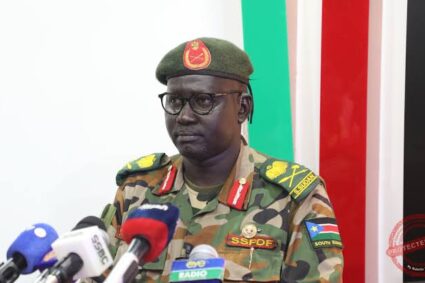
The Senior Presidential Advisor, Gen Kuol Manyang, said the little peace the country has been enjoying did not come as a surprise but was the result of a tireless effort from the government to convince the rebels to return to the country.
He said each rebel leader asked for either a position or what to eat to abandon the rebellion and join the government.
Although there are many other factors, insecurity is one of the greatest beasts to slay for the country to decide its destiny in elections.
Gen Kuol said rebellions have been the major obstacles to peaceful elections since war became a project by rebels, to get money, army ranks, and seats in government positions.
“Our people continued to be with the Sudanese government fighting us, and most of them, when they came, were absorbed into the system. If you did not absorb them into the government, they would continue fighting.
“They come with their inflated ranks, and ghost names. Now we pay money to buy peace. We give people money so that they can become peaceful, “Gen. Kuol.
He said insecurity could obstruct elections and developmental strategies.
Kuol reiterated that war was costly, saying people should rather engage in peaceful opposition by forming their own opposition parties instead of war.
He said people are free to have positive criticism against the government.
“Unfortunately, it is a continuous project. Those who were not employed went back to Sudan, [were] given arms, and they came and fought. This was where the money was going: to pay these people. South Sudan would have developed if there was no fighting. “If everybody becomes a soldier, who will feed us?” he said.
“This is what our people have not understood. Everyone wants to be in the government, to be a general; to be a minister; to be a vice president, to be a president. Why don’t they wait for the election? If fighting did not take place in 2013 in Juba, In 2015, people would have gone to the polls and the winner would have been chosen by the people.”
Differing intentions
Each of the parties to the Revitalised Peace Agreement has what they believe should be put right before elections can take place.
Early this month, a member of parliament, Eng Mayen Deng Alier, under the umbrella of Other Political Parties (OPP), stressed that the repatriation of the refugees must be done before the country can think of elections.
He said they need dignified repatriation where the refugees and internally displaced persons (IDPs) could return to their previous status before they were displaced by the war.
However, Mayen said the end of the transitional period did not mean time for election exercises but the implementation of the peace agreement.
“And all these things are in stages. So, the end of the transitional period is not the election. The end of the transitional period is the fulfilment of what is written in the revitalised agreement, “said Mayen.
“First, there should be dignified repatriation of those who have been displaced by this war. “Dignified repatriation, it means that they should be given the same status that they were given before the war.”
The preparation for the repatriation and return of refugees from the diaspora could not be an easy move and might require adequate time and resources, that will not be in place within the remaining time towards the end of the transitional period.
Last month, the Chairperson of the National Electoral Commission, Prof Abednego Akok said several bills were not passed into law by Parliament, among them the election act of 2012, which he said had not been amended, and most importantly, the permanent constitution, which also needed the refugees within the country.
“Now there are very important issues to be considered before running for elections. Number one is the amendment of the election act of 2012, to suit the peace terms. We have done our part as a commission. We made some suggestions and sent them to R-JMEC. R-JMEC will send them to the ministry of justice, and from there to the council of ministers, and [they] will proceed to the assembly for final approval. This has not been done so far,” he explained.
“This has not been done. And above all the constitutional amendments that have been recommended, it is also under process. If there is a political will, with the stakeholders of the commission, I mean the political parties, the executive, the legislatures, civil society and the media, if they have a political will, they can do anything to enable us to take over to run the election.”
However, Gen. Kuol said elections could not be carried out without the return of the refugees in the country because they may not vote for some they had never known.
On March 3, 2022, the official spokesperson of the South Sudan Opposition Alliance (SSOA), Brig. Gen Samuel Shan stressed that the unification of forces was vital for transparent elections warning that if the unification of command is not done, it might drag the country back to war.
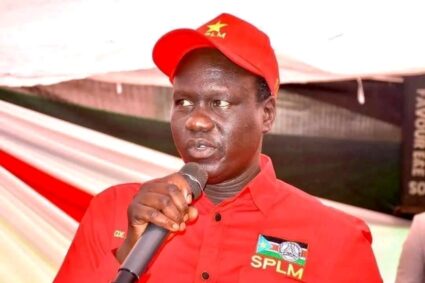
In February, the SPLM endorsed President Salva Kiir Mayardit as the party’s flag-bearer during the campaign in Eastern Equatoria State.
The SPLM Interim Secretary-General, Peter Lam Both, said the country should adopt the 2008 census to conduct elections.
But the SPLM/A-IO’s Director for Information and Public Relations, Puok Both Baluang, maintained that all the prerequisites should be implemented, including the permanent constitution, unification of command, repatriation of refugees, and census, to mention but a few.
He said that elections should not be rushed until the agreement is fully implemented in letter and spirit.
Limited time
The electoral commission’s chief said time was limited for the census to be conducted and the parties to the agreement must sit down and decide what to do with the transitional period, and also whether elections should be extended or not.
He added that they might decide to use the 2008 census data and appealed to the parties to the agreement to embrace peace, which would lead to a political will and finally to democracy.
However, Gen Kuol Manyang told the City Review that the government would struggle to repatriate the refugees because they cannot vote in the diaspora.
He said the prevalence of insecurity would not allow them to come into the country and called for a political will from all the parties to the agreement.