
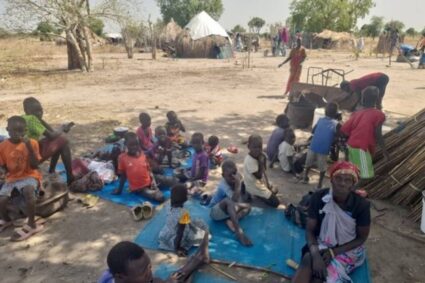

Upgrade services before returnees’ arrival, IOM tells state

International Organization for Migration (IOM) has advised the government not to rush repatriation of refugees and Internally Displaced Persons (IDPs) arguing that there is need improve service delivery first.
The UN migration agency says it prefers voluntary return of refugees and IDPs to a government-sponsored repatriation, warning that the latter could spark scramble over poor and scarcely available social services – machinating communal tensions.
IOM released the statement after the government revealed last week it would repatriate refugees and IDPS to take part in the national census to be conducted in preparation for the general election slated for 2023, in accordance with provisions of the revitalised agreement.
“When you have a community where today you have 1,000 people live and schools and health services are just okay for the one thousand people that are there. If then tomorrow 2,000 people come back to that community, you have to increase the services,” Peter Van der Auweraert, IOM Chief of Mission said.
“Otherwise people are going to compete for access to schools, health services. Again if you don’t, then the risk is that, of course, there is going to be tension between returnees and people who are living there,” the IOM Chief added.
Auweraert said refugees and IDPs should be left to decide on whether to return or not to prevent conflict. This, Auweraert says, is the position of all refugee and migration agencies.
“But the overall situation, like if you look at the whole country, our position is the same as refugee agencies; people should return on voluntary basis. So, it is a good thing if people decide to come back because they feel that things are better in their homes. But if they don’t, the risk is that it becomes a problem in itself,” he warned.
According to the United Nations High Commissioner for Refugees, there are over 4 million displaced South Sudanese, including over 2.2 million currently in neighboring countries of Uganda, Kenya, Ethiopia, Sudan, Dr. Congo and Central Africa Republic.
In 2020, IOM registered over 1.6 million returnees from both within and outside the country whom they reported have been facing lack of access to adequate basic and social services like schools, health services and food insecurity.
“I think for some people it is safe to return but for other people it may not be. It depends on what the situation is in the place where they are going to return.
“The second thing which is very important is that when people start returning we must invest efforts to make sure that when they come back to their community it doesn’t cause new conflicts, that this does not lead to new conflict or new tension between the people that stay here and people who are coming back, that is very important,” he said.
On several occasions, the Ceasefire Transitional Security, Monitoring and Verification Mechanism reported that houses of displaced people were still being occupied by armed forces, which prevented them to come out of IDPS or refugee camps to rebuild their lives.