


There is no military solution to the current crisis, says Goc

Meanwhile, the Foreign Affairs Minister urged diplomats not to leave Juba, assuring that there will be no war in South Sudan
By James Chatim
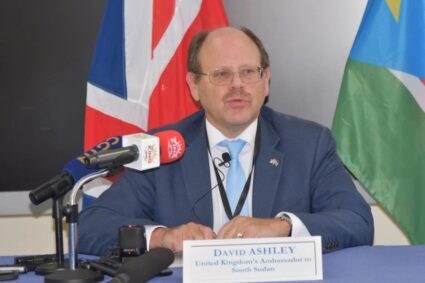
Foreign Affairs Minister Ramadan Mohammed Abdallah Goc has stated that the government of South Sudan is committed to using political means to resolve political issues, and that there is no military solution to the current issues.
The Minister issued the stated while addressing the diplomatic corps on the current situation in the country, where he gave a background to the current tension.
Goc highlighted the recent incidents in Nasir of Upper Nile State and assured the regional and international community that the government is diligently working to maintain peace and prevent the situation from escalating to other areas of the country.
Furthermore, the foreign minister acknowledged the ongoing investigation involving the First Vice President, the Minister of Petroleum, and other senior SPLM-IO officials regarding the events in Nasir.
According to the Minister, the government is committed to implementing the Revitalized Agreement on the Resolution of the Conflict in the Republic of South Sudan (R-ARCSS) in letter and spirit, particularly the security arrangements.
Goc assured the foreign envoys that the government’s fairness over the matter to ensure a transparent investigation.
He said the culprits bearing sufficient evidence would face a fair trial.
However, he also appealed to the international community to support South Sudan in lifting the arms embargo imposed on the nation by the UN Security Council.
“The restrictions hinder the government’s ability to professionalize its security forces and maintain stability,” he said, expressing his regret on the decision by some foreign embassies to close their mission in Juba, saying there is no tension that could result in the international community and diplomatic members leaving the country.
On Wednesday, March 27, the UN Commission on Human Rights in South Sudan sounded the alarm over the country’s rapidly escalating crisis, and called for urgent, coordinated action to protect civilians and preserve the Revitalized Peace Agreement, the cornerstone of South Sudan’s fragile stability.
The arrest of First Vice President and opposition leader Dr. Riek Machar, alongside mounting military clashes and reported attacks on civilian populations, signals a severe unraveling of the peace process—and a direct threat to millions of lives.
“At the heart of South Sudan’s crisis is a failure to protect civilians and uphold the commitments of the Revitalized Peace Agreement,” said Yasmin Sooka, Chair of the Commission. “The deliberate targeting of opposition leaders and civilians represents a reckless disregard for international law and the country’s future.”
Throughout March 2025, violence has intensified in multiple regions, including Upper Nile State, where aerial assaults have displaced over 60,000 people and targeted populated areas following the 7 March attack on a UN peacekeeping helicopter. Armed confrontations have crept closer to Juba, amid reports of opposition figures detained without due process, in violation of the Agreement’s provisions on political inclusion and rule of law.
The Commission warned that failure to uphold the protections enshrined in the Peace Agreement—including freedom of movement, political participation, and the cessation of hostilities—will lead to a catastrophic return to war.
“The Peace Agreement is not optional—it is binding,” added Sooka. “It’s systematic undermining by political and military actors is not only unlawful but a betrayal of the South Sudanese people who have already endured years of devastating conflict,” she said.
The Commission called on regional and international partners, including the African Union, the Intergovernmental Authority on Development (IGAD), and the United Nations, to urgently intensify diplomatic pressure, support de-escalation, and ensure full implementation of the peace agreement’s provisions.
“The Peace Agreement is not optional—it is binding. It’s systematic undermining by political and military actors is not only unlawful but a betrayal of the South Sudanese people who have already endured years of devastating conflict,” said Yasmin Sooka, Chair of the UN Commission on Human Rights in South Sudan.