

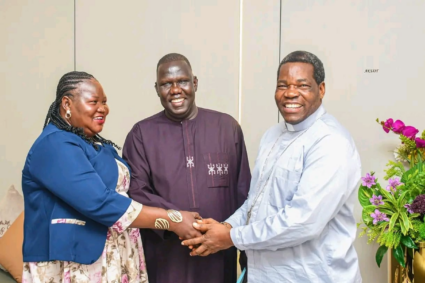
Amb. Gituai leaves S. Sudan with punchy message as he hands over mantle

The outgoing RJMEC interim chair called on South Sudanese leaders to act with urgency in implementing key provisions of the 2018 peace agreement
By Emmanuel Mandella
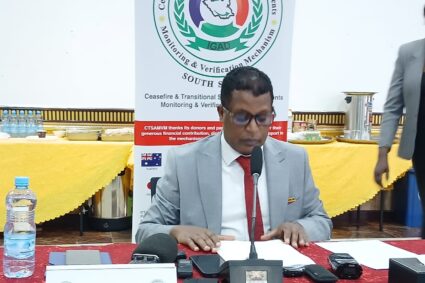
The outgoing Interim Chairperson of the Reconstituted Joint Monitoring and Evaluation Commission (RJMEC), Amb. Maj. Gen (rtd.) Charles Gituai has called on South Sudanese leaders to act with urgency in implementing key provisions of the 2018 Revitalized Peace Agreement (R-ARCSS), as he officially concluded his four-and-a-half-year tenure.
Speaking during his farewell address, the outgoing chair reflected on his tenure, which began in August 2020 at a time when South Sudan faced critical challenges, including the establishment of the Revitalized Transitional Government of National Unity (RTGoNU) and the disruptive impacts of the COVID-19 pandemic.
“South Sudan stood at a critical juncture when I assumed this duty, but over the years, I have witnessed the resilience of the South Sudanese people and their unwavering desire for peace and a better future,” he noted.
Despite notable achievements such as the sustained silence of guns since 2018 and the reconstitution of key institutions, the outgoing chair emphasized that the journey toward peace is far from complete, as he highlighted pending critical tasks, including the drafting of a permanent constitution, unification of forces, judicial reforms, and adequate preparation for the long-awaited elections now slated for 2026.
“The completion of these tasks will make post-elections South Sudan attractive and guarantee the rule of law,” he stressed.
“The upcoming elections present another critical juncture. They must be free, fair, transparent, and truly reflective of the will of the people.”
However, he raised concerns about persistent inter-communal violence and a dire humanitarian situation affecting millions. He called for more political will, trust among leaders, and adequate funding to address these pressing challenges.
The outgoing chair also urged stakeholders not to delay transitional justice processes, including the establishment of the Commission for Truth, Reconciliation and Healing, as well as the Compensation and Reparation Authority both vital for fostering reconciliation in the young nation.
Moreover, he reminded leaders of the importance of gender provisions in the peace agreement and stressed the need to support returnees and internally displaced persons (IDPs) to enable their full participation in the peace process.
“Peace is not merely the absence of war; it is the presence of justice, development, and inclusivity. It requires sustained dialogue, compromise, and a genuine commitment to putting the interests of the South Sudanese people first,” he said.
Reflecting on his time at RJMEC, he expressed regret that elections were not conducted in 2024 as initially planned but remained hopeful that the two-year extension would be the last.
“I appeal to the leaders of this country to demonstrate a sense of urgency and immediately commence preparations for elections, focusing on priority areas,” he urged.
The outgoing chairperson also expressed gratitude to key partners, including the Government of Kenya, IGAD, and international partners, for their continued support in financing RJMEC operations. He commended President Salva Kiir Mayardit, First Vice President Dr. Riek Machar, and other party leaders for their commitment to the peace process.
As he handed over the reins to his successor, Ambassador Major General (rtd) George Aggrey Owinow, he expressed confidence in Owinow’s experience and leadership.
“I know him as a friend. His experience and judgment will stand RJMEC in excellent stead during the extended period,” he said. “I appeal to all of you to offer him the same level of support and cooperation as you did to me.”
The outgoing chair concluded with heartfelt appreciation for his family, whose support he described as their contribution to South Sudan’s peace process.
“Farewell,” he said. “May the road to peace remain clear and the future of South Sudan shine brighter.”