



An analyst said the government should devise a symbolic uniting factor to defuse the ongoing inter-tribal conflicts that have caused immense suffering to innocent people in South Sudan.
Speaking in an exclusive interview with the City Review over the weekend. Prof. Abraham Kuol, the Political Analyst and Dean of the School of Social and Economic Studies at the University of Juba said the government should look for a common uniting factor among the citizens to end the vices in the country.
“The government needs to come up with an ideology that will make people value their South Sudanesness compared to be a tribe that we are better off being South Sudanese rather than being from a specific region or a particular tribe,” Prof. Kuol said.
“As long as this country will one time have something called a symbolic uniting factor that will make people see that there is an aspect of being South Sudanese, then this is where the concept of tribalism will not be promoted,” he added.
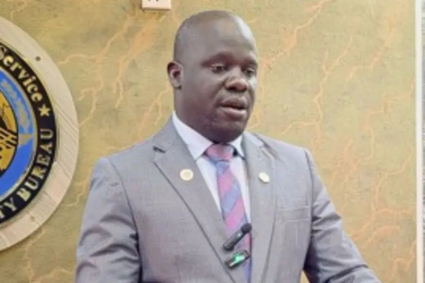
Prof. Kuol (pictured) said South Sudanese are people who love themselves and believe in one another, but politicians perpetuate the mushrooming of ethnic violence to either ascend to or retain power in the government.
“Ethnic conflict is used by the politicians as a scapegoat in the sense that if you want to be in the power, you have to use your tribe to create insecurity and as a result of that you should be able to cling to power or to come to the power,” said Prof. Kuol.
He hinted that “When we got independence there was nothing like a national-ideology that will remain a uniting factor among the people of South Sudan and because of competition over the resources, the little positions, now we got our tribes as the fallback that we should be able to defend and begin to point figures at one another and saying this one is bad, this one is good.”
South Sudan descended into devastating protracted inter-communal violence following the onset of the December 2013 conflict, in less than three years after attaining independence.
Millions have already been displaced, livelihoods destroyed with women, children, and elderly people facing one of the worse humanitarian situations in the African youngest country, according to the aid agencies.
Seven out of the 10 states and Administrative Area have been affected, including Jonglei, Bentiu, Upper Nile, Warrap, the home state to President Kiir, Lakes, Central, and the Western Equatoria States, as well as Pibor Administrative Area.