

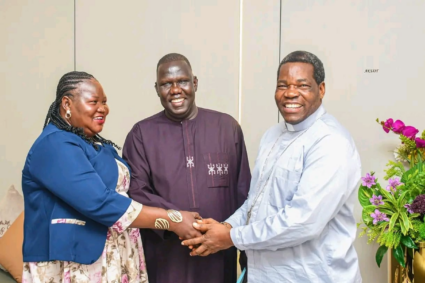
Ateny: Kiir’s press boss discusses life at J1, controversial moments

President Salva Kiir’s Spokesperson, Ateny, Wek Ateny is considered controversial but is also a man who speaks his heart out. The City Review caught up with Mr Ateny and conducted a tell-all interview regarding his personal life as well as pulling strings in the country’s most powerful office: State House. Below is the full excerpt:
Manyuon: Thank you very much for creating the time to speak to The City Review. We know you as Mr Ateny Wek Ateny, President Kiir’s spokesperson. Introduce yourself to our readers because there must be something they do not know about you.
Ateny: Yes. My name is Ateny Wek Ateny. I have been the Press Secretary in the Office of the President since 2013. From May 2013 until I was appointed on November 27, 2013, I was one of the commissioners of the Constitutional Review Commission representing civil society organisations.
I am a lawyer by profession. Furthermore, I have worked in many places in former Southern Sudan. I started as an accountant and later on as a paralegal in the United Kingdom (UK) and as a Coordinator of Policy Advocacy and Strategic Studies, a civil society organization, apart from other consultancy jobs that I have been doing on and off.
Manyuon: You were appointed by President Salva Kiir in November 2013 as spokesperson, and you immediately abandoned your “political commentary role”. Looking back on things, what does it take someone to serve in your current position?
Ateny: Well, I was a civil society activist, a job that many political leaders did before, particularly in Africa. We have presidents that were civil society activists. So, being a civil society activist is something you do to work for political correctness, and eventually, you will either join the government as an individual or join as a crook.
But, from day one, I knew that my appointment to the Office of the President on November 27, 2013, came with a lot of responsibilities. It came with duties and privileges, but I look at duties most because I was appointed and then, within 17 days, the crisis erupted in 2013.
Unfortunately, we were thrown into an extraordinary war, and everything became extraordinary as a result.
Given the circumstances of the situation, I found myself becoming accustomed to such extraordinary circumstances. I took time to visit countries within the region as a guest of the journalists, not a guest of the government officials. I tried to change the perspective of what people thought about the 2013 crisis. I took trips in 2014 from around January until the end of 2014.
This is not a job of the Press Secretary since my job is only confined to the communications of the President, but if I were to sit in the office doing the communications alone, what I did in 2014 culminated in an understanding of the situation that happened in Juba, particularly in Kenya, Uganda, Egypt and Sudan; giving them the perspective I knew could have been the case, won’t have happened. The understanding in those countries won’t have been changed the way it changed when I intervened.
Manyuon: Given that the main obligation of the President’s Press Secretary is to improve the communications, how do you now describe the current level of communication within the Office of the President under your leadership?
Ateny: Well, the level of communication in the Office of the President has changed drastically for the best. When I was appointed, I wasn’t taking over from anybody. The government of Southern Sudan then, until the declaration of independence on July 9, 2011, never had a Press Secretary in the Office of the President. But after my appointment, most of the things that happened to the Office of the President were responded to; by either staff of the Communication Department, who never had full responsibility until I was appointed on November 27, 2013.
Now, communication in the Office of the President has improved. We have a website, a Facebook page and a Twitter handle apart from the South Sudan Broadcasting (SSBC) context work that we do. All the activities of the President are edited by my office and taken to the SSBC as finished work. They do not have to edit the work from the Office of the President.
So, I can see that the communication of the President has changed drastically, but we are still addressing some extraordinary situations that we are in.
Manyuon: Mr Ateny, there are those people who perhaps think that you abandoned the call to speak for the common South Sudanese, especially when you were “beating the drum.” What is your response to this?
Ateny: No. I didn’t leave them. I am still with them because what I am doing now is public work.
I am doing a public job in which if there is anything that will help the people of South Sudan, I can advise the president because what I do is to advise the president on the issues of communication, public relations, and media.
So, I am still doing what is in the best interests of the people of South Sudan. I am doing it in a way that they don’t understand because they used to understand it when I was scrutinising government officials by pointing out their discrepancies and where they had gone wrong.
But I was trying to advise the President and the leadership indirectly by putting them in the newspaper so that it gets to the leadership and the leadership can change certain things based on what the media has been expressing.
Manyuon: So, what have been your milestones as the spokesperson for the country’s most powerful man?
Ateny: So, the best way I can put it is that we have brought the Office of the President’s closure to the people. Now, it is not difficult for you to access the Office of the President if there is anything you want as a citizen. The Office of the President’s Communications is close to people, and I can count it as a milestone.
Apart from other things that we may not discuss today, there are a number of milestones that we have achieved, some of which remain in the fact that we give advice where necessary to the leadership on how to maintain relationships with the public through communication department.
Manyuon: What have been your challenges while serving the President in his tenure?
Ateny: The challenges are so many. Some of them may not be necessarily expressed in this particular interview. But, the first challenge started with the fact we are operating in a crisis, so we don’t have the finances that allow us to do whatever things we want to do in the Office of the President to improve the communications.
We might have ideas of what to do, but the issue of money, sometimes with the crisis we are in, forces us to concentrate only on the priorities. So, we go for what is best in the priorities, leaving out others necessary to improve the communications of the President.
Other challenges include the misunderstanding of my job because most South Sudanese do not understand my job. When I am making statements, like any other press secretary in the whole world, the element of humanity comes into me and I can make mistakes.
When I make mistakes, people treat me as if I was an angel appointed as Press Secretary to make mistakes. I am a human being.
It is because people did not know that everyone could make mistakes. If you make a mistake, you’re supposed to be criticized, but the criticism must be reasonable so that it does not get out of hand. This is what I have seen, and this goes down to the ignorance of those who talk without understanding the job I do.
The other thing is that governmental institutions are supposed to have linkage among their departments, they complement each other, but sometimes, my relationship with the head of the institutions for other governmental institutions is not okay. I always refer to it as an ignorance kind of understanding between some institutions that are supposed to be connected to me, so I count it as ignorance as well. It is ignorance of other kinds of government institutions that do not know exactly how government institutions complement each other.
Manyuon: Last year, a controversial story of you went viral on social media platforms, when you spoke at a certain local wedding ceremony which elicited reactions from women, and you set the record straight that you were misquoted. Kindly tell us about this incident because some people may have misconstrued the context of your message.
Ateny: Although I significantly addressed it in July 2021, when I wrote an apology letter to women, I am not against them. I would want to revisit a bit of it now. Firstly, the video was edited by those who wanted me to have a problem because I was addressing a wedding on February 5, 2021, and it went viral in July 2021; a significant gap of six months, which can indicate that the very people who put it online were trouble makers.
There is one mistake here people don’t see. People should know that any language, be it English, Dinka, Nuer or Bari is a vehicle for communicating the culture of a given society that has the language in a certain way.
You cannot be offensive in saying the statement without taking action, but since it was addressed; it is a closed story, but I think it was used to the best by my enemies or my detractors who don’t want me to progress.
Manyuon: Still in last year’s incident, a group of women called on you to step aside till you issued an elaborate clarification on the matter. Did you mend fences further to clear the air, or did your statement suffice?
Ateny: The statement that I actually issued was to give the correct reading of what I said at the wedding, and it was not to be taken the offensive against women.
Firstly, if there are males allowed to be feminists, I should be one of them. If there are males that are allowed to be female activists, I should be one of them because I have zero tolerance for abuse against women and I am applying it in my house. The simple thing is that I have 17 daughters and I have 4 wives, with whom I have never had any domestic violence with them. I am the one telling people how to respect women.
If it were not because my enemies had wanted me to fall, I don’t see any problem that would have collided with any woman in the first place.
Manyuon: Some people tainted your name as someone who is easy-going with women, attributing it to your nickname “Ateny-Dior” which is literally translated as “Ateny-women.” Is this your true depiction or is this is a stereotype?
Ateny: This is exceedingly ridiculous. The reason why I am saying it is that it is a cultural understanding that all men are likely to be easy-going with women except those who have problems with women.
Who is against a woman so that you can’t be gentle with them, but if people got to know me as a person, they’d realise I’m a very modest person? I am a reasonable person unless people are just trying to tarnish my image. I have no experience of any sexual violence against women.
I don’t have any stories of molestation against women. My life is private, like any other person’s life. But because in South Sudan, people have actually become acquainted with gossiping, you will find people gossiping about me, which is their right.
I cannot intervene to tell them. I have no time to talk to everyone about their feelings towards me, but I know myself as a modest husband of four wives and a good father to my children.
Manyuon: Mr Ateny, journalists ask this question: why is it hard to access J1 and speak to the president or get information on time regarding the country’s issues. What is the due process to be followed because local media outlets are complaining?
Ateny: First of all, it is the nature of the situation we are in that has made it difficult for local journalists to access the President in interviews. As I told you, we have been addressing crises. The President of this country is the only one who is very much disturbed about how to pull the country out of the crisis it is in.
Most of the time, journalists want to interview the President on a number of things, but we feel that they are already available through the communication department. There are already officials that are available if the facts are just for information. I don’t think there is any single thing that we usually leave without telling the journalists so that they can look for the President to be the one talking to them.
The Office of the President is open 24/7 for them, but sometimes, they can apply for interviews with the President, and we find the President’s schedule completely full-on political work. We cannot leave him with the local journalists who come in for him every day.
But I already have a programme where whoever wants to have an interview with the President can write their application, address it to me; attach your questions, and then, from there, I will arrange the time for the President to give an interview at least once in a while, not all the local media.
If we put all the local media to have interviews with the President, it would be an average of 1 interview per day for one month; and the President will not be able to do other work.
Manyuon: You mentioned that Mr President has got a lot of commitment, making it an obstacle for the local journalists to interview him. But we have seen, on a constant basis, foreign journalists coming in to interview the President. So now, does it mean that the local journalists are not trusted to interview the President?
We have live examples like Jeff Koinange, a Kenyan journalist who was here last year. Some Chinese journalists also came about 2 or 3 years ago. Now, tell us, what is this, or do you think it is wise for the local journalists to interview the President?
Ateny: You know, the international journalists come once in a while. So Jeff Koinange came here in 2016 on our invitation to come and see how things are happening in Juba, so that he could convey the message to his Kenyan counterparts, who are good brothers of South Sudan and with whom we want to understand what transpired on July 8, 2016.
The last time he came, it was upon his request, and we put the request into consideration. So, if a particular journalist is lucky enough to find that the President has nothing to do that particular week, we could schedule your interview with the President, but it is just a matter of the President’s having a busy schedule. I am not looking down on local journalists nor doubting their capacities. Some of those who come from outside have the same capacities as our journalists here.
So, I am putting them into consideration, only that the time didn’t allow now. But, as soon as time allows, we will have local journalists interviewing the President.
Manyuon: So, this year, if in case some local journalists apply for the interview with Mr President, do you think they are likely to get Mr President?
Ateny: Yes, of course, from March till the end of this year, we will be able to arrange to put local journalists on board. At least twice, if not triple, within three months. We can put three or four journalists to interview the President.
Manyuon: Lastly, do you have any other comments that you feel like you want to share with the people of South Sudan basically about you or the Office of the President?
Ateny: Yes, of course about me, I am not like the ministers of health, education, or electricity, just to name a few service ministries that are judged by the indicators of what they do.
My job does not have indicators that the public can just see how much or how best I have achieved. But the best part is that we work through the leadership. So, if there is anything the leadership of this country does to the best of its abilities, we are part of it. If there is anything that is not done right, then we are also part of it because the same indicators that the leadership has are our indicators altogether.
Therefore, it should not be assumed that we are completely detached from the leadership. We are part of the leadership of this country in our small way. We are not the decision-makers, but we participate in the process of sharpening our decision making. This is what the people of South Sudan should also understand.
Recorded and transcribed by Manyuon Mayen Manyuon for The City Review