



The Chairperson of the National Electoral Commission, Prof Abenego Akok, has broken silence over the contested 2023 poll saying the only impediment to South Sudan’s election is the delay by the parliament to amend and enact the election act 2012.
Prof Akok yesterday revealed to The City Review that according to R-ARCSS, the election must be conducted two months prior to the end of the Revitalised Peace Agreement. He said this must be at the end of 34 months of the peace agreement which would end in December.
“Until now the election framework which is the act has not been amended by the current parliament. It should be sent to the national assembly, to be passed as a law because the R-ARCSS recommended some areas to be amended before 60 days could come nearer. So, our concern as technical people is to concentrate on these metrics of 36 months of the peace agreement,” Prof Akok said.
“These 36 months will finish in December this year. And then the peace agreement says, 60 days before the end of the peace agreement, an election must be conducted. This document is the one, governing or is the one controlling the election in the nation now.”
The national electoral commission chairman said they had done their part by sending their recommendations to R-JMEC for them to forward to the ministry of justice, then to the council of ministers and finally tabled before the national assembly for final approval.
“Now there are very important issues to be considered before running for elections. Number one is the amendment of the election act 2012, to suit the peace terms. We have done our part as a commission, we made some suggestions and sent them to JMEC, JMEC will send them to the ministry of justice and from there to the council of ministers and will proceed to the assembly for final approval and this has not been done so far,” he explained.
“This has not been done. And above all the constitution amendments, which has been recommended, it is also under process. If there is a political will, with the stakeholders of the commission, I mean the political parties, the executive, the legislatures, civil society and media, if they have a political will, they can do anything to enable us to take over to run the election.”
No time for the census
The national electoral commission chief pledged that they would be fair so long as the members entrusted to them by the parties to the agreement were people who were not involved in their politics.
Akok described the 2008 census as a good reference adding that if the parties agreed, the country might use the old constituencies because preparing for census needed ample time which has already run out and resources that might not be easily mobilised at this juncture.
“The 2008 census is a good reference because the assembly which is now operating was brought in by the peace agreement and then if the political will is there, we can use those constituencies because now to conduct census you need time and resources but the election issue is liberal; you can go about writing the voters, some of them are above 18 years old and then you can do that,” Prof Akok stated.
“The independence of electoral commission is from its members. The members are to be brought in through consultation with the political parties and the ruling party and they agree on those they think are not committed to other political parties. They are independent, we are going to be fair, and we must respect the law.”
He stressed that it was up to the parties to the agreement to extend the time for conducting elections according to what is stipulated in the peace agreement. He appealed for the parties to the agreement to embrace a culture of peace which he said would lead to political and political will would lead to democracy.
“What you need to know is the will of the political parties, the government has extended transitional period three times. And it is also possible with the political decision-makers, they can extend this provided that it is agreeable based on the Revitalised Peace Agreement,” he said.
Options on table
“The first priority is to build a culture of peace when we build a culture of peace, then below culture of peace, there is domain guiding it which is a democracy, where there is political will, democracy can be there.”
Prof Akok concluded that what was needed was to respect and implement the peace agreement in letter and spirit.
“The advice that the parties to the agreement should respect the Revitalised Peace Agreement, all of us. If we respect it, then we implement it and follow it, then we will be able to conduct free, fair and inclusive elections. So, it is a situation to be handled through consultation and with reference to the revitalized peace agreement.”
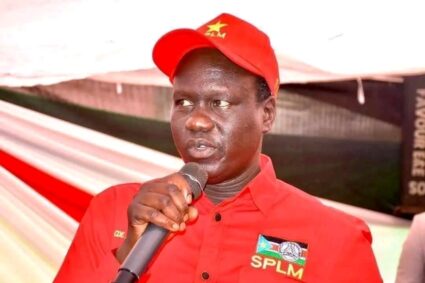
Over the weekend, the SPLM senior politicians conducted rallies in Eastern Equatoria State and endorsed President Salva Kiir Mayardit as the candidate for the election in 2023.
The ruling party spread its tentacles to Magwi County where they appealed to the citizens to vote for SPLM in the 2023 elections.
The SPLM Interim Secretary-General Peter Lam Both said that the county should adopt the 2008 census and use it to conduct elections.
“We are saying, let us use the 2008 Census for conducting the 2023 elections, with projections up to what would have been the results in 2023”, SPLM Secretary said according to a post shared by Eastern Equatoria Press.
Illegal parties
On Monday, the SPLM/A-IO Director for Information and Public Relations in the office of the First Vice President, Puok Both Baluang, said that their party were ready for elections but all the prerequisites must be in place before rushing to elections.
He told The City Review that all the political parties in the country were illegal due to delays made by the parliament in passing the political parties bill.
“All the political parties in South Sudan now are illegal unless the act or the bill is passed by the parliament and all parties to the agreement go back to register again as the political parties of South Sudan,” he stated.
“Election at the end of the transitional period is a democratic process whereby the people of South Sudan, will have the right to elect the person that they think is right to lead them in the future, the leader or the party that can deliver all the services or the party that can spy them and they can see their dreams come true.”
Puok claimed that SPLM/A-IO was the party that could cater for the needs of the citizens including protecting and guaranteeing the freedom of expression but they were not rushing with the issue of elections because they valued the implementation of the Revitalised Agreement on the Resolution of the Conflict in South Sudan first.
“And we believe as the SPLM/A-IO, we are that party. Before jumping to conclusion campaigning, we should focus first on the implementation of the peace agreement in letter and spirit and make sure that all the services as I mentioned are there,” Puok said.
“The permanent constitution, the repatriation of the refugees, the security arrangement must be in place and by security arrangement, we are not only talking about the graduation of forces, we are talking about creating a conducive environment and security must be in place for the people and also allowing the people to express themselves and there must be freedom of participation, freedom of speech and so on and so forth.”
No shortcut in election
The SPLM/A-IO Director for Information said the parties to the agreement should sit down and design what should become of the peace agreement when the transitional period elapses without elections.
He stated that campaigning was not a violation of the revitalized peace agreement except confrontations and illegal recruitment of forces.
“All the parties have the right to freedom of expression by doing what they think is important for them. We as the SPLM/A-IO, prefer that all these prerequisites must be in place before involving in conducting the election,” he said.