




How gov’t tech initiative could transform South Sudan digital landscape

The government has announced that it is currently in contact with Facebook, Google, and Twitter in an unprecedented bid to create a cache server directory for unique local content and put South Sudan on the global internet mapping.
It’s a great developmental initiative that could make the country leap after regional neighbours like Kenya, which have gone far ahead in terms of infrastructure. But how else could the country benefit from such a scheme?
South Sudan is currently missing out on critical digital services from big tech, including Amazon. Many apps from Google Play Store cannot be downloaded when one is in South Sudan, these apps include but are not limited to PayPal, The New York Times, and The Wall Street Journal.
The establishment of a dedicated server to local unique content could unlock such geo-based restrictions as the country will have an Internet Protocol identifiable by Google, Facebook, and Twitter.
Another advantage that may arise is that of prominent figures and authentic news organizations getting verification checkmarks from Twitter and Facebook. That’s a simple but powerful feature that gives credibility to media accounts and eliminates parody. This is good for a fight against fake news and disinformation. Currently, Radio Miraya is the only South Sudan-based media house with the blue checkmark on Twitter.
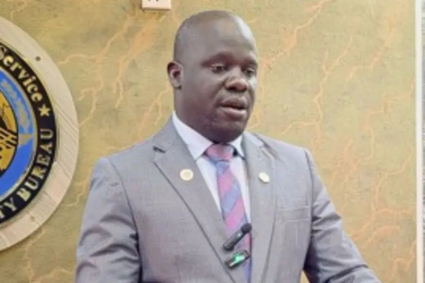
When the Director-General of the National Communication Authority Napoleon Adok revealed this plan, the idea was precisely to elevate the communication industry and inspire newsrooms to embark on an affordable digital mode of operation.
Most of the media houses in the country still operate on an analog system, including national television. In the world where the media and Artificial Intelligence are integrated to ease news production, such technologies are far from reaching South Sudan where digital expertise is greatly lacking.
The situation is even made worse by media managers who are not tech-oriented. They simply do not care about what technology is driving the media industry. Coupled with the high costs of such technologies, and the poor political economy of the media, they cannot simply invest.
The government initiative to partner with Facebook, Google, and Twitter aims at resolving those challenges by training journalists on hands-on digital skills and minimizing the costs of fiber optics in the country.
It is only after that the fourth estate in the country would join the information age and embrace the digital economy of the media.
Online publishers are enjoying massive digital revenue-generation models, some of these models are restricted to specific geographical locations, especially Google AdSense. Currently, for one to sign up for some Google services from South Sudan, the country to be selected is Ukraine. Why choose Ukraine?
Because South Sudan is not among the list of countries where Google delivers its crucial services like YouTube Red, Google Newsstand, and Google Workspace. Besides, Ukraine is the only country with an IP that mirrors the South Sudan geo-location.
These services can all be unlocked for media houses and online influencers in the country once the government establishes a partnership with Google and two other Silicon Valley-based tech giants.
Better still, the introduction of the Loon Project to the remote parts of the country. This is helpful because digital communications will be guaranteed even in times of natural disasters like floods, which wipe out on-the-ground network cell towers.
For Loon, the tennis is in the court of the telecommunications authority, which is supposed to approve or under an unlikely circumstance, reject the establishment of the high altitude balloons to deliver internet access to remote parts of the country. Loon has been tested.
The implementation of this initiative will go a long way in transforming the digital landscape in the country and empowering youth economically.