


Senior government officials have taken the media fraternity by its horns, lambasting the Fourth Estate for being negligent and letting glaring editorial mistakes get in the public domain.
In a rare and fiery reminder of journalists to adhere to professional and ethical practices, officials from government-affiliated institutions said media houses in South Sudan are losing the quality of journalism required to shape the image of the country.
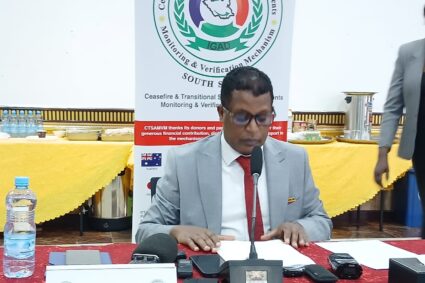
Ladu Wani, the Undersecretary at the Ministry of Information, Communication Technology and Postal Services said media houses, both print and broadcast, are performing dismally with most stories and scripts poorly edited.
“I’m sorry to say this, but the media in this country, especially newspapers, are losing direction. You find a lot of errors, some of the stories are not properly edited, and so many stories are copied and pasted from other websites.
“I don’t know what editors spend their time doing. We need to localize our content,” Wani, who represented the Deputy Minister Baba Medan Konyi, told the workshop attended by news editors and radio station managers.
The Undersecretary also challenged newsrooms relying on the analog mode of operation to make a paradigm shift and invest in digital transition or risk being left behind.
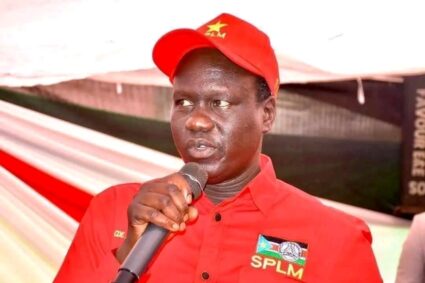
Abdon Agaw Jok, Secretary-General of the Revitalized Transitional Government of National Unity, underscoring the key role played by the media in shaping national affairs, said journalism is a make or break profession.
Agaw said a public figure who wants to thrive in his or her pursuit must build a good relationship with the media, citing an example from the recent U.S. presidential election in which the media campaigned against Trump who hated the industry, leading to his defeat to Joe Biden.
For the case of South Sudan, however, Agaw said there were still notable weaknesses in the profession urging editors to help reporters build their linguistic capacity.
The Secretary-General echoed that the glaring editorial mistakes let out for public consumption are synonymous with a lack of serious and competent editors in newsrooms.
“If you have people with good command of English grammar, make them proof-readers. If you have good proof-readers and competent editors, minor mistakes cannot go unchecked,” Agaw said. “The media industry is going down, but we cannot let that happen, we can’t afford that.”
Agaw called on the Association of Media Development in South Sudan to embark on serious training of journalists, urging the media authority to also supply learning institutions with copies of the Code of Conduct for the Practice of Journalism in South Sudan.
This, he said, should be aligned to the national curriculum so that communication-related institutions of learning produce professionally-conscious journalists.
Presidential Press Secretary Ateny Wek Ateny berated strides for being swallowed by social media, which have catapulted the rise of disinformation and deep fakes.
“Some journalists rely on the information they get on social media instead of official sources, this is not good for ethical journalism,” Ateny said in reference to an Arabic newspaper which falsely quoted him without his consent and any interview.
“When I went to their newsroom they were shivering but I said no, I’m not here to do anything bad. I just want to know who this journalist is, and when he or she interviewed me.
“Then the reporter admitted that he did not interview me but he wrote the story because he had no story to submit on that day,” Ateny said, sparking laughter from the audience.
This comes during a validation workshop organized by the South Sudan Media Authority, Community for Empowerment and Progress Organization, and the United Nations Education, Scientific, and Cultural Organization at Juba Grand Hotel.
Held under the theme ‘Uphold Professional and Responsible Journalism in South Sudan’, the workshop aimed at reminding strides on adherence to the national Code of Conduct gazetted by the South Sudan Media Authority and CEPO in 2016.