

Ministry of Roads and Bridges targets to construct 12,000 Kilometers nationwide

New Minister announces major policy shift after securing approval from the Council of Ministers, stating that the ministry will now advertise road contracts openly to attract competent construction companies
By Aguok Chok
The new administration in the National Ministry of Roads and Bridges faces the huge task of constructing 12,000 kilometers of roads across the country, amid stalled national road projects and the oil-for-roads programme.
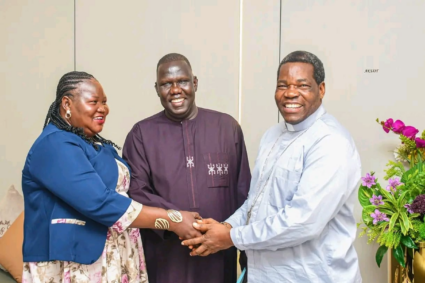
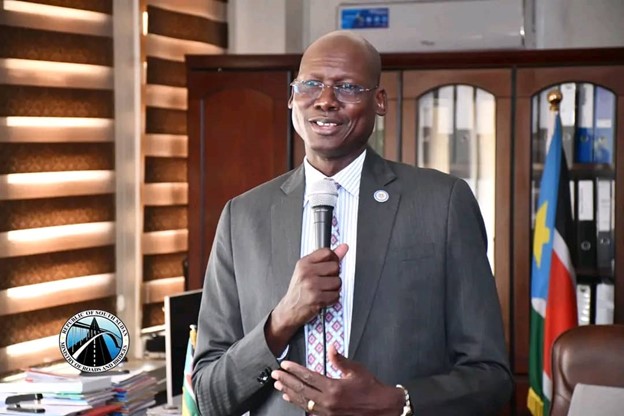
Welcoming the new undersecretary, the Minister of Roads and Bridges, Peter Lam Both, said the ministry must rise to the challenge and deliver on road infrastructure that supports national development and connectivity. He announced a major policy shift after securing approval from the Council of Ministers, stating that the ministry will now advertise road contracts openly to attract competent construction companies.
“People who don’t have the money who are just coming here to hold on a road and give them a contract, we said we are not doing that anymore. We can’t give you, if we don’t have the money and you don’t have the money, why do we do business? So you do business with somebody with money,” the minister said.
According to Lam Both, the new approach is aimed at ensuring professionalism, accountability, and timely delivery of projects. He emphasized that road connectivity must be balanced so that infrastructure development reaches areas that have long been cut off from reliable transport networks.
“And so that is where we want to go. And we also want to consider that this road connectivity must be balanced. We need to make sure that roads reach other places that they have not reached before,” he added.
The minister said priority areas include roads in Bahr el Ghazal, Terkeka–Rumbek, and other locations. He confirmed that the ministry has already engaged professional road construction companies willing to begin work using their own resources, with government compensation planned at a later stage.
“This year is the year for roads for us to start. Before the rainy season comes, let us show that something starts,” Lam Both said.
He explained that the companies being engaged have strong financial and technical capacity. “These are companies that don’t need money now. They have their own means. They will construct the roads, and by the end of the day, after five, ten, seven years, they will ask for their payments,” he noted.
The minister expressed confidence that with strong political will, South Sudan can transform its road sector. “We only need one cargo to construct the whole of South Sudan. Just one. We don’t need two cargo. Just one,” he said.
The new undersecretary, Gabriel Makur Amour, said national trunk roads are high on his work agenda. He noted that his leadership will be guided by three priorities, focusing on economic corridors rather than isolated interests, and ensuring that investment supports cross-border trade routes.
“Therefore, the three priorities will guide my approach first. All plans rules myself, economic corridors, not isolated interests, rules investment must be programmed to support cross-border trade routes when this is needed,” he said.
Gabriel Makur Amour is not new to the ministry, having previously served as Director of Roads and Bridges from 2006 to 2010, Director General from 2011 to 2014, and Undersecretary from 2015 to 2017. His return, officials say, brings experience at a critical moment as the ministry moves to restore confidence through competitive and transparent road contracting.
Utilities
“These are companies that don’t need money now. They have their own means, they will construct the roads, and by the end of the day, after five, ten, seven years, they will ask for their payments,” says Roads and Bridges Minister, Peter Lam Both.