


Parties bullish as Kenya’s President meets S. Sudan high-level standing committee

The committee met President William Ruto in State House Nairobi, where they discussed the Tumaini Peace Initiative, even as players locally support the initiative’s drive
By Emmanuel Mandella
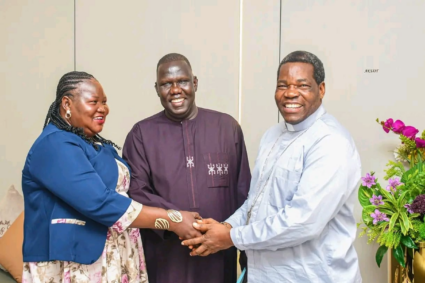
In a crucial meeting held on Monday October 28, Kenya’s President William Ruto engaged with South Sudan’s High-Level Standing Committee, led by Minister Martin Elia Lomuro, who delivered a message from President Salva Kiir. The message focused on South Sudan’s initiative to promote the Tumaini Peace Talks within the Intergovernmental Authority on Development (IGAD) region, aiming to advance peace efforts.
The Community Empowerment for Progress Organization (CEPO) has cautiously welcomed this move, voicing support and concern over the potential impact of the process on South Sudan’s fragile peace. CEPO’s Executive Director, Edmund Yakani, emphasized that while the Tumaini Initiative has the potential to contribute to peace, it must complement, not replace, the existing Revitalized Agreement on the Resolution of the Conflict in South Sudan (R-ARCSS).
Yakani pointed out that linking the outcomes of the Tumaini Initiative with the unresolved tasks under the R-ARCSS offers a significant political opportunity to transition South Sudan from violence to lasting peace. However, he warned of the risks posed by influential actors within the government who have previously manipulated the peace process, calling for genuine political will from the presidency.
“The current Revitalized Transitional Government of National Unity (RTGoNU) is grappling with a significant deficit of trust and confidence among the signatories of the peace agreements and influential actors who have previously manipulated and misled presidential leadership,” Yakani stated. He expressed skepticism about the government’s readiness to implement the second phase of forces unification, which, remains unfulfilled.
CEPO’s caution comes at a crucial time, as South Sudan’s political establishment faces increasing pressure to deliver on its commitments. Yakani urged that the regional lobbying efforts must not be misconceived as a means to replace or undermine R-ARCSS. Doing so, he said, would only deepen the suffering of South Sudan’s citizens, further delaying the establishment of an inclusive government.
CEPO also announced plans to launch a National Transitional Dialogue initiative next month, a platform designed to hold political leaders accountable for their promises under both the R-ARCSS and the Tumaini Peace Talks.
As South Sudan navigates this complex political landscape, Yakani called for transparency and collaboration among all political factions. “The Tumaini Initiative and the R-ARCSS should be treated as complementary frameworks, both essential to achieving lasting peace,” he concluded.
For now, the future of South Sudan hinges on the successful integration of these efforts and the ability of its leaders to rise above the norm for the sake of sustainable development.
CEPO’s caution comes at a crucial time, as South Sudan’s political establishment faces increasing pressure to deliver on its commitments.