




Police warn of suspected kidnappings as missing-person cases rise nationwide


National Police spokesperson says situation in parts of Juba has improved following intensified police operations, but warned residents to remain vigilant against suspected criminals
By Emmanuel Mandella
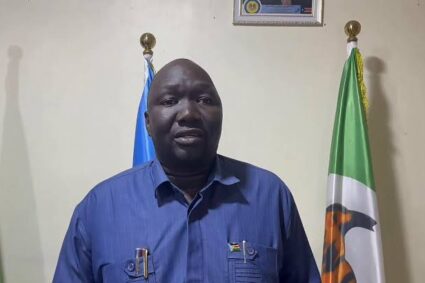
National Police Service spokesperson Major General Daniel Justin. [Photo: Courtesy]
The National Police Service has urged the public to promptly report missing persons and suspected abductions as authorities investigate rising cases of disappearances, including cases involving children, amid growing concerns about public safety in the country.
Police spokesperson Major General Daniel Justin said the situation in parts of Juba had improved following intensified police operations, but warned that residents must remain vigilant against suspected criminals who allegedly disguise themselves as public transport operators to lure unsuspecting passengers.
According to Justin, some suspected kidnappers offer people rides before taking them to undisclosed locations, where they may be robbed. He urged members of the public to report missing relatives and suspicious activities to the nearest police station without delay.
The warning comes as recent reports from Juba have highlighted suspected child abduction and trafficking networks, alongside individual disappearances that have left families searching for missing relatives.
Although the reported incidents differ in their circumstances, they have renewed questions about how authorities investigate missing-person reports, protect vulnerable people and coordinate efforts to reunite families.
The police have called on residents to provide timely information whenever a family member disappears or circumstances suggest that a person may have been abducted.
“Early reporting can help investigators establish when and where a person was last seen, identify possible witnesses and pursue leads before crucial information becomes difficult to obtain”.
Justin’s warning about suspected criminals posing as transport operators also highlights the need for passengers to exercise caution when accepting rides from unfamiliar drivers, particularly when travelling alone or using unverified transport services.
However, the warning should not be interpreted as evidence that all public transport operators are involved in criminal activities. Authorities have not provided figures establishing how frequently this particular method has been used or how many reported cases have been conclusively linked to it.
The police have also not released a comprehensive breakdown of the recent cases, including the number of people reported missing, those subsequently found, suspected abductions confirmed through investigations or cases still unresolved.
On October 17, the South Sudan People’s Defense Forces (SSPDF) announced the arrest of eight suspects over alleged child abduction and trafficking following an intelligence-led operation.
Army spokesperson Major General Lul Ruai Koang said residents had reported 23 children missing from the area under suspicious circumstances. The military alleged that some suspects lured children, kept them in houses and facilitated their transfer to other people, including alleged buyers outside Juba.
The military also reported that one boy, identified as Hakim, had been recovered and reunited with his family, while eight other children had been traced to people suspected of holding them. At the time of the announcement, authorities said efforts to locate and recover additional children were continuing.
Meanwhile, on October 20, state broadcaster, SSBC, reported that police, working with military intelligence, had arrested seven suspected child traffickers in a separate announcement concerning the crackdown in Juba. Police spokesperson Major General Daniel Justin said four children had been rescued and that authorities were working with the Greater Pibor Administrative Area to facilitate the return of other children and reunite them with their families.
The recent incidents are not the first reports of people disappearing under circumstances that have alarmed families in Juba.
In May 2026, Radio Tamazuj reported that a family was seeking help to locate Nyenlonge Manyuon Mayah, a 22-year-old woman who reportedly disappeared from her family’s residence in the Checkpoint area on April 27.
Her father said the family had reported the disappearance to the local police and community leaders while seeking public assistance.
Another incident was reported in May, when police investigated the transportation of 46 children from Aweil South County in Northern Bahr el Ghazal State to Juba.
According to local media, the children, aged between four and 12, were found in a vehicle whose occupants reportedly claimed they were bringing them to the capital for schooling. Police said the adults had failed to provide documentation demonstrating parental consent or proper authorization.
Authorities detained the suspects and began verifying the children’s identities and consulting their families, as the circumstances raised concerns about child protection and the movement of minors across state boundaries without appropriate safeguards.
The case highlights the importance of checking parental consent, guardianship arrangements and the legitimacy of organizations claiming to provide education or care for vulnerable children.
Beyond suspected criminal activity, South Sudan continues to face abductions associated with insecurity and armed conflict.
In January 2026, the United Nations Mission in South Sudan (UNMISS) reported that its human rights brief covering July to September 2025 had documented 159 abductions among 1,153 civilians affected by 295 incidents of conflict-related violence.
The incidents were recorded amid persistent armed hostilities affecting parts of Central Equatoria, Jonglei, Unity, Upper Nile, Western Bahr el Ghazal and Western Equatoria states, among other areas identified in the report. UNMISS said abductions had increased by 20 per cent compared with the preceding quarter, even as the overall number of civilian victims declined.
In conflict-affected areas, people may be abducted during armed attacks, cattle raids or other violence. Humanitarian workers have also faced kidnapping. The Associated Press reported in 2025 that more than 30 South Sudanese aid workers had been abducted that year, amid escalating insecurity and concerns about ransom-related kidnappings.
For families searching for missing relatives, the first hours and days after a disappearance can be marked by uncertainty, financial losses and emotional distress, with family searches stretching beyond hospitals, police stations, neighborhoods and other locations while circulating photographs and personal information through social media.
The latest warning from the National Police Service places renewed attention on the responsibility of security agencies to investigate disappearances promptly and protect the public.