

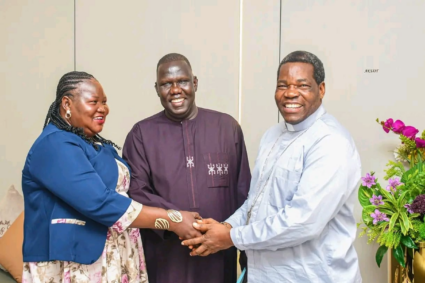
South Sudan faith leaders rally for peace at interfaith harmony Week

By Samuel Yuang
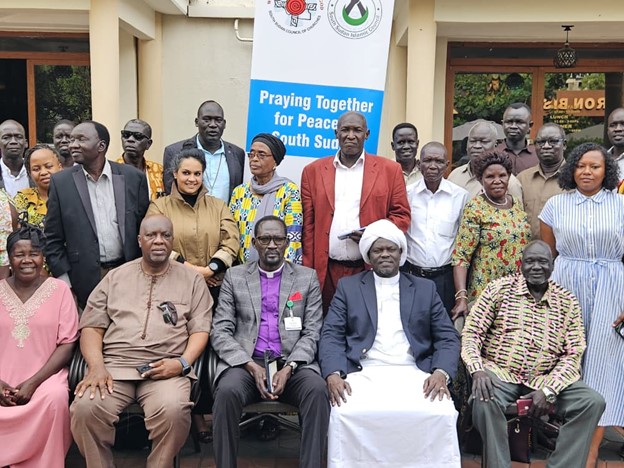
The South Sudan Council of Churches in partnership with the South Sudan Islamic Council, has held a joint interfaith prayer in Juba to mark World Interfaith Harmony Week under the theme “Peace Advocacy.”
The event, supported by the United Nations Mission in South Sudan (UNMISS), brought together religious leaders, peace actors and community representatives to promote dialogue and national cohesion.
In his opening remarks, UNMISS Chief of Political Affairs Guy Bennett described World Interfaith Harmony Week as a global initiative recognized by the UN General Assembly, aimed at strengthening unity and cooperation among faith communities.
According to him, this year’s theme, “Love of the Good and Love of Neighbour,” emphasizes the power of peaceful dialogue and collective responsibility in addressing divisions.
Bennett noted that the convergence of Ramadan and Lent this year presents a rare and symbolic opportunity for Muslims and Christians to unite in prayer and action for lasting peace.
He acknowledged that despite ongoing regional and continental efforts, including discussions by African leaders on South Sudan, violence and displacement continue to affect civilians in parts of the country.
He stressed that South Sudanese voices must remain central in shaping the nation’s future.
Rev. Tut Kony Nyang Kon, General Secretary of the South Sudan Council of Churches, said the country is at a delicate stage marked by political uncertainty, economic hardship, localized violence and humanitarian pressures.
He emphasized that churches and mosques remain among the most trusted institutions and must use their influence to promote moral clarity, social cohesion and responsible leadership.
Dr. Abdullah Barag, Secretary General of the South Sudan Islamic Council, highlighted the importance of equipping religious leaders with mediation and negotiation skills to actively contribute to peace processes.
He commended UNMISS for its continued technical and logistical support, saying faith leaders serve as trusted bridges between communities and decision-makers.
The interfaith leaders reaffirmed their commitment to transforming prayer into practical peace building efforts, calling for unity, humility and sustained engagement to achieve lasting national reconciliation in South Sudan.