




The Jonglei Crisis: Army, aid agencies move in as tension escalates


Military spokesperson, Maj. Gen Lul Ruai warns civilians, aid bodies to move out of opposition controlled areas ahead of an military operation, as UN, government calls for emergency meeting to address bottlenecks
By The City Review Editorial
As tension between national army and opposition forces escalates, multiple approaches are being employed to address the situation.
On Saturday, the South Sudan People’s Defence Forces (SSPDF) issued directives ordering civilians, humanitarian workers, and United Nations personnel to leave opposition-controlled areas of Jonglei State ahead of a military operation dubbed Operation Enduring Peace.
In a press statement, SSPDF Spokesperson Maj. Gen. Lul Ruai Koang gave precautionary measures targeting areas under the control of the Sudan People’s Liberation Army-In Opposition (SPLA-IO), particularly Nyirol, Uror, and Akobo counties.
“With imminent commencement of ‘Operation Enduring Peace’, all civil population in SPLA-IO controlled areas of Nyirol, Uror and Akobo are directed to immediately evacuate for safety to government-controlled areas as soon as possible,” the statement read.
The army further ordered armed civilians who do not wish to participate in hostilities to surrender their weapons at the nearest SSPDF garrison without delay. The youth who are not members of the White Army were also instructed to relocate their families and livestock to government-held territories.
The SSPDF said any armed civilians found near SPLA-IO barracks, assembly points, or rally grounds would be considered legitimate military targets.
“All NGOs and UNMISS personnel operating and working in Nyirol, Uror and Akobo counties are given 48 hours to leave,” the statement added.
The directive comes amid escalating military tensions in Jonglei State following recent clashes between government forces and opposition fighters, alongside mobilization of the White Army in parts of Upper Nile and Jonglei.
With security situation deteriorating, humanitarian aid agencies have have also faced the rough side, forcing them to either halt operations or evacuate staff.
On Saturday, medical charity MSF (Doctors without Borders) evacuated its critical staff from Akobo County due to rising tension in the area. Jonglei State has long suffered intercommunal violence and clashes between government forces and opposition fighters.
Overwhelmed by tension following renewed fighting between the armed factions, more than 60,000 people reportedly fled their homes early this month following a military advance by the SPLA-IO after it captured the towns of Yuai and Waat in the Greater Lou Nuer areas within Jonglei State.
Similar advancements were reported in areas such as Akobo, Uror, and Nyirol counties, creating fear and displacement among locals.
While addressing a large number of troops at Baidit Payam of Bor County on Wednesday last week, Chief of Defense Forces Gen. Paul Nang Majok, ordered the forces to prepare to move toward Duk County to reinforce National Security Service personnel deployed in Poktap, a town located a few kilometers away from Pajut, giving them just one week to conclude the operation.
The looming operation, announced by the SSPDF, and the order for NGOs and UNMISS staff to vacate the affected counties within 48 hours has already raised concerns among humanitarian bodies, over the interruptions to humanitarian services that the move would accompany..

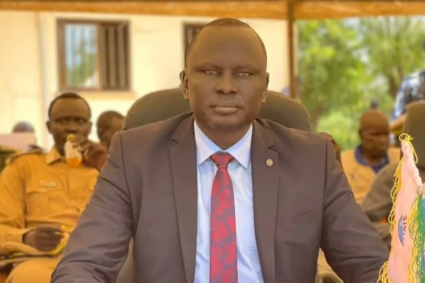
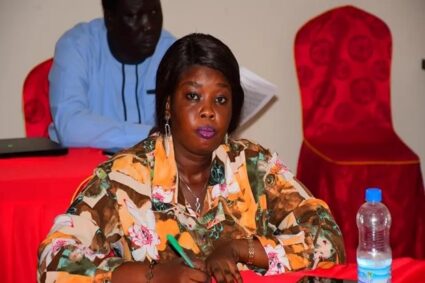
Minister of Humanitarian Affairs and Disaster Management, Hon. Albino Akol Atak, and the United Nations Humanitarian Coordinator for South Sudan, Ms. Anita Kiki (left) during a meeting. [Photo: Courtesy]
To put its best foot forward, the Ministry of Humanitarian Affairs and Disaster Management and the United Nations Mission in South Sudan convened a high-level emergency meeting of senior government officials and United Nations representativesto address the escalating humanitarian constraints affecting displaced populations across Jonglei State.
The meeting, jointly chaired by the Minister of Humanitarian Affairs and Disaster Management, Hon. Albino Akol Atak, and the United Nations Humanitarian Coordinator for South Sudan, Ms. Anita Kiki, underscored the Government’s firm commitment to addressing the humanitarian constraints affecting displaced persons in Jonglei State and reaffirmed the importance of strong collaboration between the Government and humanitarian partners.
The high-level engagement focused on the urgent crisis requiring rapid and well-coordinated intervention to alleviate suffering and restore dignity to affected communities. Participants noted that displaced populations across Jonglei State continue to face severe challenges, including shortages of food, shelter, health services, and protection. The meeting emphasized that the escalating situation demands immediate and decisive action to prevent further suffering.
During the discussions, the meeting resolved to scale up emergency humanitarian assistance, strengthen inter-agency coordination, and accelerate the delivery of life-saving services. The Government pledged to lead and support sustained humanitarian responses, with key priorities including improving humanitarian access, reinforcing protection mechanisms for civilians and aid workers, and mobilizing additional resources to meet growing needs across the state.
During the meeting, the Minister emphasized the government’s unwavering commitment to safeguarding vulnerable communities and strengthening coordinated responses with humanitarian partners. He stressed that effective leadership and cooperation are essential to address the escalating humanitarian constraints affecting displaced populations across Jonglei State.
The Minister further reiterated the “Government’s firm commitment to addressing the humanitarian constraints affecting displaced persons in Jonglei State,” highlighting that protecting displaced communities remains a national priority despite ongoing challenges.
The United Nations Humanitarian Coordinator, Ms. Anita Kiki, reaffirmed the United Nations’ continued support to the Government of South Sudan and humanitarian actors on the ground. She emphasized the need for a collective and sustained response to ensure that assistance reaches those most in need.
She highlighted “the need for unhindered humanitarian access, enhanced protection of civilians, and improved security guarantees for humanitarian workers operating in hard-to-reach and conflict-affected areas.” Her remarks reflected ongoing concerns about access limitations and security risks that continue to hinder humanitarian operations in Jonglei State.
Participants agreed that addressing the escalating humanitarian constraints requires strong coordination, political will, and adequate resources.
Meanwhile, the United Nations has cautioned officials from inflammatory rhetoric that could further spur tension, condemning statements from an unnamed senior military officer for ‘urging troops to inflict indiscriminate violence against civilians in Jonglei.’
“Inflammatory rhetoric calling for violence against civilians, including the most vulnerable, is utterly abhorrent and must stop now,” said Mr. Graham Maitland, the Officer in Charge of UNMISS.
Maitland urged the country’s leaders to put the interests of their people first by stopping the fighting and upholding their commitments under the peace agreement.