

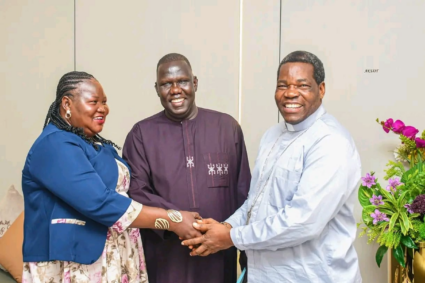

According to UNMISS head, Nicholas Haysom, if S. Sudan leaders fail to implement key electoral processes, the international community should not be blamed for failing to fund the elections
By Aguok Chok
The Special Representative of the UN Secretary-General and head of UN Mission in South Sudan (UNMISS), Nicholas Haysom said the international community will not provide any funds for elections unless South Sudan’s leaders demonstrate the political will to follow through the electoral process.
“I have to make it absolutely clear. There is not one penny that is coming for these elections if the South Sudanese don’t indicate the political will to implement this electoral program,” Haysom declared.
According to Haysom, the integration of the armed forces, and voter registration must be implemented to ensure the participation of all South Sudanese in the elections.
Haysom said if the leaders fail to implement those electoral processes, the international community should not be blamed for failing to fund the elections.
“It cannot be, as some of them say to me, that the international community wants elections and democracy more than the South Sudanese.”
He disclosed that people are closely observing the South Sudanese government’s actions to demonstrate their commitment to moving past the transition period.
However, Haysom warned that without clear timelines and deadlines for the elections, South Sudan risks further delays.
“If we follow all of the deadlines set out in the legislation, there will be no election,” Haysom remarked.
“There will be a need for another extension. Let’s be clear. We all know there can be no further extension. The people of South Sudan will be very clear about this.”
He urged all South Sudanese stakeholders to act in a spirit of compromise to finalize the electoral framework.
“I am begging all South Sudanese to make progress in finalizing the timelines and agreeing on the procedures that will make the elections possible,” Haysom said.
He was addressing a leadership forum organized by the United Nations Mission in South Sudan and its partners in Juba yesterday.
The forum aimed to finalize security sector unification, advance the permanent constitution-making process, and progress election preparations.
On a positive note, Haysom said though some progress had been made in areas such as judicial reforms and security sector reforms, the political parties had failed to make meaningful strides toward organizing the elections.
“There has been important progress on security sector reform frameworks, but there has been no progress at all in areas concerning the elections since the extension was announced,” he remarked.
He underscored that the international community’s role was not to impose standards on South Sudan but to support the implementation of the agreement.
“Our engagement is not to enforce or prescribe international standards,” Haysom said.
“It has been and will remain our assistance to South Sudanese to implement an agreement they reached amongst each other.”
The UNMISS boss stressed the importance of moving forward with the election process. “We need to make critical progress on the organization for the implementation of the elections,” he said.
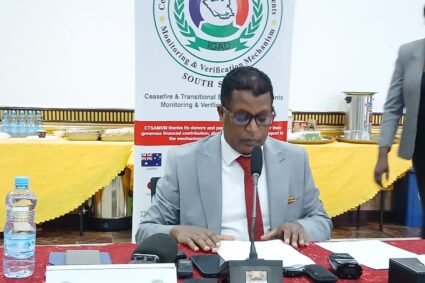
Speaking at the same forum, Amb. Berhanu Kebede, the Reconstituted Joint Monitoring and Evaluation Commission (RJMEC) Chief of Staff, reminded the Agreement Parties that the country, region and the international community have high expectations that there will be no further extension. The peace monitor encouraged the parties to ensure that all necessary milestones are realized and marked by a peaceful democratic transition at the end of the transition period.
“RJMEC encourages the Agreement Parties, stakeholders and all partners participating in this Leadership Forum to explore practical approaches to achieve the critical benchmarks that will make the post-transitional arrangement more attractive than the status quo. Such a framework will ensure peaceful democratic elections that will usher in a smooth transition and consolidate the gains of the R-ARCSS,” it said.