

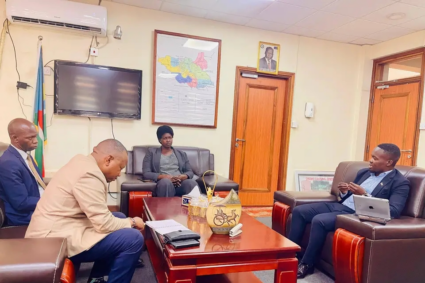




Western Equatoria State launches first planting season in Yambio

The launch was spearheaded by the state ministry of agriculture, a leading NGO and farmers, with a shared vision to reclaim Western Equatoria’s title as the breadbasket of South Sudan.
By Emmanuel Mandella
In a powerful stride toward boosting food security and economic growth, the Western Equatoria State Ministry of Agriculture, Forestry and Environment, in partnership with the Star Trust Organization (STO), has officially launched the first cultivation season of 2025 in Gangura Payam, Yambio County.
The launch, held at the Maperegizo Farmers’ Cooperative Group in Gangura, saw government officials and partners, including STO and farmers, unite in a shared vision to reclaim Western Equatoria’s title as the breadbasket of South Sudan.
Speaking at the launch, the State Minister of Agriculture, Alison Barnaba, called on local farmers to embrace the fertile opportunity of the region to double cropping seasons.
“Western Equatoria has the potential to feed this nation like we did during the liberation struggle. Our hardworking farmers must rise again and turn this land into a national food basket,” Barnaba said.
He reminded the audience of the historical significance of Nzara County during the Sudanese regime, when agricultural complexes attracted workers from across the then Sudan to cultivate and produce abundant food.
The minister encouraged farmers to invest in long-term and cash-generating crops such as teak, coffee, lemon, and banana to diversify income sources and ensure sustainability.
STO, a key partner in the initiative, applauded the efforts of the Maperegizo cooperative and pledged continued support under the Smallholder Agriculture Market Support (SAMS) Project, which aims to connect farmers to the market.
“We are committed to building farmers’ capacities in agriculture, poultry, and beekeeping. Beyond training, we are working to link local farmers to larger markets so that their harvests don’t go to waste,” said an STO representative during the event.
STO has previously offered vital support through technical training, modern farming techniques, and cooperative development in various counties of Western Equatoria.
Farmers on the ground expressed readiness to scale up food production but emphasized the need for improved infrastructure, such as roads and security.
“We have cultivated 37 fedans of groundnuts and 47 fedans of maize this season. We don’t beg for seeds or tools; we work hard. But we’re calling on the government and partners to improve road access and link us to national markets,” said Mr. John, Chairperson of the Maperegizo Cooperative.
John’s remarks reflect a strong local work ethic in his group that has been active since 2013 and continues to expand with minimal outside help.
Western Equatoria’s naturally fertile soils give it a unique edge in agriculture, but poor road networks remain a major bottleneck.
Despite this, farmers in the region, including those under the cultural leadership of the Azande Kingdom, have recorded significant harvests of maize, rice, groundnuts, watermelon, and coffee in recent years.
The involvement of the Azande Kingdom in championing agriculture adds further momentum. Last year alone, the kingdom’s farming efforts contributed significantly to local food production and supported peaceful coexistence through shared labor initiatives.
As South Sudan continues the fight for food security, successful cultivation of food in regions like Western Equatoria could be a game-changer. With support from organizations like STO and local leadership structures, the promise of linking farmers to wider markets could pave the way for food self-sufficiency and economic revival.
“Food is peace, food is wealth. When we grow more, we fight hunger, and we build our economy,” Minister Barnaba stated.