


Yambio traders blame 26 roadblocks, multiple taxes for soaring food prices

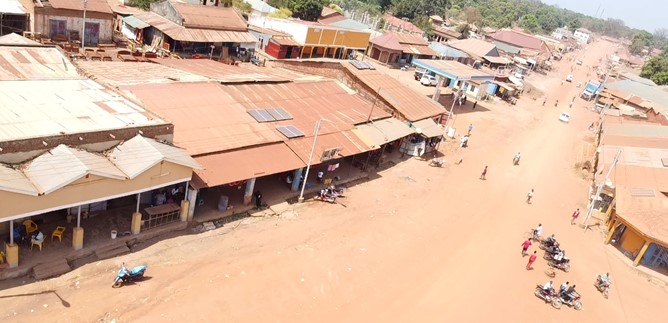
According to the area’s Chamber of Commerce, traders transporting goods from Uganda through Juba to Yambio must navigate more than 26 checkpoints, where payments are allegedly demanded without receipts.
By Emmanuel Mandella
The Chamber of Commerce in Yambio County has issued a public apology to residents over soaring commodity prices, blaming multiple road checkpoints, overlapping taxes, and a worsening cash crisis for the sharp increase in cost of food and household goods across Western Equatoria State.
In an interview with The City Review, the Chairperson of Trade and Commerce in Yambio County Mr. Victor Elisa said traders are under immense pressure due to the ‘excessive levies along the Juba–Yambio supply corridor and multiple layers of taxation imposed at county and state levels.’
“We are appealing and apologizing to our people for the high prices in Yambio Open Market. It is not our making. If the dollar was the issue, the price would have not reached this level. But the real problem is the checkpoints and the taxes we are forced to pay from Juba to Yambio,” he said.
According to the Chamber of Commerce, traders transporting goods from Uganda through Juba to Yambio must navigate more than 26 checkpoints, where payments are allegedly demanded without receipts.
“When you bring goods from Uganda through Juba, there are over 26 checkpoints before reaching Yambio. At each point, money is being collected from us. If you ask for a receipt, there is none,” Mr. Victor claimed.
He described the situation as unsustainable, arguing that these cumulative costs are eventually transferred to consumers.
“When we calculate all the losses along the road, we are left with no option but to adjust prices to recover costs,” he explained.
The Chamber is now appealing to the Western Equatoria State Government to urgently reduce the number of checkpoints and streamline taxation systems to ease the burden on traders and consumers alike.
The Chairperson further condemned what he described as taxation even within local administrative boundaries.
“If you move from one payam to another, you are taxed. From one boma to another, you are taxed. This should not happen among our own people,” he said.
He warned that internal taxation within the county is discouraging small-scale traders and disrupting the free flow of goods.
Despite the challenges, the Chamber insists that traders remain committed to serving the community, even as profits shrink.
“What we are doing now is because of the love for our people. We could have stopped business because the taxes are too much. But if we stop bringing the essential commodities, it will create more problems for the community,” he said.
He urged fellow traders not to exploit the situation by inflating prices beyond reasonable margins.
“To my fellow traders in Yambio, I call upon you to set prices that our communities can afford,” he added.
Mr. Victor also raised concerns about foreign traders dominating business operations in Yambio Open Market, estimating that about 95 percent of stalls are currently operated by non-nationals.
The Chairperson argued that the free-market policy, which allows anyone to set prices freely, has contributed to inconsistencies and price disparities.
“The law says South Sudan is a free market where anyone can fix prices as they wish. This has spoiled everything in our market. We are calling on the government to review and amend this law and set standard price guidelines so that the market can operate fairly,” he stated.
Price regulation
He believes regulated pricing could create stability and protect both traders and consumers.
Beyond taxation and roadblocks, the Chamber cited the ongoing cash-flow crisis as another major factor affecting trade in Yambio County.
The Chairperson noted that many civil servants who form a significant customer base have gone months without salaries, reducing purchasing power in the market.
“Government and civil servants are our bosses. But they have stayed for some time without receiving their salaries. Now there is no money circulating in the market,” he said.
He described a bleak trading environment where traders can open their shops in the morning and close in the evening without making a single sale, as they called on the national government to prioritize payment of civil servants’ salaries to restore economic activity.
“You go to the bank and you see figures on the account, but there is no cash. Yet authorities still come to collect taxes, if salaries are paid, money will circulate, and the market will revive,” he emphasized.
Despite the challenges, the Chamber acknowledged ongoing efforts by Yambio Municipal authorities to reorganize the open market to meet modern standards, including proper arrangement of salons, restaurants, and food vendors.
The Chairperson expressed hope that dialogue between traders and authorities would yield reforms to ease business conditions and stabilize prices.
“We are hoping that one day things will change,” he said.
Residents in Yambio have recently complained about rising prices of basic commodities such as sugar, soap, salt, and cooking oil. The Chamber insists that unless structural issues along the supply chain are addressed, prices may remain volatile.
Locals argue that reducing informal taxation and improving road governance could significantly lower the cost of living in Western Equatoria State.
For now, traders say they are balancing between survival and service, absorbing some costs while transferring others to consumers in order to keep shelves stocked.
As the economic pressure mounts, the Chamber’s message remains clear: without reducing checkpoints, harmonizing taxes, and restoring cash flow through salary payments, the burden will continue to fall on ordinary citizens in Yambio and beyond.
Utilities
“If you move from one payam to another, you are taxed. From one boma to another, you are taxed. This should not happen among our own people,” Chairperson of Trade and Commerce in Yambio County, Mr. Victor Elisa said.