




Economists urged to explain Kiir’s 100 per cent salary raise

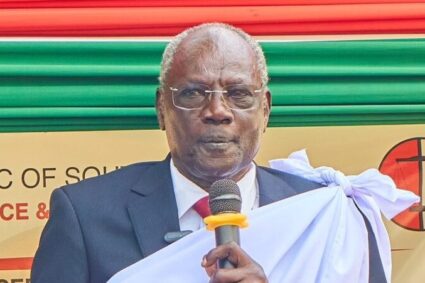
The head of the communication committee in the Reconstituted Transitional National Legislative (R-TNLA) has asked the economists to assist President Salva Kiir in translating the 100 per cent salary increment to the civil servants.
According to John Agany Deng, the people who pay the wages of civil servants misconstrued the 100 per cent pay increment for civil servants.
He said that, given the country’s current market conditions, it makes no difference whether a civil servant is paid SSP 1,500 or SSP 3,000 per month.
On Tuesday, Agany was asked if he believed the parliament’s debate on the Emolument Act—which governs the payment of constitutional post holders— would also help to solve the issue of civil servants’ salaries.
“Our economists should have sat down and asked themselves what the 100 per cent payment for civil servants means. I don’t know if our people who are paying got this message because if you say [it is] 100 per cent, and I am receiving SSP 1,500. This is simple arithmetic [and it is] having SSP 3,000, ” he explained.
“So what do you expect if I am given that 100 per cent, and it amounts to SSP 3,000. What would you do with the SSP 3,000? Our economist should capture it and translate it into [another] language, not the President’s; the President is not an economist,” stressed.
He urged the economist to take a seat and carry out a thorough analysis of the president’s remark that civil servants should be paid 100 per cent of their salaries before the parliament passes any law without positive proceeding.
“I have been an MP for almost 11 or 12 years, making a lot of laws. The laws that we are making here are a hundred plus laws, but when you go to the market do you see them? this beautiful law we are passing,” he asked.
He reiterated that the economists are the ones who can define the ABC’s of the salary increment and inform the government on how to deal with the current economic condition.
He said if the government fails to pay its employees, then it is its own fault.
The lawmaker said the problem with most South Sudanese leaders is that they often do not follow through on what they say. He emphasised the importance of having policies in place.
Several government employees who spoke to The City Review in response to the president’s announcement of 100 per cent expressed discontent with the new pay structure.
They argued that the money was not enough to meet their families’ basic needs.
They said they expected to have a reasonable raise, but only to be disappointed when they received less than what they needed to support their families.