


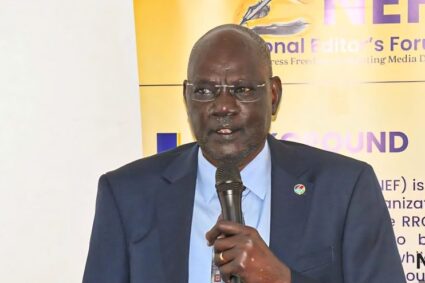



Finance Minister signs Public Procurement Regulations into Law

Dr. Marial Dongrin Ater, signed the Public Procurement and Disposal of Assets Regulations into law. But could this put lock to key to public finance manage and stamp discipline?
By Emmanuel Mandella
South Sudan’s Minister of Finance and Planning, Dr. Marial Dongrin Ater, signed the Public Procurement and Disposal of Assets Regulations into law on Thursday. The legislation marks a crucial development in the government’s efforts to strengthen public finance management and improve transparency in resource allocation.
“This is one of the key 11 areas the government has been working on. Today is a great day as we conclude the legal framework for the operationalization of Public Procurement and Disposal of Assets in South Sudan,” Minister Dongrin announced at the signing ceremony.
“The people of South Sudan expect the country’s resources to be spent transparently, with no wastage. I assure you, we have come a long way, and the government is committed to helping you discharge this important mandate.”
The newly enacted regulation is part of broader reforms in public finance management, addressing the country’s history of mismanagement and inefficient use of resources. By putting clear guidelines in place for procurement and asset disposal, the government aims to close loopholes that have allowed corruption and misallocation of funds to thrive.
Ayii Bol Akol, Chairperson of the Board of Directors of the Public Procurement and Disposal of Assets Authority (PPDAA), highlighted the long journey toward finalizing the regulation.
“This process began in 2021, with a validation workshop in 2022, and the formation of our board in 2023. Signing this regulation signifies the start of the procurement reform agenda,” he said. “Despite limited resources, we are committed to achieving value for money.”
The signing of the regulation is also seen as a crucial step toward fostering better governance, accountability, and efficiency in public finance. Juvenal Nzambimana, Acting Country Manager of the World Bank South Sudan Office, called the move a “milestone” for the country.
“The operationalization of this regulation is crucial for improving public finance management, governance, transparency, and accountability,” Nzambimana said. “South Sudan can now look forward to enhancing efficiency and integrity in its procurement processes.”
However, the successful implementation of the regulations will require widespread public awareness. Minister Dongrin emphasized the need for the PPDAA, the Ministry of Finance, and other government bodies to actively promote and educate the public on the new processes. “We expect the entire government to create public awareness about the processes so that we are guided by these regulations,” he stated.
For ordinary South Sudanese, this law promises a future where public funds are used more effectively, reducing the rampant corruption that has plagued the country for years. With more transparent procurement practices, the government can redirect resources to crucial areas like healthcare, education, and infrastructure development, ultimately improving service delivery and fostering trust between the government and its citizens.
The regulation also stands to boost investor confidence in South Sudan, as transparent procurement processes are critical in ensuring that the country’s resources are used efficiently. This could, in turn, contribute to the country’s economic growth, providing more job opportunities and stimulating local industries.
Nzambimana stressed the importance of disseminating information on the new regulation to ensure broad compliance and understanding. “The PPDA Act and its regulations must be widely disseminated so that all users are aware and able to comply. This will be key in achieving the full benefits of these reforms,” he said.
While challenges remain, the signing of the Public Procurement Regulations signals a hopeful step toward a more accountable and transparent financial system in South Sudan. The government’s commitment to these reforms offers a pathway toward better governance, improved public services, and a brighter future for the nation’s citizens.
“We expect the entire government to create public awareness about the processes so that we are guided by these regulations.” – Minister of Finance and Planning, Dr. Marial Dongrin.