


Transitional period risks another extension, says Dr. Yer

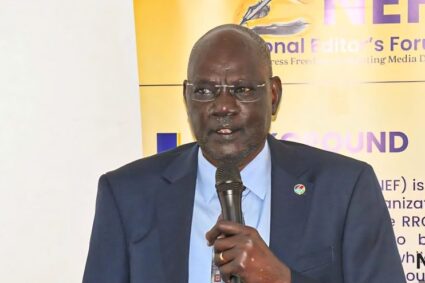
Dr. Riang Yer Zuor, Chairperson of the NCRC, outlined the critical challenges facing the process, emphasizing that funding delays could derail the progress made
By Emmanuel Mandella
The National Constitutional Review Commission (NCRC) said the transitional period could risk another extension should the government fail to provide timely funding for the constitution-making process.
Addressing the 8th Governors’ Forum in Juba last week, Dr. Riang Yer Zuor, Chairperson of the NCRC, outlined the critical challenges facing the process, emphasizing that funding delays could derail the progress made so far.
“Determining a time frame is one thing, but supporting the activities within that time frame is entirely another,” Dr. Zuor cautioned.
The NCRC initially proposed an 18-month timeline for the constitutional process, which hinges on immediate and uninterrupted funding.
However, the government has only disbursed $800,000 of the $43 million budget needed for activities such as civic education, public consultations, and drafting.
“Without the timely release of funds, we risk wasting significant portions of the extended period,” Dr. Zuor warned. “This could leave the country with two undesirable options: either another extension or elections that lack democratic integrity.”
Despite financial constraints, the NCRC has completed preparatory activities, including developing operational manuals, training staff, and establishing infrastructure.
However, the critical phase of civic engagement and public consultations remains stalled.
“If resources allow, we aim to launch civic education before year-end and conduct nationwide consultations in early 2025. These campaigns will extend across all ten states, three administrative areas, and even diaspora communities,” Dr. Zuor added.
Dr. Zuor warned that further delays could compromise the quality of South Sudan’s first elections, risking a repeat of past conflicts.
“The thought of elections without a new constitution is dangerous. Such elections will not be free, fair, or peaceful, and the people of South Sudan cannot afford a return to war.”
The revitalized peace agreement mandates a people-driven permanent constitution before elections, positioning it as the cornerstone of South Sudan’s democratic future.
The 8th Governors’ Forum echoed the NCRC’s appeal, urging the national government to prioritize funding for the constitution-making process.
“The government must act swiftly to avoid further delays that could jeopardize the peace agreement and democratic transition,” the forum’s Resolution 33 stated.
South Sudan’s elections were initially slated for December 2024, but a two-year extension was granted to finalize key transitional tasks. With the December 2026 elections looming, the urgency for financial and political commitment has never been greater.
As Dr. Zuor concluded, “The NCRC is ready to proceed, but the government must match its readiness with the necessary resources. The stakes are too high to falter.”
“Determining a time frame is one thing, but supporting the activities within that time frame is entirely another,” Dr. Riang Yer Zuor, Chairperson of the NCRC.