



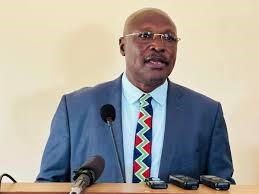


Lobong directs commissioners to mobilize resources to pay civil servants

According to Lobong, local resourcemobilization was not previously prioritized before the cut-off of the oil flow due to the war in the neighboring Sudan, but now is a must do
By Theophilous Ochang
Eastern Equatoria State Governor, Louis Lobong, has tasked the county commissioners to mobilize resources to pay civil servants salaries.
The governor made this statement while meeting eight County commissioners and one chief administrator in Torit on Tuesday.
Lobong told the commissioners that it is the sole responsibility of the state government at all levels to pay the civil servants’ salaries.
“It’s our obligation as the government at the state level and also it’s your obligation at your county level to pay the civil servants salary because those institutions, the reason why they were created or they approved to be a county, to be a municipal council, is because we expressed and we wrote that we are capable of that. We have resources and we are capable of raising our resources,” he said.
According to Lobong, local resourcemobilization was not previously prioritized before the cut-off of the oil flow due to the war in the neighboring Sudan.
“All these times we did not look into this because there was money flowing coming from the oil. The realities now is happening and therefore, we must go back to what we have,” Lobong said.
He directed the county commissioners to focus on their workforce to ensure a limited number of staff that they can manage to pay at the end of every month.
“This also will enable you in your governments to understand your workforce and identify the number you can manage to pay conveniently. I know there are so many ghost employees that are being paid creating a crowded staff.”
“I am directing the ministry of finance and the agencies of the revenue to sensitize, to help you, train you, and be able to identify you some of the other taxes or other sources of revenue you might not been collecting and start to do so to meet your obligation,” Governor Lobong said.
Peter Lokuju, the state minister of finance reminded the county commissioners that there has been no salaries from the national government for sometime for the state public servants.
“Nothing is coming from national government. What we can do as a state is to create avenues for collecting more revenues and making resources,” he said.
He said the state remained vulnerable as their office on the Nimule border was shut down by the national government.
“The state experiences challenges with the closure of its office at the Nimule Border. I am sure they will close Nadapal and Seretenya,” he said.
Meanwhile, David Naye, the Kapoeta North County commissioner expressed his dissatisfaction over the initiative, saying it would not work with his county, which has fewer sources of revenue.
“I think it will be very hard for a county like Kapoeta North. It may be possible with others somehow, but others like Kapoeta North may not be able to make it so fast because when you look at the type of the market we have, it is a mini market, a very small one if you can count they will not reach even 20 or 30 traders,” the commissioner said, and added:
“If you send people to collect tax from there it will not reach SSP 200,000 or SSP 500,000, which is very difficult. Looking at the people and their livelihood, it is very difficult to tax them,” he added.
The meeting between the state governor and the county commissioners was part of the implementation of the resolutions obtained from the recently concluded Governors’ forum in Juba.