


The civil society activist shared various reasons as to why the new alliance came to life at such a critical juncture, when the new phase of the Kenya-mediated peace talks is set for resumption
By James Chatim
On Thursday, the South Sudan Opposition Movement Alliance (SSOMA), which has been in talks with the government at the Tumaini Initiative in Nairobi, renamed to the United People’s Alliance (UPA).
And to put stamp to paper, named the leaders of the UPA alliance, with Pagan Amum, as chairperson, Gen. Paul Malong Awan, as First Deputy Chairperson, Gen. Mario Loku Thomas, Second Deputy Chairperson, Gen. Stephen Buay Rolnyang, Chief of General Staff of Unified Forces, Hon. Lual Dau Marach, Secretary-General, Dr. Matur Gorjok Gak, Member and Gen. Henry Oyai Nyago as member.
The move came at a critical point, when the talks between the government and the holdout groups are set to resume, after taking a break for the festivities, which pegged the question: What could have necessitated this decision at this point in time?
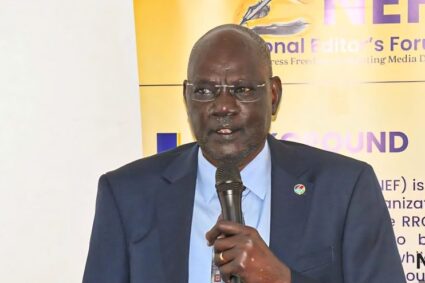
According to Edmund Yakani, a civil society activist in South Sudan, the opposition’s goal in forming the new coalition under the name “United People’s Alliance” is to pressure the government to accept the peace process in Nairobi and rally with it to its conclusion.
Yakani stated that the alliance is a strategy to create new pressure on the government within the framework of the negotiations in Nairobi.
“In my opinion, the alliance is a strategy to create new pressure on the government within the framework of the negotiations to reach a peaceful political solution to the problems,” he said.
Yakani also considered that the formation of the new alliance is read within the framework that those under it are looking for a new body, larger than the old alliance, South Sudan Opposition Movement Alliance (SSOMA).
“Especially, since there is confusion about the fact that the SOMA alliance led by Pagan Amum and Paul Malong is not the original alliance, there is talk that the alliance is still under the leadership of General Thomas Cirillo, who refused to join the Tumaini talks,” he said.
Yakani believes that one of the motives for establishing this new alliance is that its leadership, represented by General Pagan Amum, and the rest of the leadership, are looking for a more disciplined organizational arrangement, following the split of the SSOMA alliance into two groups, one of which is participating in Tumaini talks, and the other, not party to the negotiations.
“It is worth noting that the SSOMA alliance itself did not have organized political and military structures, as they do now in the new alliance,” he said.
It is expected that the Tumaini talks will resume in the coming days, according to sources from Nairobi.
However, the newly formed United People’s Alliance has already established a leadership structure called the Interim National Leadership Committee.
Accordingly, General Pagan Amum Okech, of the Real Sudan People’s Liberation Movement (Real-SPLM), is the Chairman, General Paul Malong Awan of the South Sudan United Front/Army (SSUF/A), as First Vice Chairman, General Mario Loko Thomas of the (NAS) as Second Vice Chairman, and General Stephen Buay, as the Chief of General Staff of the Unified Forces of the Alliance.
“We, the opposition parties currently engaged in peace negotiations with the Government of the Republic of South Sudan at the Tumaini Initiative, under the auspices and mediation of the Government of the Republic of Kenya, hereby declare the formation of the United People’s Alliance (UPA) on this historic day of January 9, 2025 to commemorate the signing of the Comprehensive Peace Agreement (CPA) on January 9, 2005, and the exercise of the right to self-determination by the people of South Sudan to finally achieve independence on July 9, 2011,” a statement from the new alliance read, adding:
“The alliance calls on all the people of South Sudan, other opposition parties and stakeholders to unite and intensify the struggle for peace and good governance using all possible means to end the immense suffering of our people.”
“It is worth noting that the SSOMA alliance itself did not have organized political and military structures, as they do now in the new alliance,” Edmund Yakani, renowned civil society activist.