


Government proposes six action points to strengthen R-ARCSS

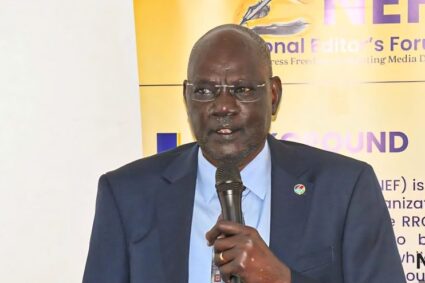
Dr. Elia Lomuro, the Minister of Cabinet Affairs and Secretary of the High-Level Standing Committee on 2018 peace deal said the committee wants to ensure the agreement moves the country forward.
By James Chatim
The government has put in place six strategic action points to reinvigorate the implementation of the Revitalized Agreement on the Resolution of the Conflict in South Sudan (R-ARCSS).
Speaking at a press conference in Juba on Saturday, Dr. Martin Elia Lomuro, the Minister of Cabinet Affairs and Secretary of the High-Level Standing Committee on 2018 peace deal said that the committee is to ensure the agreement moves the country forward.
According to Dr. Lomuro, the first action point is the Leadership Presentation. Here, the High Leven Committee will determine the legitimate SPLM-IO faction and submit candidate nominations for key government structures.
Second is the Reconstitution of Agreement Structure, where recognized parties will nominate representatives to national commissions and implementation mechanisms, with appointments made by the president.
Third, the electoral budget: The High-Level Standing Committee will meet with the ministry of Finance to adjust the budgets for electoral institutions.
Fourth, is the revised electoral timelines, HLSC to coordinate with the National Transitional Committee to establish a new, realistic electoral roadmap to complete pending provisions and conduct credible elections.
Fifth, the Security Sector Reform, which will see the government expedite unification of forces and integration into a cohesive national army and security organs. And finally, the sixth action plan, Roadmap part two, where the draft a revised implementation roadmap, remove completed provisions and focus on pending tasks.
“We want to establish a democratic system and move towards elections, because we believe it is only through elections that the country will have stability,” Dr. Lomuro said.
An all-inclusive roadmap
Meanwhile, in an exclusive interview with The City Review on Sunday, Edmund Yakani, the Executive Director of Community Empowerment for Progress Organization (CEPO) stated that the roadmap should not leave any element of the R-ARCSS out.
Yakani said the development of the second road map should be in an inclusive manner with all chapters of agreement being considered.
He added that the divisions within the SPLM-IO party have no effect for the upcoming election of 2026 saying that what is required is legitimacy.
“Roadmap shouldn’t leave any element of the access out. The roadmap should consider all the elements in terms of chapters, because leaving out some chapters and focusing on others is actually doing a selective way of peace implementation,” said Yakani.
“I urge that the development of the second roadmap should be in an inclusive manner with all chapters of agreement being considered. Topmost issue should be the unification of forces. After the question of forces, we move to the transitional justice. After transitional justice, we moved to financial reforms. After the financial reforms, what we need to see coming on the ground is really having an adequate and timely funding of this process. Some of the reforms will come later after we have elected government. So, that’s really leaving our transitional justice and consolidating process,” he stated.
“To be honest with you, the dictions that internal are within the IO. What we need to do is legitimacy. And my concern is that the Political Parties Council has the bureaucracy to define eligibility of political parties for elections. But also, I will appeal to the (SPLM) IO not to let the sharp appetite for power destabilize their institutional setup,” said Yakani.
“I urge that the development of the second roadmap should be in an inclusive manner with all chapters of agreement being considered,” Edmund Yakani, civil society member.