



Birth defects, climate crisis: glaring mishaps of oil-producing areas

An oil-producing area under a normal circumstance should rank among some of the most developed cities or towns within that particular country. But this is not the case with South Sudan.
The uncontrolled oil pollution is increasingly causing ‘harms and unbearable damages’ on the local inhabitants of the producing areas.
Several animals and people in
Rubkona and Koch Counties of Unity State have been reportedly affected as the areas continued to experience deformed births in both humans and animals.
Last year late, authorities of Unity State reported that over 400 cows and 300 goats had died in Rubkona County after sipping water contaminated by oil spills.
The current statistic indicates that over 100,000 cows have so far died as the result of oil pollution, according to the Unity State’s acting Minister of Health Stephen Tot Chieng
Women in the area have also continued to give birth to deformed children.
Gatluak Gai, a resident of Rubkona County, said the situation was deteriorating and it is beyond description by now.
“It is really like a curse to us as we speak. The six oil field blocks are underwater. The situation in the oil areas is very worse to the communities,” he explained.
The inhabitant confirmed that animals were severely affected as they continue to drink polluted water.
John Kuol Mayen, another Bentiu resident, said the areas affected include Tumur and Kaikang.
“It started happening in October 2017. But it is now triggering a lot of issues all the cattle are dying,” he said.
“The green grasses are dying off. They even dry off during the rainy season. Don’t mention the animals. The water is already mixed with the oil, that’s also a problem,” Mayen stressed.
He blamed the government for doing enough to alleviate the suffering of the communities in the oil-producing states.
“The government is not serious to take care of it. It started a long time ago but they are not bothering to intervene,” Mayen added.
Related incident
Earlier October 2020, the Unity State authorities revealed that the counties were affected by the floods caused by heavy rains including the main oil-producing Melut County, Upper Nile State.
The locals and authorities had feared the flood water may spread anytime and carry petroleum waste into the White Nile.
The Unity State authorities also raised similar concerns claiming that the oilfield of Thar-Jath was then inaccessible and most of the pipelines were underwater
The failed promise
On October 24, 2021, South Sudan’s Ministry of Environment and Forestry promised to address the rising environmental pollution concerns in the oilfields mounted by the floods.
The government’s pledge came after local authorities in the oil-producing states raised several concerns about possible ecological contamination as most areas were submerged by the floods.
Responding to the fears in the oilfields last year, South Sudan’s government through the Undersecretary in the Ministry of Environment Africano Bartel said the government was working with relevant institutions to design possible means to address the matter.
“We are in the process of commissioning a company to conduct an environmental audit, but at the time, if there is an oil spill, it has to be addressed immediately,” said Africano.
Current situation
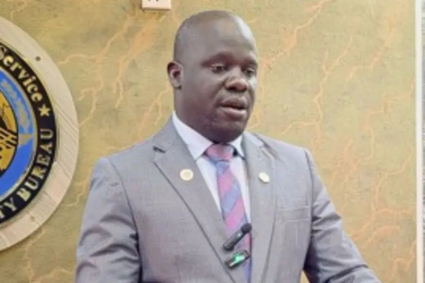
Stephen Tot Chieng, the Unity State acting Minister of Health admitted the area has been experiencing environmental pollution since the state got submerged in the water last year.
He said two cases of children born with deformities have been recorded.
“There was a child born and the head was very big; unfortunately, the head got exploited some few minutes after the birth. This particular case occurred in October last year,” he explained.
According to the state official, the child passed on at Rubkona health facility
Mr. Chieng revealed that the arising cases of animals dying are being received from the Northern part of Rubkona County.
“A lot of cows are dying and we are not sure whether this is the water diseases or oil fields pollution,” he said.
Up to now, more than 100,000 cows and goats have died so far, adding “everywhere you find goats, cows are dying. Every time, they are dying,” he stressed.
The state’s minister said some of the counties were ‘hard to reach areas due to the tragedy.
Health concerns
Cases ofsnake bites and water-borne diseases have also been on the rise in the counties, with Panyijar and Mayom Counties taking lead.
“It is difficult now, and we are also receiving a budget cut from health partners, it is affecting the state hospital, a lot of challenges,” Chieng said
Health perspective
Dr. Thuou Loi, a senior health professional who is the former Spokesperson of the National Ministry of Health said though the impact of the oil drilling could inflict consequences on the environment globally, he said the country was supposed to investigate the situation.
“It is not good for the health of the people. We need to establish the cause, if the cause is directly related to the oil exploration, then some measures should be taken to avoid that in the nearby feature,” he said.
“They can always be mitigated by you know putting in place the measures to reduce or minimize the impact and the consequences of oil exploration and drilling,” Dr. Thuou said.
According to him, in-depth studies need to be established to curb the tragedy.
Experts’ viewpoint
Several environmentalists argued that the oil sector in South Sudan has left a landscape pocked with hundreds of open waste pits, the water, and soil contaminated with toxic chemicals and heavy metals including mercury, manganese, and arsenic.
Nhial Tiitmamer, the Director of the Environmental and Natural Resources Program at Juba-based Sudd Institute research institute affirmed last year that there have been huge negative impacts of the oil wastes on the environment.
“I am speaking from the perspective of what is already known about the environmental impact of petroleum refineries. Otherwise, there has been a huge negative impact of the oil wastes on the environment and the health of the people,” he explained.
Though the previous reports exposed the oil spills effects, nothing was done by the authorities to stop the cause.
But Mr. Tiitmamer said then “If the refinery is not well managed, it can cause a lot of negative environmental impact especially wastes and another compound that can affect the quality of the environment and the health of the people” Nhial stated.
Mitigation measures
The environmental activist called on the government to conduct an environmental impact assessment on the current oil crisis.
Most of the environmental impact assessments in South Sudan are not subjected to public review, though the law requires that they should be to ensure qualities are in line with international best practices.