



Bishop Hiiboro declares Nzara County the cradle of unity, nationhood in S. Sudan

By Emmanuel Mandella
The Bishop of the Catholic Diocese of Tombura Yambio, Barani Eduardo Hiiboro Kussala has declared Nzara City the origin of South Sudan’s unity, resistance, and nationhood, describing the town as a living symbol of what the country once achieved and what it can still become.
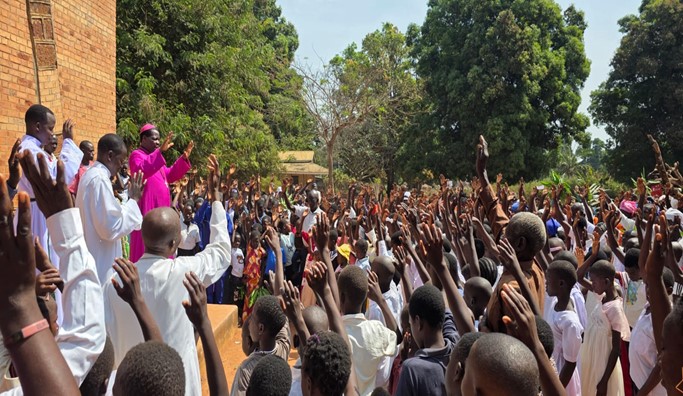
Speaking during a pastoral visit to Nakindo Sene Catholic Parish in Nzara, Bishop Kussala told worshipers that Nzara is not merely another town in Western Equatoria State, but the foundation upon which South Sudan’s harmony, industrial ambition, and political resistance were built.
“Nzara is not just a city. Nzara is a beginning. This is where peace all began,” Bishop Kussala said.
The Bishop emphasized that Nzara remains one of the few places in South Sudan where all 64 ethnic communities coexist peacefully, calling it a rare example of practical unity in a country still struggling with divisions along ethnic and political lines.
“In Nzara, people did not wait for peace agreements to live together, they practiced unity naturally, through daily life, work, and shared purpose,” he said.
He described the town as a miniature version of the nation itself, famously likening it to the “United States of South Sudan”, where diversity has historically been a strength rather than a fault line.
Nzara’s industrial history
Bishop Kussala also reminded residents of Nzara’s once-prominent role as an industrial powerhouse under the 1923 Azande Scheme, when the town ranked first in industrial production in the then Southern Region.
Nzara, he said, was a center for cotton and textile production, sugar processing, soap and oil manufacturing, and large-scale agriculture and fruit production.
“This town proved nearly a century ago that discipline, productivity, and development are possible in South Sudan. Nzara showed that Africans could manage industry, labor, and progress with excellence,” the Bishop noted.
He lamented that this legacy has been largely forgotten, urging leaders and citizens alike to draw lessons from Nzara’s past as the country seeks economic recovery.
Beyond economics, Bishop Kussala placed Nzara at the heart of South Sudan’s liberation story, describing it as the cradle of political resistance against marginalization and injustice.
He recalled that the first organized southern resistance strike occurred in Nzara, marked by open defiance that later inspired the historic Torit Military Mutiny, which ignited the Anyanya liberation struggle.
“One month after resistance began here, Torit followed,” he said. “From that fire emerged Anyanya, later the SPLM, and finally the Republic of South Sudan.”
According to the Bishop, Nzara did not simply witness history it actively shaped it.
“Nzara did not stand by as history passed. Nzara made history,” he declared.
The Bishop linked Nzara’s historical importance to its strong faith foundations, praising Nakindo Sene Catholic Parish, which he affectionately calls the “Small Vatican,” for its role in shaping moral leadership and social cohesion.
From Nakindo Sene Parish alone, six full parishes and one quasi-parish have been established, making it one of the most influential faith centers in the region.
“The Church grew here because the people believed,” Bishop Kussala said. “Faith and nationhood walked together in Nzara.”
He revealed that the Catholic Diocese of Tombura–Yambio invests over two million US dollars annually in Nzara through education, health, agriculture, and social development projects an investment he said reflects the town’s historic and strategic value.
Bishop Kussala urged the people of Nzara, especially the youth, to protect the city’s legacy and carry it forward responsibly.
“You are not ordinary citizens, you are guardians of a national heritage. Your history demands discipline, unity, and hard work,” he told them.