



Ceasefire body warns South Sudan peace deal under “significant strain”


By Binia Elizabeth and James Chatim
The ceasefire monitoring body overseeing South Sudan’s peace agreement has warned that the country’s fragile peace process is under “significant strain,” citing escalating violence, restricted access for monitors and severe resource constraints as key challenges.
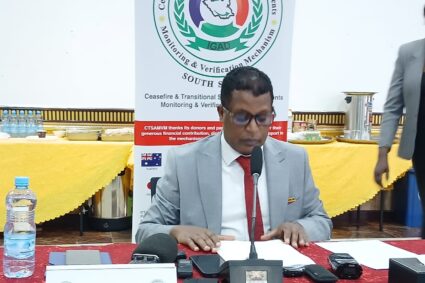
Meeting after a prolonged hiatus, the Chairperson of the Ceasefire and Transitional Security Arrangements Monitoring and Verification Mechanism (CTSAMVM), Maj. Gen. Teshome Anagawe Ayana, alongside representatives and officials from IGAD and members of the diplomatic community gathered to review various violations of the 2018 Revitalized Agreement on the Resolution of the Conflict in the Republic of South Sudan (R-ARCSS).
The session opened with prayers and remarks emphasizing unity and the urgency of restoring momentum to the peace process. CTSAMVM chairman stated that the meeting came at an “exceptional moment,” following months of deteriorating security conditions across Upper Nile, Unity, Western Bahr el Ghazal and Jonglei states.
“The peace process is under significant strain,” Teshome said. “Agreements are upheld not by signatures but through consistent compliance. Protection of civilians must be unconditional.”
CTSAMVM officials pointed to the March 2025 violence in Nasir, Upper Nile State, as a critical turning point. Since then, they said, direct hostilities between signatory parties have increased, with reports of armed clashes between the South Sudan People’s Defence Forces (SSPDF) and opposition’s SPLA IO forces, shifting territorial control and alleged aerial bombardments affecting civilian areas.
If verified, such attacks could constitute serious violations of the permanent ceasefire and international humanitarian law, CTSAMVM warned.
The monitoring body also documented ambushes, abductions, looting, attacks on markets and alleged extrajudicial killings, as well as rising incidents of sexual and gender-based violence. Disruptions along key river transport corridors have further compounded economic hardship and food insecurity.
Between August 2025 and January 2026 alone, CTSAMVM recorded 407 alleged violations. However, the body acknowledged that its ability to verify incidents has been hampered by insecurity, denial of access and internal disputes within signatory parties.
The mission has also undergone major restructuring due to dwindling donor funding. As of January 2026, monitoring teams were reduced from six to three, with field offices in Bentiu and Yambio closed. Geographic coverage has been consolidated under three main bases in Juba, Malakal and Wau.
Despite reduced capacity, officials said 25 priority verification tasks are being pursued, contingent on security guarantees and unrestricted access.
CTSAMVM further expressed concern that the Joint Military Ceasefire Commission had not approved several monthly activity plans in 2025 and early 2026, limiting predictable implementation of its mandate.
In his closing remarks, the chairperson called for renewed political will and accelerated implementation of transitional security arrangements, including disarmament, demobilization and reintegration (DDR), deployment of unified forces and strengthened accountability mechanisms.
“The durability of the agreement ultimately depends on accelerated implementation, Let us recommit not only in principle but in practice,” he stated.