

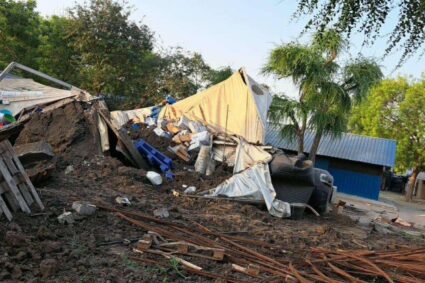




CES government reaffirms order to evacuate settlers from graveyards

For the umpteenth time, the Central Equatoria State government has resolved to evict displaced families from Juba graveyards; but the rallying question is on the need for a proper relocation plan
By Anak Dut
For more than a decade, thousands of displaced families in Juba have known no other home than the cemeteries.
Following the outbreak of the 2013 conflict, these families were forced to seek refuge in the capital Juba. With no capital to buy land, nor shoulders to lean on, these families found solace in the secret shantytowns.
And now, for the umpteenth time, the Central Equatoria State government is asking them to leave, in a bid to decongest these areas and give room for proper burial processes.
On Thursday, during a State Council of Ministers meeting chaired by Governor Rabi Mujung Emmanuel, the state government made a resolution to evict those sheltering at the graveyards across Juba County.
The cabinet expressed concerns about the impact the influx of dipalced families in these area has on proper burial processes, families’ ability to visit the graves of their relatives and the potential for criminal activities to take place in these areas.
The State Acting Minister of Information and Communication, Jacob Aligo Lo-Lado, said the Cabinet tasked the Commissioner of Juba County and the Mayor of Juba City Council with overseeing the relocation of people from all graveyards to preserve their original purpose.
The Minister of Housing, Land and Public Utilities was also directed to include graveyards in land demarcation processes to address the issue of limited burial space.
”We have received complaints over insecurity, especially in Moroyok graveyard located west of Juba near the former Protection of Civilian camp and in the Jebel Lemon graveyard, where some individuals have occupied these graveyards and occasionally threaten people going for burials,” said Aligo.
The Commissioner of Juba County is directed to address these concerns and ensure the safety of mourners.
The Mayor of Juba City Council was also tasked with clearing the Hai Malakal graveyard and ensuring it is fenced to preserve the dignity of those buried there,” he added.
Cycles of eviction notices
Surprisingly, this is not the first time such an order is being issued by the state government and allied authorities.
In 2022, Juba City Council sent out an eviction notice to people residing in various cemeteries in the city to leave or they get evicted by force.
Then City Mayor, Michael Lado Thomas Allah-Jabu said the plan had been set to decongest the graveyards, especially in Hai Malakal Cemetery, where more than 3000 refugees were residing.
“Hai Malakal cemetery is full of people not less than 3,000 in number and some of them are living in the tombs. They tend not to fear the souls of the dead. So, that is something shameful and it is already in our plan. We are going to work on it,” he said.
“We going to remove those people but we are not going to tell you when we are going to do it because we are still planning.”
The same eviction call was repeated in April 2024, when the Central Equatoria State government evicted dozens of families residing at the Munuki graveyard, demolishing their makeshift shelters.
Mawa Moses, who headed the demolition committee at the time and also served as the state minister for Roads and Bridges, said the eviction would continue in other graveyards in the city.
However, despite the talk, no bankable relocation plan has been issued, nor a requisite location for the would-be evicted families.
Residents in the cemeteries say they feel abandoned, an assertion loudly echoed by civil society organizations like the Community Empowerment for Progress Organizations (CEPO), headed by Edmund Yakani.
According to CEPO, the government should do more for its people by providing land to live on that is affordable or free.