






With Yaba Odongo Odoyo
Is this a regional political gimmick, reality dawn or just testing of the waters and the depths of stability at the expense of the much needed development in the East Africa Community (EAC)?
If so, then it may signal the collapse of one of the currently strongest economic blocs in Africa- the East African Community (EAC).
If the recent reported social media pronouncement by Uganda’s military chief Gen. Muhoozi Kainerugaba threatening to cancel the 272-kilometre Malaba-Kampala SGR line contracted to Turkish firm Yapi Merkezi is anything to go by, then the move could signal past memories that threatened the regional bloc.
Pundits and critics alike smell the danger of such utterance in the corridors of the regional bloc’s socio-political integration.
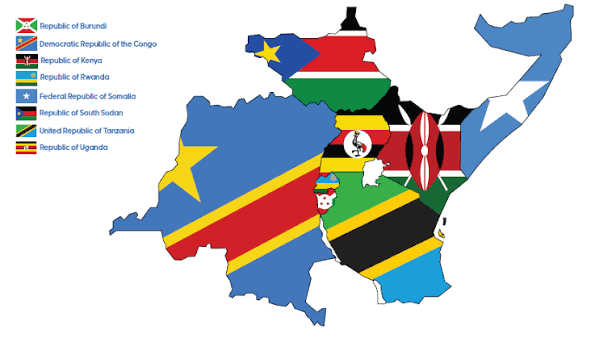
The Community was founded in 1967 by Kenya, Tanzania, and Uganda but officially collapsed in 1977 due to economic inequalities, political friction, and clashing ideologies. Currently, it appears there is some silent war between Kenya and Tanzania over the control of the region, which has a membership of eight countries membership, including Burundi (joined July 2007), Democratic Republic of the Congo (joined July 2022), Kenya (founding member, July 2000), Rwanda (joined July 2007),Somalia (joined March 2024),South Sudan (joined August 2016),Tanzania (founding member, July 2000) and
Uganda (founding member, July 2000).
President Samia Suluhu Hassan of Tanzania visited Uganda recently and signed a framework agreement for the extension of the SGR. The extension will connect Tanzania to DRC through Uganda and it has already been signed in Entebbe.
After that visit, Gen Muhoozi Kainerugaba cancelled Uganda’s Malaba-Kampala SGR. He announced that the contract with Turkish firm Yapi Merkezi had been canceled indefinitely. The two actions by both Tanzania and Uganda are indicators of mistrust on the survival of EAC with sector players questioning the rationale of Gen. Muhoozi in the regional formation.
The line is to link Kampala to Malaba, to Kenya’s SGR, to Mombasa. Almost the same time, Kenya’s President William Ruto cut short his development tour of Western Kenya to travel to Congo.
He arrived in DRC to meet President Félix Tshisekedi in a meeting hosted by Denis Sassou-N’Guesso.
Historically,EAC collapsed once, in 1977 ten years after its founding in 1967, before being revived in 2000.
Commenting on the foregoing regional issues, chairperson of South Sudan freight Forwarders Association/Business Community-EAC, Ustaz Emmanuel Kachoul expressed concern of this latest move imploring the community to maintain the cooperation ideologies for the well being of the regional bloc.
“I wish to comment and advise on the recent regional hiccups between Kenya, Uganda and Tanzania over the region’s railway project SGR; which may again lead to the second collapse of the bloc, while the EAC has now been expanded to eight members states. Therefore, we cannot allow that bad history to repeat itself on our watch as new member states,” he noted.
Lack of goodwill after Idi Amin overthrew Milton Obote in Uganda in 1971, key decision-making meetings stalled, and personal and political tensions grew—especially between Uganda and Tanzania.
- Ideological differences: Member states pursued conflicting economic and political models, such as Tanzania’s ujamaa socialism versus Kenya’s market-oriented approach.
- Unequal economic benefits: Kenya gained a larger share of manufacturing growth and trade surpluses, while Tanzania and Uganda faced trade deficits, customs revenue disputes, and uneven development.
- Nationalism over regionalism: Leaders increasingly prioritized national interests and sovereignty over shared regional institutions and cooperation.
- External economic shocks: Global challenges like oil shocks and regional droughts added strain to already fragile economies.
* Unequal Economic Benefits: Kenya enjoyed a faster rate of industrialization and captured a disproportionate share of the bloc’s manufacturing and trade benefits, leaving Tanzania and Uganda feeling economically marginalized.
* Ideological Clashes: Member states followed vastly different post-independence economic models—Tanzania pursued socialist Ujamaa policies, Kenya favored a market-based capitalist economy, and Uganda operated under mixed and volatile policies then.
- Political Turmoil and Leadership Conflicts: Following Idi Amin’s 1971 military coup in Uganda, Tanzanian President Julius Nyerere refused to sit or meet with Amin, causing a complete breakdown in the East African Authority (the EAC’s top decision-making body).
- Disagreements over Governance: Kenya pushed for greater representation and voting weight in EAC decision-making organs compared to Tanzania and Uganda.
- Financial Crises and Control Restrictions: As tensions mounted, Tanzania and Uganda imposed strict trade and exchange controls, and Tanzania eventually closed its border with Kenya in 1977. This crippled shared regional corporations—such as East African Airways, railways, and harbors—leading to unmanageable debts and the final dissolution of community assets.
Reasons for the Collapse of the First EAC in 1977
- Ideological Differences
- The member states (Kenya, Tanzania, and Uganda) had different political and economic ideologies. Tanzania followed socialism (Ujamaa), Kenya had a capitalist approach, and Uganda experienced political instability under Idi Amin. These differences led to conflicting national interests and policies.
- Unequal Distribution of Benefits
- Kenya was perceived to benefit more from the EAC due to its relatively advanced economy and industrial base. Tanzania and Uganda felt marginalized, leading to dissatisfaction and mistrust among the member states.
- Political Instability
- Uganda experienced political turmoil, especially after Idi Amin seized power in 1971. The instability made cooperation difficult and strained relations between Uganda and the other member states.
- Personal Differences Among Leaders
- There were personal and political disagreements among the leaders: Jomo Kenyatta (Kenya), Julius Nyerere (Tanzania), and Idi Amin (Uganda). These differences hindered effective communication and decision-making.
- Failure to Implement Common Policies
- The EAC failed to harmonize policies on trade, currency, and transport. Each country prioritized its own interests, leading to the breakdown of common services and institutions.
- Closure of Borders and Breakdown of Communication
- In 1977, Tanzania closed its border with Uganda due to political tensions. This action disrupted the movement of goods and people, making regional cooperation impossible and leading to the official collapse of the EAC.
The revival of the East African Community began with the 1984 Mediation Agreement, where Kenya, Tanzania, and Uganda divided the former bloc’s assets and liabilities while agreeing to explore future cooperation.
Key Milestones in the Revival
- 1993 Tripartite Commission: Presidents Daniel arap Moi (Kenya), Ali Hassan Mwinyi (Tanzania), and Yoweri Museveni (Uganda) signed the Agreement for the Establishment of the Permanent Tripartite Commission for East African Co-operation to restart regional integration.
- 1996 Secretariat Launch: The Secretariat of the Permanent Tripartite Commission was officially launched in Arusha, Tanzania, creating a dedicated administrative headquarters.
- 1999 Treaty Signing: The three heads of state signed the Treaty for the Establishment of the East African Community in Arusha on November 30, 1999.
- 2000 Entry into Force: Following ratification by all three member states, the Treaty officially entered into force on July 7, 2000, marking the formal rebirth of the EAC.
How the Revived EAC Avoided Past Mistakes
- Private-Sector Led Integration: Unlike the 1967 model—which relied heavily on state-owned regional monopolies like East African Airways—the revived EAC was designed to be market-driven and led by the private sector.
- Structured Step-by-Step Milestones: Rather than rushing into full political union, the 1999 Treaty established a phased roadmap: a Customs Union (launched in 2005), a Common Market (2010), a Monetary Union, and ultimately a Political Federation.
- Expansion to eight Partner States: To broaden regional stability and trade, the bloc has since expanded to include Rwanda and Burundi (2007), South Sudan (2016), the Democratic Republic of the Congo (2022), and Somalia (2024).
Would you like to explore the benefits of the EAC Common Market for citizens (like the East African Passport and free movement of labor), or look into the current challenges facing the eight-nation bloc.
Yaba (Jaduong) Odongo Odoyo is a leading commentator, writer and established Editor with long standing career in journalism and media industry internationally. The comments and insight shared are his own. You can contact him at +211921351878, +254795226883 or e-mail: odoyo2002@gmail.com.