

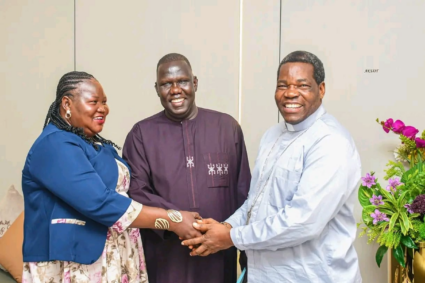
Fiscal devolution and revenue management forum kicks-off in Juba

South Sudan Vice President Dr. James Igga says the forum came at the right time when the country is moving towards the Federal system of government as per the constitution-making process
By Opio Jackson
The fourth high-level forum on fiscal devolution and revenue management kicked off in Juba yesterday.
The three-day forum is organized by the Council of States with support from the United Nations Mission in South Sudan and the United Nations Development Programme (UNDP), bringing together participants from government agencies, line ministries, and the state governors.
In his opening remarks to the participants, Dr. James Wani Igga the Vice President for the Economics Cluster said the forum came at the right time when the country is moving towards the Federal system of government as dictated by the constitution-making process.
He said the participants in their discussion to compare with other countries that have similar practices to come up with the best recommendation.
“Let us compare the situation with the practices that have been happening in other countries,” he said.
The constitution-making process is expected to produce a federal system of government and revenue sharing including the oil share to the producing community and the state is an integral part of the discussions.
Dr. Igga asked the participants about the general guidelines that should be considered when it comes to oil production.
He noted the continued violations of the rights of the oil-producing community who have not been benefiting from their share.
“The oil share does not reach the intended communities. It is from Juba to somewhere in the State, that the money does not reach the community.”
“We must propose some working mechanisms to ensure the oil share reaches the local communities in the state,” Igga stated.
Meanwhile, the First Deputy Speaker for the Council of the State, Mary Ayen Mijik hailed the UNDP for its continued support of the institution which said had enable them to review the previous meeting.
However, she noted birth defects in the oil-producing area, especially in the Ruweng Administrative Area, and casted doubt whether the companies were adhering to the environmental policy.
Ms. Ayen also noted the oil spill reported by the media, saying it is very dangerous to the environment due to the persisting floods in the area.
According to the previous forum, it was resolved that the Petroleum Revenue Management Act, 2023 should be amended to ensure that 2 per cent and 3 per cent be deducted from gross petroleum revenue as opposed to net petroleum revenue.
Ms. Ayen echoed the sentiment on the violation of the rights of the oil-producing communities, “The bank of South Sudan has not been supplying them with hard currency they promised to supply their projects.”
In this forum, the participants are expected to deliberate and validate the policy recommendations and resolutions from the previous High-level Conference and consult with stakeholders on fiscal federalism given conflict management between and among the oil revenue-generating states and communities and non-oil producing states in the would-be federal country.
RJMEC lauds progress, urges continued commitment
Representing Maj. Gen. (Rtd) Charles Tai Gituai, the Interim Chairperson of the Reconstituted Joint Monitoring and Evaluation Commission (RJMEC), a spokesperson delivered a compelling address emphasizing the long path South Sudan has traversed since 2016 in its journey toward federalism.
The spokesperson lauded the work of the Ministry of Federal Affairs, the Transitional National Legislature, and various partners including the United Nations Mission in South Sudan (UNMISS) and the UNDP for their steadfast support in shaping a robust policy framework for the federal transition.
“Today’s discussions on fiscal responsibility and wealth sharing are not only timely but critical,” the spokesperson affirmed, reflecting on the essence of the forum. “These are among the fundamental tenets of federalism and often represent the make-or-break elements in achieving a viable federal system.”
The RJMEC’s address highlighted Article 4.1.6 of the Revitalized Agreement on the Resolution of the Conflict in South Sudan (R-ARCSS), which stresses the commitment to revenue sharing as an integral part of devolution and governance.
Additionally, Article 4.1.5, which mandates equitable wealth distribution to empower all levels of government to fulfill their constitutional duties, was cited as a cornerstone for a cohesive national policy that supports reconstruction and development.