



He’s walking the talk, Cepo hails Chief Justice move on the judiciary

By Emmanuel Mandella
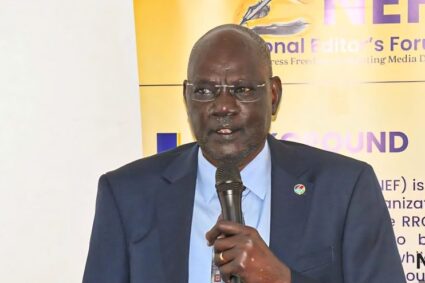
The Executive Director of the Community Empowerment for Progress Organization (CEPO), Edmund Yakani, has commended Chief Justice, Dr. Benjamin Baak Deng, for taking bold steps to revive the judiciary by promoting and deploying judges across the nation’s High Courts and Courts of Appeal.
Yakani described the appointments as a “clear demonstration of commitment” to the long-awaited judicial reforms, calling them foundational to the country’s political transition and lasting peace.
“The Chief Justice is walking the talk. These reforms are what we have been advocating for over the years,” Yakani stated in a press release issued on behalf of civil society. “We’re now seeing leadership and action. This is the kind of commitment South Sudan needs if we’re serious about peace and stability.”
On July 28, the Chief Justice promoted and deployed 18 High Court judges to serve in the Court of Appeal across the three major judicial circuits- Greater Equatoria, Greater Bahr el Ghazal, and Greater Upper Nile.
The move is part of a broader reform agenda to decongest the appellate courts and restore public trust in the justice system.
According to the deployment order seen by The City Review, seven justices were assigned to the Greater Equatoria Circuit, six to Greater Bahr el Ghazal, and five to Greater Upper Nile. Each circuit now has an appointed president to lead operations.
In Juba (Greater Equatoria Circuit), Malou Yel Akok will serve as President of the Court of Appeal, supported by justices Sumeya Saleh Abdalla, Noah Gabriel Kau, Acham Tong Onwar, Abraham Majur Lat, and Dr. Charles Oyo Nyawello.
In Wau (Greater Bahr el Ghazal Circuit), Andrew Joshua Lado was named President. Other appointees include Duoth Kulang Bichiok, Obac Denyong Anyong, Nicola Nyuol Makuac, Mathiang Kuac Mathiang, and Bol Ayuel Akuei.
For Malakal (Greater Upper Nile Circuit), Garang Ajak Deng was appointed President, with support from Kuol Monyioc Deng, Dr. Kimo Othwan Dak, Alexander Sabur Sobek, and Michael Atem Chol.
In addition, 16 County Court judges were promoted to serve in High Courts across the country five in Equatoria, six in Bahr el Ghazal, and five in Upper Nile.
“This is not just about numbers, it’s about accountability, impartiality, and access to justice. For too long, we have invested in war and violence. Now it’s time to invest in the rule of law and human rights,” Yakani stated.
The judicial overhaul follows repeated appeals from legal practitioners and civil society for urgent action to address the backlogs of cases and delayed justice, key issues that have undermined the effectiveness of the justice system.
All appointed justices were instructed to report to their respective stations within two weeks, by July 31. The order also stipulated that any grievances regarding the deployments will only be considered after six months.
Yakani concluded with a strong reminder that civil society will continue to monitor the reform process, urging the judiciary to stay on the course and uphold its constitutional role as a guardian of justice for all.
“The hope of a peaceful and just South Sudan depends on this reform. We are impressed. We urge the Chief Justice to keep the momentum high.”