



The Rajaf Training Centre has beautifully painted white-blue fence that hosts thousands of trainees expected to graduate and form part of the first batch of the South Sudan’s unified professional forces.
It sparkles from the outside and appeals to the admiration of the passers-by till one makes a trip into the camp only to encounter the worst it can offer.
At the entry gate is a littered path which ushers visitors to some grass-thatched structures and tents blown off by the recent storm. Here, trainees are loitering dressed in untidy clothes, some looking pale and sickly- a sign that they have to go an extra mile to get a decent meal, healthcare and clean water.
Some of the trainees who spoke to this reporter on the condition of anonymity lamented the negligence they have been subjected to since they arrived in the camp last year.
They arrived with smiles on their faces ready to graduate to serve their country in less than two months. But it changed into a circus as they overstayed with no information on the exit formula.
The place has grown into a jungle where the fittest survive. They depend on manual jobs to access food and medicine. And it is like a drop in the ocean for the luckiest who makes a penny due to the unprecedented inflation levels in the country.
No hopes
Susan Albert (not her real name), 23, settled down next to her partly blown off grass-thatched house to narrate to this reporter her tribulations at the camp. She represents thousands of trainees who had their hopes dashed by the unforeseen delay in graduation of the forces.
Albert had not eaten anything nor had she taken tea by the time this reporter arrived at the centre at 9:45am. She was so financially incapacitated that she could neither buy food nor airtime. She was even unable to charge her phone to communicate with her relatives back home in Western Equatoria State.
“I fetch grass and sell to get some money, which I use for buying food. And these days it is very risky to go to fetch grass because people are being attacked there,” Albert said.
“I now sometimes go to dig for people and use the money to buy food and today there’s no work, so I have nothing to eat.”
The centre was established in accordance with the provisions of chapter two of the revitalised peace agreement but some trainees spend days here without and only survive on untreated drinking water drawn directly from the River Nile, few meters away east of the training centre.
‘No funds’
The National Transitional Committee (NTC), a body tasked with responsibility of ensuring proper establishment of training centres, cantonment sites, and affairs of trainee forces across the country, has decried lack of funding.
“We have not been given food since last month. Nothing to eat here, we are just waiting for graduation so that we can be free,” she narrates as her voice breaks. “We were told that we will spend 45 days in the training when we arrived in January 2020, but it is now one year and three months without graduation,” she bemoaned.
In January, Gen. Tut Gatluak, Chairperson of NTC and Presidential Security Advisor, told media at his office that forces were going to be graduated early February. But it is almost April and there seems to be no plan to graduate the forces in the near future.
Recently, the Minister of Defense and Veteran Affairs, Angelina Teny, feigned ignorance about the date of graduation of the first batch of the unified forces. However, Anjelina said the graduation has been impeded by lack of finance and logistics.
She said approximately 48,000 young men and women were taken in for the program.
The security monitoring mechanism has, on several occasions reported on the dire situation at the training centers and cantonment sites in the country that has forced some of the trainees to desert the areas due to hardships.
“If they don’t graduate us this time soon, it will be better for us to go home rather than dying here for nothing,” another trainee called John Peter (not his real name).
The NTC has not issued any information about the graduation of the first batch of the unified forces since February this year.
However, according to Dr. Riek Machar, Chairperson of the SPLM-IO in December last year, the financial and logistical constraints were exacerbated by lack of joint army command yet to be formed by parties.
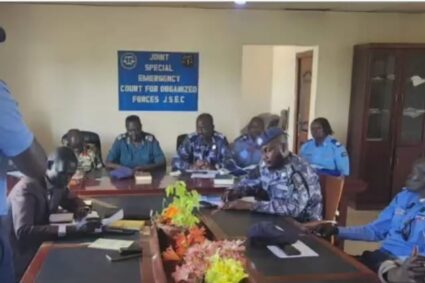
On Thursday, March 25, Teny led a delegation including Reconstituted Joint Monitoring & Evaluation Commission (RJMEC) and IGAD leaderships in assessing the Rajaf centre. The stakeholders of the 2018 peace deal have called on the authorities to address the squalid living conditions in the camp.