


The Commission has called on the national government to swing to action to address the pressing issues for effectiveness of the extended election period.
By Aguok Chok
On September 13, South Sudan Presidency announced the extension of the country’s transitional period by two years. The country’s top leadership also postponed the elections from the initial timeline, December 2024, to December 22.
Presidential Adviser on National Security, Tut Gatluak said the extension provides an opportunity to implement the critical remaining protocols in R-ARCSS, such as the permanent constitution process, census, and the registration of political parties.
Meanwhile, the Minister of Cabinet Affairs Dr. Martin Elia Lomuro said the extension is in response to the recommendations from both electoral institutions and the security sector. Citing pending critical tasks necessary for the successful conduct of elections, necessitating the delay, saying there is a need for additional time to complete essential tasks before the polls.
Call to action
However, the Reconstituted Joint Monitoring and Evaluation Commission (RJMEC) has raised concerns over the slow-paced implementation of the tasks. The Commission has called on the national government to swing to action to address the pressing issues for effectiveness of the extended election period.
Maj Gen. Charles Tai Gituai, the chairperson of RJMEC emphasized on the urgent need for effective planning. “This is a tight timeline that requires deliberate planning and a sense of urgency.”
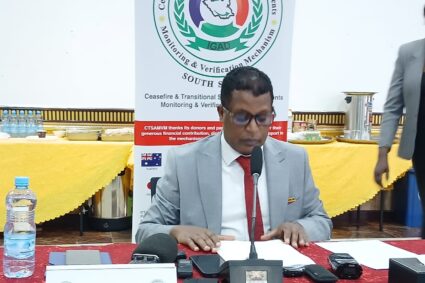
He was addressing the 38th Monthly RJMEC meeting in Juba yesterday.
The RJMEC interim chair acknowledged mixed reactions to the extension, particularly concerns about the slow pace of implementation and the need for stronger political commitment from the Transitional Government of National Unity (RTGoNU).
He highlighted critical challenges, notably rising insecurity and insufficient funding, especially the recent violent incidents in Nasir Upper Nile State and Jebel Iraqi in Central Equatoria State.
Gituai called for urgent investigations,” Those found responsible should be held accountable, a stable security environment is essential for progress.”
However, he also noted the importance of enhancing women’s representation in governance, advocating for a minimum of 35% of leadership roles to be filled by women. “Women’s leadership is central to achieving lasting peace and security in South Sudan,”
He emphasized the vital role of gender equality in addressing ongoing conflicts that disproportionately affect women and children.
The discussions revealed a consensus on the necessity for collaboration among various institutions to ensure alignment in work plans.
“A clear demonstration by the RTGoNU to mobilize sufficient resources will indicate their commitment,” Maj. Gen. Gituai noted, emphasizing the need for enhanced cooperation to tackle the country’s multifaceted challenges.
Nicholas Haysom, the Special Representative of the UN Secretary-General for South Sudan, echoed these sentiments, urging immediate action.
“The clock is ticking, and a realistic, harmonized timeline has not been forthcoming,” he said.
Haysom stressed the importance of a cohesive work plan to restore confidence among citizens and the international community.
He identified several achievable benchmarks, including the deployment of unified forces and a code of conduct for political parties. “Quick wins must be seized to demonstrate commitment to peace,” he emphasized.
Bouwe-Jan Smending, representing the IGAD Partners Forum, welcomed the extension of the transitional period and highlighted the necessity of adequate funding for relevant institutions. “The responsibility for implementing the peace agreement rests with the government of South Sudan,” he stated.
The discussions underscored a strong consensus on the need for a clear roadmap to guide the upcoming elections and peace processes. Gituai’s recommendations included mobilizing predictable funding and increasing women’s representation in political roles. He stressed that “urgency and collaboration are key to implementing critical tasks.”
“The slow pace of implementation and inability to adhere to timelines by the RTGoNU are major sources of concern,” said RJMEC in its report.
The Commission pointed to insufficient political will, trust deficit, lack of sufficient, dedicated and predictable funding, and capacity gaps as main reasons for the slow implementation of the peace agreement.
In an interview with a local media early October, the National Election Commission (NEC) chairperson, Prof. Abednego Akok highlighted that there is need for political will for the elections. He acknowledged the pending tasks the commission was yet to address, including opening offices in the states and counties, and training staff.
“The budget cannot be reduced because it is reasonable. We do not have offices in the states and counties and we do not have vehicles. We need those things to work properly. We also need to train all the staff and make available all the materials for the elections,” he said.
“A clear demonstration by the RTGoNU to mobilize sufficient resources will indicate their commitment,” Maj. Gen. Charles Gituai, RJEM interim chair.