


SSPDF to recruit 4,000 more soldiers in riverine, peace mission

Maj. Gen. Lul Ruai Koang, SSPDF spokesperson announced on Monday the new recruiting slots for riverine soldiers around the country
By William Madouk
South Sudan Peoples’ Defense Forces (SSPDF) is seeking to recruit at least 3,000 riverine forces and 1000 SSPDF peace keeping mission soldiers through an exercise set to kick-start from today.
Maj. Gen. Lul Ruai Koang, SSPDF spokesperson announced on Monday the new recruiting slots for riverine soldiers around the country. The program will run for a duration of six months.
“The office of SSPDF’s spokesperson is proud to announce to the members of public, open recruitment aimed at filling 3,000 vacancies in the national army,” he said.
Lul said willing, brave, dedicated, patriotic and nationalistic applicants are required to meet the position’s requirements.
“The applicant must be a South Sudanese citizen. He or she must be between the ages of 18 to 35. [They must] have secondary school certificate or equivalent. Must be physically fit. Must be mentally sound. Morally upright..,” he explained.
In general, the ambitious applicant must have no criminal record and be fluent in English and Arabic. The recruitment site is in Lelo, Malakal County, Upper Nile State, with each state providing 240, and three administrative areas 200 recruits.
Maj. Gen Lul also announced an open recruitment of 1,000 soldiers to join SSPDF peacekeeping force for a duration of six months.
“Serve your nation and be part of 120 countries contributing troops to United Nations peacekeeping missions,” he said.
“Once again, the office of the SSPDF spokesperson had the pleasure to announce to the public open recruitment of 1,000 vacancies in the National Army,”
The training will be conducted in Wuliat, West of Juba town, in Juba County of Central Equatorial State.
Recruits are asked to report to the ten states, particularly the headquarters of each division, as well as the SSPDF headquarters in the three administrative areas.
“Recruitment commences tomorrow [today] because we are making the announcement today [yesterday]. And the allocation of numbers per 10 states is as follows. 10 states, 80 each, making a total of 800.
“The three administrative areas, 50 each, making 150. And the reserve vacancies for 50 will be handled by JVMM headquarters here. So, the total is 1,000. So, we have made an announcement of recruitment of 4,000 in the respective units indicated,” Lul said.
The army spokesperson explained that the fresh recruitment is within the law and does not go against chapter two of the 2018 peace deal.
“We have some reports indicating we have a total of 86 (checkpoints). There is one source along riverine, another source says we have a total of 63 checkpoints along riverine, starting from here all the way up to Renk.”
Lul claimed that the Riverine forces will be tasked with removing illegal checkpoints along the river to ease water movement, facilitate delivery of humanitarian aid, among others.
“So, we are doing it (recruitment). We are not doing it for any bad purposes. We are doing it to clear off River Nile of illegal checkpoint. So, in my opinion, the two announcements I have made are not in conflict with Chapter 2,” he said.
Reactions
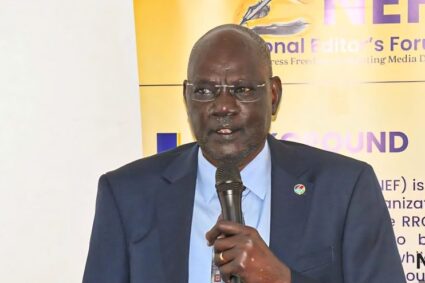
Reacting to the matter, Center for Peace and Advocacy (CPA)’s Executive Director, Ter Manyang Gatwech said forced disarmament is not a path to peace — it is fuel for further conflict.
“Disarmament, in itself, is not inherently harmful. In fact, when carried out by a legitimate, trusted government capable of ensuring the safety and dignity of all civilians, it can be a step toward stability,” Manyang said.
According to the activist, proliferation of arms happen when the state fails in its fundamental duty to protect its citizens. “In such a vacuum, communities often arm themselves out of necessity — not aggression. They do so because they cannot rely on state institutions to guarantee their survival.”
“To then forcibly disarm these civilians without addressing why they felt compelled to bear arms in the first place is not just unjust — it is dangerous. It ignores the root causes of the insecurity and strips vulnerable populations of the only means they believe can keep them safe,” he added.
Manyang stressed that if peace is truly the goal, the solution must begin with dialogue, trust-building, and the restoration of state legitimacy. The path forward must be peaceful, inclusive, and centered on justice. Otherwise, forced disarmament will not end the war — it will escalate it.