


WES govt. officials attend workshop on tax reforms, prudent financial management

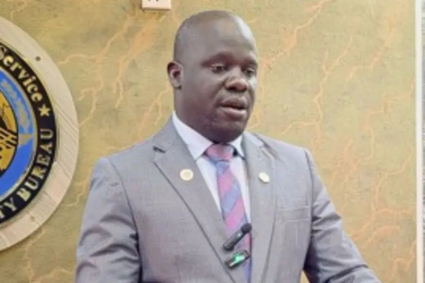
The meeting brought together various leaders from across the state to come up with a unified approach to tax collection and public service financing.
By Emmanuel Mandella
In a move aimed at boosting public financial management, Western Equatoria State government officials have are participating in a three-days capacity-building workshop on inclusive tax harmonization.
Held under the theme “Strengthening Effective Revenue Collection to Improve Service Delivery in the State,” the workshop has been organized by the State Ministry of Finance and Planning with technical support from the United Nations Development Programme (UNDP).
The meeting brought together county commissioners, state ministers, lawmakers, director generals, and executive directors from across the state to come up with a unified approach to tax collection and public service financing.
Speaking to the media at the event in Yambio on Monday, the State Minister of Finance and Planning, Hon. Bazia Tito Morris, emphasized on the critical need for coordinated tax efforts to meet growing service delivery demands to the vulnerable people in the state.
“It is important that we come together to understand the importance of tax collection not just to collect them, but to identify and broaden the tax base. A strong tax base allows us to develop a realistic budget, which is the backbone of service delivery,” said Hon. Morris. “Without adequate revenue, we simply cannot meet the needs of our citizens.”
He also stressed on the importance of legal awareness in taxation, stating that better knowledge of tax laws would enhance transparency and effective management of public resources.
For his part, the Commissioner General of the State Revenue Authority, Mr. James Richard Ramadan, welcomed the initiative and underscored the need for collective responsibility in revenue management.
“It is good for us to come together as stakeholders to learn and know our roles in managing revenue to improve service delivery to our people,” said Ramadan.
Meanwhile, Hon. Clement Gongi Liba, member and the Chairperson of the Specialized Committee on Economic, Finance, and Investment in the Transitional State Assembly, said the workshop is a timely intervention in harmonizing fragmented tax systems.
“We aim to eliminate duplication, promote accountability, and foster a more efficient fiscal framework that will ultimately benefit our citizens,” he stated.
A civil society leader, Odeta Miwai James said such a meeting was long overdue, as it will help address the many issues related to over-taxation and poor accountability.
“Many citizens, including civil servants, have been complaining about over-taxation. Yet, there is little impact. This workshop gives us a chance to confront these realities,” she noted.
Otto James Avelino, an Economic Governance Analyst at UNDP, reaffirmed the organization’s commitment to building institutional capacity in the state.
“We are particularly focused on improving accountability and promoting transparency in the way public funds are handled. Harmonizing the tax system will ease the burden on both citizens and businesses while improving service delivery,” said Avelino.
If implemented effectively, the harmonized tax strategy is expected to increase local revenue, enabling the government to invest more in health, education, water, and other basic services. A broader tax base will reduce the dependence on limited central government transfers and promote local development.
Revenue collection in South Sudan, including in states such as Western Equatoria, has faced various challenges. These include weak tax administration systems, overlapping mandates among institutions, corruption and lack of transparency, limited taxpayer awareness and trust, inadequate legal frameworks and enforcement and over-reliance on manual systems, which are prone to inefficiencies
As the workshop concludes, the focus now shifts to implementation—to translate these policies into action and ensure that every coin collected counts for the people.