

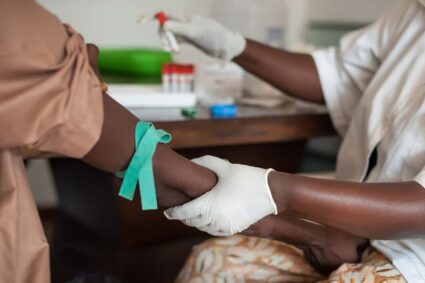


Picture this. You head to your nearby clinic feeling unwell and then the medic prescribes a pregnancy test for you. You would probably be perplexed and begin telling the doctor, ‘I am a man, and how do I start even thinking of such a test, leave alone doing it?’
ABC News ran a story on November 6, 2012; about a youthful American man who went to see a doctor only for his life to be rescued by a pregnancy test. Having displayed symptoms of testicular infection, the unnamed patient had human chorionic gonadotropin (hCG) blood test recommended —a diagnostic method primarily used to test pregnancy—which returned two red lines, implying a positive result.
‘‘…hCG test measures the exact amount of hCG in your blood. It can find even very low levels of hCG. These tests may help track problems during pregnancy. Your doctor may use them along with other tests to rule out an ectopic pregnancy, when the fertilized egg implants outside your uterus, or after a miscarriage, when hCG levels fall quickly,’’ Webmd notes on the description of the test.
Why the test?
According to Cancer.org, the test is meant to assess the level of concentration of the hCG, a cancer-causing protein especially in men.
‘‘Some blood tests can help diagnose testicular tumors. Many testicular cancers make high levels of certain proteins called tumor markers, such as alpha-fetoprotein (AFP) and human chorionic gonadotropin (HCG),’’ it states, and goes on to say ‘‘when these tumour markers are in the blood, it suggests that there’s a testicular tumour.’’
Upon returning a positive result for the pregnancy test, the patient will be advised to see an oncologist or medical specialist who may order for various tests depending on the patient’s condition.
Test options
Apart from the blood tests, which mostly involve the AFP and hCG tests, medics have the options of going for the ultrasound test for the scrotum.
‘‘During an ultrasound you lie on your back with your legs spread. Your doctor then applies a clear gel to your scrotum. A hand-held probe is moved over your scrotum to make the ultrasound image,’’ Mayoclinic.org notes on the diagnosis.
It adds that the importance of using an ultrasound is that it refines the examination by enabling the medic to ascertain whether the lumps are inside or outside the testicles, or whether they are solid or liquid in existence.
Also, the diagnosis may encompass a surgical procedure to examine the lump whether it is cancerous or not. The testicular cancer can then be categorised as either seminoma or nonseminoma. Mayoclinic states that seminoma is more common in the elderly but has lesser aggression as compared to the nonseminoma which spreads faster and is frequent in younger men.
The doctor may need to determine the stages of the cancer. This may involve using the Computerised Tomography (CT) to look at its spread and whether it may recur after the removal of the lump.
Apart from the CT scan, there are other imaging tests like the chest X-ray which can be used to find out whether the cancer had reached the lungs. A Magnetic Resonance Imaging (MRI) can also be significant in helping the medics to check the brain and the spinal cord.
The others are Positron Emission Tomography (PET) scan and bone scans.
Symptoms
Cancer.net details certain symptoms to watch out for to necessitate the testicular cancer test.
They include: Painless lump on both or either of the testicles, pain, discomfort or numbness on the scrotum, change in the feel of the testicles, ache in lower abdomen or groin, build-up of fluid in the scrotum, lower back pain and breast tenderness or growth.
These symptoms should not be misconstrued with other noncancerous health problems. For instance, change in testicular size or lump may mean a cyst in the epididymis, fluid buildup in membrane, hernia or enlargement of blood vessels. Pain may mean twisting, infection or injury.
The treatment options involve the regular cancer treatments such as surgical removal of the lump, radiation therapy and chemotherapy.
‘‘If cancer is diagnosed, relieving symptoms remains an important part of cancer care and treatment. This may be called palliative care or supportive care. It is often started soon after diagnosis and continued throughout treatment,’’ Cancer.net states on its website.