


Hundreds of women armed with sledgehammers and unwavering grit who wake up daily to toil under the rising sun in Rock City
By Binia Elizabeth
At the break of dawn in Juba’s Rock City, the rhythmic clang of iron on granite echoes across the hillside like a cry of resilience. It is the sound of survival—hundreds of women, armed with sledgehammers and unwavering grit, toiling under the rising sun to eke out a living by breaking stones.
Among them is 60-year-old Hellen Akujo, a widow and mother of seven, who has spent nearly two decades in this unforgiving trade.
“If it wasn’t because of extreme poverty and lack of employment in this country, I would not be doing this hard labour at my age,” she says, wiping red dust from her tired eyes.
For Akujo and many others, quarrying is not just work—it’s a lifeline. Yet, it is one that comes with devastating cost. Climbing Jebel Kujur to collect 50-kilogram loads of stone, these women haul them down to break into gravel, supplying construction projects across Juba. What fuels the city’s growth is also fueling a silent crisis: back-breaking labour, chronic illness, and shattered dreams.
“I spend most of what I earn on medicine—for my back pain, for my lungs, for my eyes,” says Akujo, her voice laced with fatigue. “We have no protective gear. No gloves. No masks. We just breathe in the dust and hope to make it to the next day.”
Their children, too, are drawn into this cycle of struggle. Schooling is often a luxury they cannot afford. Many sit beside their mothers, scavenging for stones, dodging sharp splinters, and risking injuries that could scar them for life.
Another woman, 40-year-old Jenifer Keji, has worked in the quarry for 12 years to support her seven children. “It takes me a whole month to gather enough gravel to fill one truck,” she explains. That truck fetches SSP 300,000—barely enough for rent, school fees, and medical bills. “We are the women behind the stones that build your homes. We don’t ask for pity—just opportunity. Give us safety. Give us support. Help us turn our struggle into strength.”
The dangers of this trade are well-known. Local health officer Dr. Kenyi warns of long-term damage: “Without masks or medical checkups, many of these women could lose their lungs before they reach old age.”
He called for urgent action—distribution of basic protective kits such as helmets, gloves, and dust masks, along with mobile clinics and subsidised health care. Beyond that, he advocated for vocational training and micro-credit programs to help women transition into safer livelihoods, like tailoring or small-scale vegetable vending.
For Angelina Pita, who has broken stones for 25 years, the lack of change is disheartening. “If there was a steady market, maybe this pain would be worth it,” she says. “Sometimes, when my stones don’t sell, I turn to collecting plastic bottles just to feed my family.”
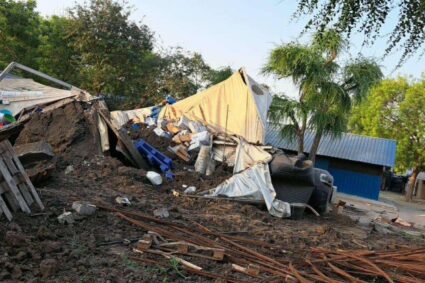
A survivor of conflict, orphaned and now widowed, Angelina lives in a tent with her children. “We have nothing—no house, no help. Just this mountain and our hammers.”
Her story mirrors that of countless women across South Sudan—worn by war, driven to extremes, and left to break stones in the hope of building a better tomorrow.