




Yakani: Merge R-ARCSS with Tumaini to ensure credible 2026 elections

The activist says the country stands at a critical crossroad between a painful past defined by violent conflict and a hopeful future anchored on democratic transition and political stability.
By Emmanuel Mandella
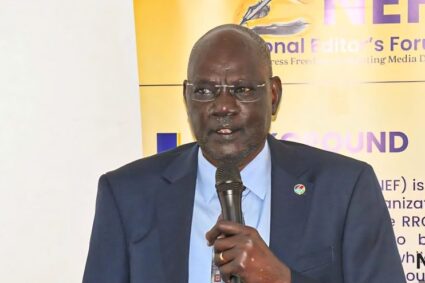
As South Sudan marked 14 years of independence, the Executive Director of the Community Empowerment for Progress Organization (CEPO), Mr. Edmund Yakani, has called on the country’s leaders to seize the moment for genuine political transition by merging the Revitalized Agreement on the Resolution of the Conflict in South Sudan (R-ARCSS) with the Tumaini Initiative, in order to lay the groundwork for credible and peaceful elections in December 2026.
Yakani said the country stands at a critical crossroad between a painful past defined by violent conflict and a hopeful future anchored on democratic transition and political stability.
“For our political path to be successful, we must move from violence to peace through a deliberate and inclusive process.
Merging R-ARCSS and the Tumaini Initiative offers a real opportunity to achieve a national political consensus necessary for peaceful elections,” Yakani told The City Review on Thursday.
He emphasized that the next steps after the Independence Day celebrations must focus on creating “good enough conditions” for conducting the proposed elections in December 2026.
These conditions, he noted, include the unification of forces, adequate and timely funding, unrestricted civic and political space, constitution-making and population census.
While acknowledging that not all elements must be fully achieved before elections, the activist stressed that the first three unified forces, funding, and civic space are essential.
“Some factors like census or constitution-making can be delinked from the elections timeline, but we cannot ignore the urgent need for a unified national army, open civic space, and timely financing of the electoral process,” he stated.
The Tumaini Initiative, spearheaded by regional partners, is seen as a fresh approach to political dialogue and consensus-building. Yakani believes it must not be treated as an alternative to R-ARCSS but rather as a complementary force that can bring all political and military stakeholders under one umbrella.
“Consolidating national political consensus for peace and credible elections is paramount, and the Tumaini initiative offers that opportunity. Investing in a merger between R-ARCSS and Tumaini can help us transition effectively from war to democracy,” Yakani said.
In a call for inclusive national dialogue, Mr. Yakani also welcomed the recent reconstitution of the High-Level Ad Hoc Committee for the implementation of R-ARCSS. He urged the committee to immediately organize an inclusive national dialogue on renewing the pledge for genuine implementation of the peace agreement.
“This committee must not be symbolic. It should engage all stakeholders including women, youth, traditional leaders, and opposition groups in renewing their commitment to peace,” he added.
“We’ve celebrated 14 years of independence, but true freedom lies in stability, credible elections, and a government chosen by the people. Let’s not miss this opportunity,” Yakani explained.
The R-ARCSS was signed in 2018 to end a five-year civil war that caused huge human casualties and displaced millions. Although it led to the formation of a revitalized unity government in 2020, key provisions including security arrangements, constitutional reforms, and justice mechanisms remain largely unimplemented.
In recent months, delays in the peace process has raised fears that the planned 2026 elections could be marred by violence or political exclusion. The Tumaini Initiative, launched in 2024, seeks to revive stalled peace efforts by engaging a wider range of actors, including non-signatories to R-ARCSS.