

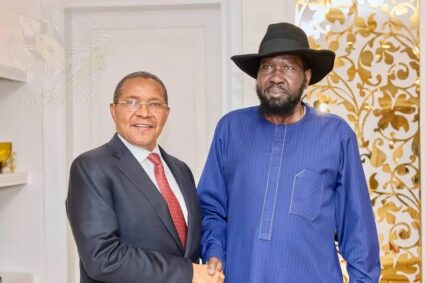


Kenya’s special envoy to South Sudan, Dr Stephen Kalonzo Musyoka, yesterday held discussions with President Salva Kiir Mayardit to address the dragging implementation of the peace agreement and strengthen ties between the two countries.
According to the information shared by the office of the president, the discussions focused on various areas of the implementation of the Revitalised Agreement on the Resolution of Conflict in South Sudan (R-ARCSS).
“President Salva Kiir Mayardit met in his office with the Kenyan Special Envoy to South Sudan, Dr Stephen Kalonzo Musyoka, and discussed a wide range of issues pertaining to the progress of the ongoing implementation of the (R-ARCSS) as well as issues of bilateral relations between South Sudan and Kenya,” read the statement.
However, the details of the meeting remain scanty as the press secretary in the office of President Ateny Wek Ateny and the Minister of Presidential Affairs, Barnaba Marial Benjamin, could not respond to the phone calls. The Kenyan Embassy either did not give details of the discussions.
In attendance was the Minister of Presidential Affairs, Dr Barnaba Marial Benjamin, and the Minister of Foreign Affairs and International Cooperation, Mayiik Ayii Deng.
Dr Musyoka played a pivotal role in the signing of the comprehensive peace agreement (CPA) in Naivasha between South Sudan and Sudan, which ended in the secession of South Sudan from Sudan. He was the tenth Vice President of Kenya and served in many government offices in Kenya.
Relations between Kenya and South Sudan have been strengthening in recent months, which resulted in the visa waiver between the two countries. However, there remains an outstanding border issue between Kenya and South Sudan that is yet to be ironed out.
Call for dialogue
Late last month, the Minister for Foreign Affairs and International Cooperation, Mayiik Ayii Deng, called for a dialogue between the nation and its neighbouring countries.
Mayiik said during the governors’ forum that handling the border issue should be left in the hands of the ministry to resolve through bilateral and multilateral relations engraved in their foreign policy agenda.
He said that a committee comprised of officials from the ministry of foreign affairs and the revitalised transitional national legislative assembly, among others, had already been formed to look into the matter.
“One of the challenges incorporated into the foreign policy is the importance of South Sudan entering into dialogue with its neighbours and agreeing on secure borders, fair trade, and economic cooperation both bilaterally and multi-literally,” he said.
“Border issues are the national government’s responsibility, and all state governors whose states border international borders should refer all border issues to the national government.”
Border disputes
For years, South Sudan and Kenya have been locked in a lasting row between Eastern Equatoria State’s Toposa and Kenya’s Turkana of Turkana District.
In August, a conflict between the two tribes led to the deaths of two people. The commissioner of Kapoeta East County, Abdalla Loken, earlier disclosed to The City Review that there had been persistent tensions despite the fact that fighting had stopped.
“There is a problem between the two communities because the Turkana came and entered the Toposa side, claiming that the area belongs to Kenya territory [and] that is how they started fighting near Jebel Mogila,” he said.
‘‘…as I talk [to you] there is no more fighting in the area. The youth of Toposa have gone to search for those who are still missing. “
In the aftermath of such an incident, the Toposa raised a concern with President Kiir, claiming that the Kenya government was encroaching, annexing and occupying the Losoloa and Kauto areas of Kapoeta East County.
The Toposa youth demanded a border post at Nadapal that was established by the Kenyan authorities, claiming that it was a violation of the meeting held in August 2009.
On a separate note, South Sudan and Uganda had a dispute in Lamwo district between the Acholi tribes of Uganda and the Acholi tribes of South Sudan. In 2018, a committee was formed by the two countries to resolve the existent border issues.
This dispute resulted when Lamwo district local leaders accused the Sudan People’s Liberation Army (SPLA) of blocking road engineers from constructing the road that connected Uganda with Magwi County in Eastern Equatoria State.
Another dispute was also in the Moyo district of northern Uganda between Uganda’s Madi tribe and South Sudan’s Kuku in Kajo Keji County in 2015. It, therefore, resulted in conflict between the two tribes.